Ingredients · Category-wide
Is carrageenan gluten-free?
Carrageenan is extracted from red seaweed. It contains no grain and no celiac organisation lists it as a gluten risk.
- Evidence
- CPublished label or regulation
- Last checked
- 2026-08-10
- Varies by country
- No
Source celiac.org+4 more
Why
Carrageenan is a polysaccharide harvested from marine algae, extracted with hot water or alkali, filtered and dried. Nothing in that supply chain touches a cereal grain. It appears on labels as carrageenan, carrageenan gum, Irish moss extract or E407 (and E407a for processed eucheuma seaweed).
The reason to trust this is what the additive is, not who says so. Gluten is a specific protein complex, the prolamins gliadin and hordein and secalin, found in the endosperm of wheat, barley and rye. Carrageenan is a sulfated polysaccharide from an organism in an entirely different kingdom. It is not derived from grain, is not processed with grain, and there is no economic reason anyone would put grain into it.
The celiac organisations' silence is informative here. The Celiac Disease Foundation publishes lists of gluten-containing and questionable ingredients: malt, malt flavour, malt extract, malt vinegar, brewer's yeast, and anything with "wheat," "barley" or "rye" in the name or in parentheses. Carrageenan does not appear on any of them. Additives that genuinely need scrutiny (malt derivatives above all, and to a lesser extent modified food starch and hydrolysed vegetable protein), are named. Carrageenan is not, because it is not one of them.
You will find it inside gluten-free products. Carrageenan is a workhorse in gluten-free formulation: it does some of the structural work that gluten does, holding water, stabilising emulsions and giving mouthfeel to dairy alternatives, ice cream, deli meats, jellies and dressings. It shows up in gluten-free foods precisely because gluten isn't there to do the job.
Why the name alarms people
This page exists because of how the word looks, not because of anything the molecule does.
It reads as synthetic. A long chemical-sounding name with an E-number attached triggers the same instinct as "maltodextrin" or "modified food starch", a suspicion that something has been hidden behind jargon. It is a fair instinct generally. It is misapplied here: the name comes from Carragheen, a place on the Irish coast where the seaweed was harvested.
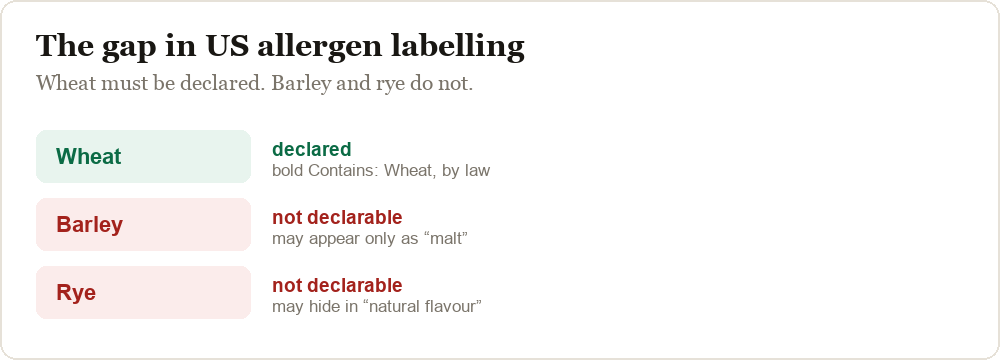
Additive lists have taught people to be suspicious. And correctly so, some additives really are gluten-derived or ambiguous. Malt extract is barley. "Natural flavours" can, rarely, be barley-derived. Modified food starch in Europe can be wheat-based, though EU rules require wheat to be declared. Carrageenan sits in a different bucket: a single-source additive with an unambiguous origin.
A separate controversy gets confused with the gluten one. Carrageenan has been argued about for years on digestive grounds, some research has raised questions about gastrointestinal inflammation, particularly with degraded carrageenan (poligeenan), which is not the food-grade form. The FDA classifies food-grade carrageenan as generally recognised as safe, and it is approved in the EU as E407. Some people in celiac communities report feeling unwell after carrageenan-heavy foods. That is worth taking seriously as a personal tolerance issue and it has nothing to do with gluten. If you react, you are reacting to carrageenan, not to a hidden gluten exposure, the distinction matters, because chasing it as a glutening will send you looking in the wrong place.
How much risk is this?
Celiac disease: carrageenan is not a gluten risk. The only thing worth checking is the rest of the product it is in, which is where the actual risk lives.
Non-celiac gluten sensitivity: no gluten issue. If you consistently feel worse after carrageenan-containing foods, that is a separate sensitivity, try switching to a carrageenan-free version of the same product and see whether it changes.
IBS or inflammatory bowel disease: this is the group with a genuine reason to experiment with avoiding it, on tolerability grounds rather than gluten grounds.
Cross-contact: effectively a non-issue. Carrageenan is produced in dedicated seaweed-processing plants, not bakeries.
What to have instead
You do not need to avoid carrageenan for gluten reasons. If you want to avoid it anyway, for digestive tolerance or preference, these are the gluten-free thickeners and stabilisers that do a similar job, and the products that already skip it.
- Gellan gumThe most common carrageenan replacement in plant milks; gluten-free and used at tiny inclusion rates.
- Guar gum and locust bean gumLegume- and seed-derived, gluten-free, standard in ice cream and dairy alternatives.
- Xanthan gumGluten-free (fermented from sugar, usually on a corn substrate) and already the backbone of most gluten-free baking.
- Agar-agarAlso seaweed-derived, also gluten-free, a direct swap for carrageenan's gelling function in desserts.
- Tapioca or arrowroot starchSimple gluten-free thickeners for home cooking.
- Carrageenan-free plant milksSeveral brands (including MALK, which publishes its cross-contamination position), build around short ingredient lists without gums at all.
The genuinely useful shopping rule: on a label, the words to stop at are malt, malt extract, malt syrup, malt flavour, brewer's yeast, wheat, barley, rye and oats without a gluten-free mark. Carrageenan is not one of them.
Related questions
Is E407 the same as carrageenan? Yes. E407 is the European additive number for carrageenan; E407a is processed eucheuma seaweed, a closely related and also gluten-free ingredient.
Is carrageenan vegan? Yes. It is a seaweed extract. It is often used as a vegan replacement for gelatin in desserts and as a stabiliser in plant milks.
Is agar-agar gluten-free? Yes, and for the same reason: it is extracted from red algae. It sets more firmly than carrageenan and is the usual choice for vegan jellies.
Is xanthan gum gluten-free? Yes. It is produced by bacterial fermentation, usually on a corn-derived sugar substrate. It is a standard ingredient in gluten-free baking rather than a risk to it.
Is carrageenan bad for you? That is a live and separate debate. Food-grade carrageenan is GRAS in the US and approved in the EU, but some studies have raised gut-inflammation questions and some people report poor tolerance. None of that is a gluten question.
Why do I feel glutened after eating something with carrageenan? Look elsewhere in the product first, a shared line, a malt-derived flavouring, oats without certification. If carrageenan is genuinely the trigger, it is an individual intolerance to the additive, not a gluten exposure, and the practical response is the same: avoid it.
How we checked
| Source | Tier |
|---|---|
| Celiac Disease Foundation, Sources of Gluten, carrageenan absent from gluten-containing and questionable-ingredient lists | B |
| Celiac Disease Foundation, 2024 Food Label Reading Guide | B |
| Botanical origin: red seaweed (Chondrus crispus, Eucheuma spp.); FDA GRAS status and EU approval as E407 | C |
| foodadditives.net, carrageenan overview | D |
| Gluten Free Society, argues against carrageenan on inflammation grounds, not gluten grounds | D |
| Celiac.com forum thread, community reports of individual intolerance | D |
Overall source tier: C. No national celiac organisation publishes a dedicated carrageenan page, so there is no tier-A or tier-B document to point at that says "carrageenan is gluten-free" in those words. The verdict rests on its botanical source and on its consistent absence from the ingredient-watchlists those organisations do publish. That is strong evidence of a different kind, and we would rather label it accurately than dress it up.
Last verified: 10 August 2026. Carrageenan's source cannot change, but the products containing it can be reformulated. The label in your hand outranks this page, and read the whole label, not just this line.