Sauces & condiments · Category-wide: House of Tsang (Hormel), Iron Kitchen, restaurant house-made
Is General Tso sauce gluten-free?
By default. Bottled versions are built on wheat-brewed soy sauce and declare wheat. Certified gluten-free versions exist and must be bought deliberately.
- Evidence
- CPublished label or regulation
- Last checked
- 2026-08-23
- Varies by country
- No
Source ironkitchenproducts.com+4 more
Why
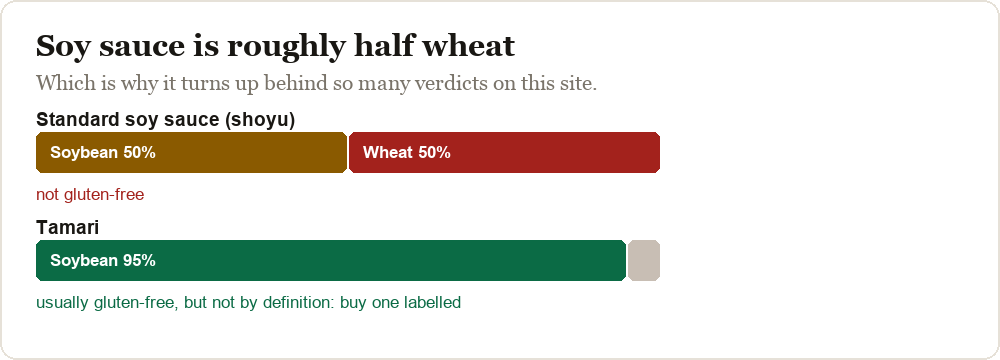
General Tso sauce is sugar, soy sauce, vinegar, a starch thickener, tomato paste or chilli, garlic and ginger. Take that list apart and only one line matters. Sugar, vinegar, tomato paste, garlic, ginger and corn starch are all gluten-free. Soy sauce is not, because standard Japanese and Chinese brewed soy sauce is made with wheat. Kikkoman's own panel is four words: water, soybeans, wheat, salt. San-J, which sells the wheat-free alternative, says plainly that "soy sauce is usually made with wheat, soybeans, salt and water, which means most soy sauces contain gluten."
The bottle confirms it. Hormel publishes the panel for House of Tsang General Tso Stir-Fry Sauce on its own site, and the third ingredient is soy sauce made with wheat: "Sugar, Water, Soy Sauce (Water, Soybeans, Wheat, Salt), Tomato Paste, White Vinegar." That is the General Tso sauce most likely to be in a US supermarket, published by its manufacturer, declaring wheat on the front half of the ingredient list.
Hoisin is the second wheat source, where it appears. Many General Tso recipes and some commercial sauces include hoisin, which is frequently thickened or flavoured with wheat. It is not on every panel, but where it is, it is a second independent reason for a no.
The thickener is not a problem. Corn starch and modified corn starch are what these sauces use, and on an FDA-regulated US label an unqualified "modified food starch" is not wheat, because wheat is a FALCPA major allergen and would have to be declared. That applies to ingredients, not to cross-contact.
The dish is a separate no
This is the part that catches people who solve the sauce and stop there. General Tso's chicken is battered. The standard restaurant method is chicken tossed in wheat flour or a flour-and-egg batter, deep fried, then coated in the sauce. A gluten-free sauce on wheat-battered chicken is still a wheat dish.
And it comes out of a shared fryer, alongside egg rolls, wontons and crab rangoon, all of which are wheat wrappers. Even a kitchen that swaps in tamari cannot undo the batter or the oil.
So there are three separate things to fix, and a restaurant almost never fixes all three:
- The soy sauce in the sauce (wheat, unless tamari).
- The coating on the chicken (wheat flour, unless corn starch).
- The fryer (shared with wheat-wrapped items).
How much risk is this?
Celiac disease: treat restaurant and takeaway General Tso's as unsafe, and treat any bottle without a gluten-free claim as unsafe. This is not a marginal call. The declared wheat in the mainstream bottles is an ingredient, not a trace, and the restaurant dish adds a batter and a shared fryer on top of it.
Non-celiac gluten sensitivity: brewed soy sauce is lower in residual gluten than its wheat content suggests, and some people tolerate it in dipping quantities. A sauce reduced onto fried chicken is not a dipping quantity, and the batter is straightforward wheat flour. This one is worth skipping regardless.
Wheat allergy: avoid outright. The wheat here is declared on the panel, which means it is present in a form that fermentation does not remove for allergy purposes.
Ordering out: a Chinese kitchen that keeps tamari and a dedicated fryer exists but is rare. The more reliable ask is for a steamed dish with a sauce you have seen the bottle for, or to make this at home, where all three problems disappear at once.
What to have instead
A bottle you can trust:
- Iron Kitchen Gluten Free General Tso's SauceYesCertified gluten free, and the panel shows why: it is the standard recipe with "naturally brewed gluten free tamari soy sauce (water, soybeans, salt)" in place of the wheat-brewed version, thickened with modified corn starch. This is the direct swap.
- Be careful with the rest of the shelfSeveral General Tso sauces are marketed as gluten-free on retailer listings without the claim appearing in the manufacturer's own gluten-free product listing. A retailer tag is not the maker speaking. Look for the claim on the bottle itself, ideally with a certification mark.
- San-J Tamari100% soybeans, no wheat, GFCO certified.
- Kikkoman Gluten-Free Tamari Soy SauceYesFour ingredients and certified by the Gluten Intolerance Group. Note this is a different bottle from Kikkoman Tamari Soy Sauce, which lists wheat.
- Corn starch, not flourFor the chicken. Corn starch gives a crisper, lighter coating than flour anyway, which is why plenty of non-gluten-free recipes use it.
Or make it, which takes about five minutes: Whisk 60 ml gluten-free tamari, 60 ml water or gluten-free stock, 3 tablespoons sugar or honey, 2 tablespoons rice vinegar, a grated garlic clove and a teaspoon of grated ginger. Simmer, then thicken with a teaspoon of corn starch slaked in cold water. Add dried chillies to taste. It costs less than the jar and you know every ingredient. The base ingredients to build it on: Avoid as substitutes: regular soy sauce, "lite" soy sauce, hoisin sauce and oyster sauce unless each one is separately labelled gluten-free, and any restaurant's house General Tso sauce.
Related questions
Is General Tso's chicken gluten-free? No, on two counts. The sauce is built on wheat-brewed soy sauce, and the chicken is coated in wheat flour or batter before frying. Fixing one does not fix the other.
Is the sauce at a Chinese restaurant gluten-free? Assume not. House bottles of soy sauce are wheat-brewed, and the sauce is usually made in bulk from them. Unless the kitchen can show you a gluten-free tamari bottle, treat every brown sauce on the menu the same way: sweet and sour, teriyaki, hoisin, oyster and General Tso all start in the same place.
Which General Tso sauces are gluten-free? Ones that name a gluten-free tamari on the panel and carry a gluten-free claim. Iron Kitchen's is certified. Others carry the claim on retail listings only, which is worth verifying on the bottle before you rely on it.
Is a chain restaurant's version safer than an independent's? No, and often the opposite instinct is what gets people. A chain publishes an allergen menu, which is useful, but a battered fried item out of a shared fryer is the hardest thing on any Chinese-American menu to make safe. Check whether the chain claims gluten-free status for that specific dish rather than assuming scale means safety.
Is corn starch gluten-free? Yes. It is one of the naturally gluten-free starches, and it is the standard thickener for this sauce. On a US label, "modified food starch" without a wheat declaration is also not wheat.
What about hoisin sauce? Frequently made with wheat, either in the soy sauce base or as a thickener. If a General Tso recipe calls for hoisin, that is a second ingredient to replace, not just the soy sauce. Gluten-free hoisin exists and has to be bought deliberately.
How we checked
| Source | Tier |
|---|---|
| Iron Kitchen Gluten Free General Tso's Sauce, certified gluten free, built on "naturally brewed gluten free tamari soy sauce (water, soybeans, salt)" | A |
| San-J, Is Soy Sauce Gluten Free?, "soy sauce is usually made with wheat, soybeans, salt and water, which means most soy sauces contain gluten" | A |
| Kikkoman Gluten-Free Tamari Soy Sauce, certified by the Gluten Intolerance Group | A |
| House of Tsang General Tso Stir-Fry Sauce, Hormel's own panel, "Soy Sauce (Water, Soybeans, Wheat, Salt)" | C |
| Kikkoman Soy Sauce, published panel "Water, Soybeans, Wheat, Salt." | C |
| FALCPA, wheat is a declarable major allergen; barley and rye are not | C |
Overall source tier: C. No celiac organisation has ruled on General Tso sauce, because it is a preparation rather than a single branded product. The verdict is built from the published panels of the two mainstream bottles, both of which declare wheat inside their soy sauce, and from the manufacturers of soy sauce confirming that the standard product is brewed with wheat. That is a short, strong chain, and it is still an ingredient-level argument rather than a test result.
Last verified: 23 August 2026. Bottled formulations change, House of Tsang's panel has already changed once in recent years, and restaurant sauces are outside anyone's labelling. The bottle in your hand outranks this page.