Dairy · Category-wide: Land O'Lakes, Organic Valley, Horizon, store brands
Is half & half gluten-free?
Half & half is milk and cream, no gluten. Only the fat-free and flavoured versions add ingredients worth reading.
- Evidence
- BNational celiac organisation
- Last checked
- 2026-08-13
- Varies by country
- No
Source landolakes.com+6 more
Why
This is the easiest verdict in the dairy aisle, and it stays easy right up until someone adds something.
Plain half & half has a two-ingredient panel. Milk and cream. That is the whole product. Organic Valley's and Horizon's organic half & halfs list exactly that; the lactose-free versions add one thing, lactase enzyme, which is an enzyme and not a grain derivative. Land O'Lakes' traditional half & half is likewise milk and cream. There is nowhere for gluten to hide in a two-line panel.
Gluten is a grain protein. Dairy is not a grain. Gluten comes from wheat, barley and rye. The proteins in milk are casein and whey. There is no biological route by which a cow produces gluten, and no processing step in pasteurising and blending milk with cream that introduces one.
So the entire risk in this category is additives, which is why the fat-free version is the one that gets asked about. Take fat out of a dairy product and it goes thin and watery, so manufacturers rebuild the body with sugars and thickeners. Land O'Lakes Fat Free Half & Half runs: skim milk, corn syrup, cream, then under 0.5% of carrageenan, sodium citrate, dipotassium phosphate, mono and diglycerides, vitamin A palmitate and added colour. Longer list, still no gluten. Carrageenan is extracted from red seaweed; sodium citrate and dipotassium phosphate are mineral salts; mono and diglycerides are fats. None of them are grain proteins.
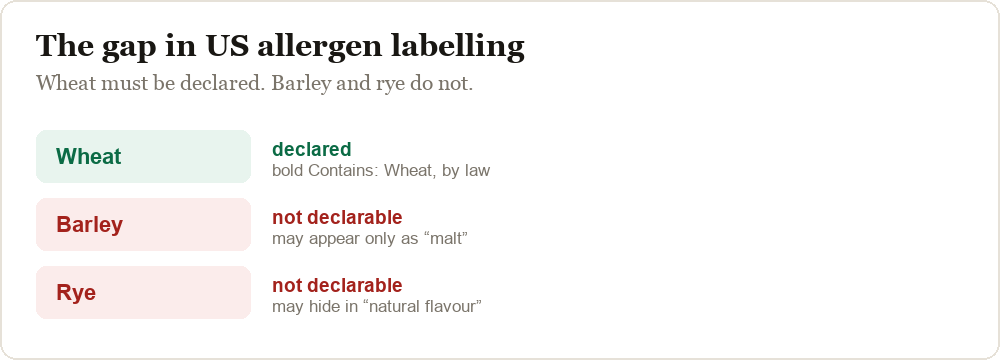
The one ingredient that genuinely trips people up is "modified food starch," and the rule that resolves it is simple. In the United States, wheat is a major allergen under FALCPA, so a wheat-derived ingredient must say so, either in the list itself ("modified food starch (wheat)") or in a Contains: Wheat statement below it. That means an unqualified "modified food starch" on a US label is not wheat. It is corn, potato, tapioca or rice. The National Celiac Association puts it as modified food starch being "most of the time… made from corn in the United States, but not always", with wheat as the alternative that must be declared. Most pages ranking for this query hedge on modified food starch because they don't know the labelling rule. It is the single most useful thing to learn about reading a US dairy label.
One qualifier worth stating precisely, because it is where the rule stops working: FALCPA covers wheat, not barley or rye. Those are not conventional food-starch sources, so the starch itself is rarely the route: but barley malt can sit undeclared inside "natural flavour", which is a different ingredient and a genuinely open risk.
Two honest limits on that rule. It is FDA jurisdiction, USDA-regulated foods (meat, poultry, egg products) aren't bound by FALCPA. Half & half is FDA-regulated, so the rule applies. And it covers ingredients, not cross-contact; shared-facility advisories are voluntary and separate.
Almost no half & half carries a gluten-free certification, and that isn't a red flag. Land O'Lakes publishes product FAQs but no gluten statement specific to half & half. Dairies rarely certify products that never had a plausible gluten route, certification costs money and plain cream doesn't need it. Absence of a seal on a two-ingredient dairy product means nothing.
How much risk is this?
Celiac disease: plain half & half is safe. Buy the version with the shortest panel and you have removed the question entirely. If you want a rule for the coffee station: plain > lactose-free > fat-free > flavoured.
Non-celiac gluten sensitivity: no gluten issue. If you feel bad after half & half, the likely culprits are lactose or, for some people, carrageenan, neither of which is a gluten reaction. Worth separating, because newly diagnosed celiacs very often have temporary secondary lactose intolerance while the gut heals, and mistake it for a glutening.
Wheat allergy: same answer. No wheat, and any wheat derivative would have to be declared.
Where you should actually be careful: the coffee shop, not the carton. Fluid dairy lines run dairy, so cross-contact at the plant is minimal. In a café, the shared frothing pitcher that also handled a cookie-crumb drink, the flavour syrups and the counter beside the pastry case are the real exposure.
What to have instead
You don't need a substitute for half & half. These are the safe neighbours if you're building out a gluten-free coffee routine, or if you also need dairy-free:
- Plain half & half from any major brandLand O'Lakes, Organic Valley, Horizon, or the store brand. Look for a two-ingredient panel and stop worrying.
- Heavy cream or whipping creamCream plus a stabiliser at most, and richer in coffee with less volume.
- Lactose-free half & half(Organic Valley, Land O'Lakes). Same product with lactase enzyme added, the fix if lactose is your actual problem.
- Whole milkOne ingredient. Nothing to read.
- Canned coconut milk or a barista-style oat drinkIf you need dairy-free, but buy certified gluten-free oat drinks specifically, because oats are the one plant milk with a real cross-contact problem.
- Almond, cashew or soy creamersGenerally fine; check flavoured versions.
Genuinely read the label on: flavoured coffee creamers (the highest-additive product in this aisle), anything with "malt" or "malted milk" on the panel, malt means barley and it is the one word that turns a dairy product into a hard no, cookie-, cake- or cereal-flavoured creamers, and powdered creamers, which are a different formulation altogether.
Related questions
Is fat-free half & half gluten-free? Yes, though the panel is longer. Land O'Lakes' version adds corn syrup, carrageenan and mineral salts to replace the fat, none are gluten sources. Read it once and you're done.
Is carrageenan gluten-free? Yes. It is extracted from red seaweed and contains no grain protein. Some people with sensitive guts, IBD or IBS report reacting to it, but that is a separate issue from a celiac immune response, don't file it as a glutening.
Is "modified food starch" in dairy safe? On a US label with no wheat declaration, yes. FALCPA requires wheat-derived ingredients to name wheat, so unqualified "modified food starch" means corn, potato, tapioca or rice. Barley and rye aren't used as food starches.
Is Land O'Lakes half & half gluten-free? The traditional version is milk and cream, so yes on ingredients. Land O'Lakes does not publish a gluten-free claim for it, which is normal for plain dairy and not a warning sign.
Is coffee creamer gluten-free? Usually, but this is where the category earns its caution. Flavoured creamers carry sugars, starches, stabilisers and "natural flavours." Under US rules any wheat would be declared, so the practical risk stays low, but this is the one product in the aisle where reading the panel is worth the five seconds.
Can half & half make me feel like I've been glutened? It can, and it usually isn't gluten. Lactose intolerance is very common right after a celiac diagnosis, because the damaged intestinal lining stops producing lactase. It typically resolves as the gut heals on a gluten-free diet.
How we checked
| Source | Tier |
|---|---|
| Beyond Celiac, Is Milk Gluten-Free?, plain cow's milk and cream are gluten-free; added flavourings and malt are the exceptions | B |
| Beyond Celiac, Is Modified Corn Starch Gluten-Free? | B |
| National Celiac Association, modified food starch | B |
| Gluten Intolerance Group, label reading | B |
| Organic Valley lactose-free half & half, published ingredient panel | C |
| FDA/FALCPA rule: wheat-derived ingredients must declare wheat | C |
Land O'Lakes product FAQs, no gluten-free statement published for Half & Half, tier n/a: an absence of a manufacturer claim is not manufacturer evidence | n/a |
| Glutenfreeda, corroborating secondary coverage | D |
Overall source tier: B. This is a category verdict resting on national celiac organisation guidance plus published ingredient panels, not on a manufacturer gluten-free claim, most half & half brands don't make one, because plain dairy has never needed one. Where a specific carton adds starches or flavourings, the FALCPA declaration rule does the work.
Last verified: 10 August 2026. Manufacturers reformulate without notice, and fat-free and flavoured variants change more often than plain ones. The carton in your hand outranks this page.