Alcohol · Category-wide
Are ciders gluten-free?
Cider is fermented apple juice, no barley, no wheat. Coeliac UK and Beyond Celiac both class it as gluten-free.
- Evidence
- BNational celiac organisation
- Last checked
- 2026-08-10
- Varies by country
- No
Source coeliac.org.uk+3 more
Why
Cider is the drink most coeliacs are pointed at the day they are diagnosed, and the reasoning holds up.
The base is fruit, not grain. Beer gets its fermentable sugar by malting barley, germinating the grain to convert its starch into sugar. Cider skips that entire step, because apples already contain sugar. The ingredient list of a traditional cider is apple juice, yeast, and sometimes water and sugar. There is no mash, no malt and no grain.
Coeliac UK's position is unambiguous. Its alcohol guidance lists cider, wine, sherry, spirits, port and liqueurs as gluten-free, and separately lists beer, lagers, stouts and ales as not suitable. Beyond Celiac describes hard cider as "almost always naturally gluten-free" and a good alternative to gluten-containing beers. Two national coeliac organisations agreeing on a category verdict is about as strong as a category answer gets.
The yeast question, briefly. Yeast is sometimes flagged as a gluten risk because brewer's yeast is a by-product of beer brewing and carries barley residue. Beyond Celiac notes that cider fermentation uses yeast that is typically naturally gluten-free, and that this is not the same product as spent brewer's yeast sold as a supplement. It is not a live concern for cider.
Where cider actually goes wrong. Four places, in rough order of how often you will meet them:
- Flavourings and additions. Both Coeliac UK and Beyond Celiac name added flavourings as the thing to check. A ginger, spiced, dessert or confectionery-flavoured cider is a blended product, and the blend has its own label.
- Malt in the can. Beer–cider hybrids exist, and in the US some sweet, "cider-flavoured" products are built on a malt base for licensing and tax reasons rather than being cider at all. If a can says malt beverage anywhere on it, it is not cider in the sense this page means, and it is not gluten-free. This is the same trap that catches people with flavoured malt beverages generally.
- Shared plant. Beyond Celiac explicitly flags that cider may be processed in a facility, or on equipment, also used to brew or bottle beer. Plenty of craft cider is made inside a brewery. This is a cross-contact question, not an ingredient one, and for most people it is a low-order risk, but it is the reason certified brands exist.
- Barrel ageing. Specialty ciders aged in used whiskey or beer barrels are worth asking about. Whiskey barrels are a non-issue on the celiac organisations' own logic, since distillation removes gluten. Used beer barrels are the ones strict drinkers tend to skip.
A note on how UK labelling works, because it changes what silence means. Drinks above 1.2% ABV are not required to carry a full ingredient list. But if a gluten-containing cereal is present, it must be declared, "contains barley," "contains wheat." So on a UK cider, no allergen declaration is meaningful information rather than an absence of information. Processing aids that are filtered out before bottling are not declarable, which is why finings are a recurring worry in cider forums; we found no documented case of a barley-derived fining in a named cider, and if a gluten cereal were present in the finished drink the label would have to say so.
How much risk is this?
Celiac disease: cider is one of the genuinely easy drinks. Order it in a pub without a conversation. Reserve your questions for flavoured ciders, barrel-aged specials, and anything from a producer that is primarily a brewery.
Non-celiac gluten sensitivity: no issue. If a cider makes you feel unwell, sulphites, sugar or the volume are far likelier culprits than gluten.
Wheat allergy: no wheat is used in cider production.
Cross-contamination: the realistic scenarios are a brewery-cidery shared bottling line and a pub's dirty draught line. Bottles and cans sidestep both; if you are highly sensitive and drinking in a beer-forward pub, ask for a bottle rather than the tap.
What to have instead
You do not need an alternative to cider, but if you want more of the same, or a cider with an explicit safety statement behind it:
- Any straight, unflavoured apple cider or perryCoeliac UK's guidance covers both, including fruit-flavoured versions.
- Producers who make a written statementWoodchuck states its cider has always been made only from apples and never from wheat, barley or rye, and ACE Cider makes a similar celiac-facing statement. If you want a name to reach for without reading a label, reach for one of those.
- Cideries that make only ciderA dedicated cidery has no beer on site to cross-contaminate with, Portland Cider Company is one that discusses the issue publicly.
- Wine, prosecco and champagneGrapes and yeast; nothing else to check.
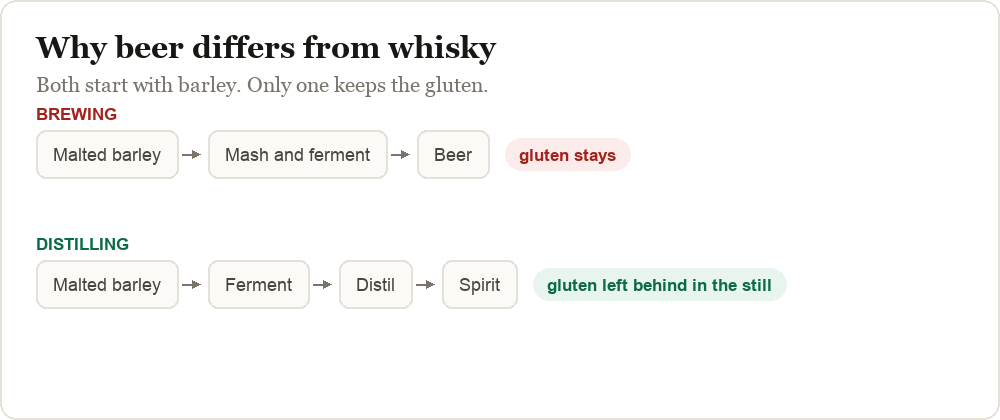
- Spirits, including whiskyCoeliac UK is explicit that distillation removes gluten, so even malt whisky made from barley is safe for coeliacs.
- Dedicated gluten-free beersYesIf it is really beer you miss: Green's, Redbridge, Ghostfish and Holidaily. These are brewed from sorghum, millet, rice or certified gluten-free grain, barley never enters them.
"gluten-removed" beers, including Omission and Estrella Damm Daura. These start as barley beer and are treated with an enzyme to break the gluten down. Beyond Celiac's position is that the test method used on them has not been validated, GFCO declines to certify them, and Daura cannot legally be labelled gluten-free in the US. They are easy to mistake for the category above because they are shelved alongside it. Also avoid any canned "-rita", "hard" lemonade or malt seltzer, which are usually malt-based in the US.
Related questions
Is Strongbow / Thatchers / Magners / Angry Orchard gluten-free? All are straight apple ciders and fall under Coeliac UK's category verdict. None of them declares a gluten cereal, and under UK and EU rules they would have to if one were present. Flavoured line extensions are the ones to check individually.
Is perry gluten-free? Yes. Coeliac UK covers perry alongside cider. It is the pear equivalent, made the same way.
Is non-alcoholic apple cider gluten-free? Fresh pressed apple cider and apple juice are just fruit. The gluten risk in the American autumn version is not the drink, it is the cider doughnut sitting next to it.
Is scrumpy or farmhouse cider gluten-free? By ingredients, yes, traditional scrumpy is about as short an ingredient list as cider gets. Small producers rarely carry certification, but they also rarely have a beer line in the shed.
Is a snakebite gluten-free? No. Half of it is lager. The cider was never the problem.
Does cider ever contain barley? Not in the traditional product. Where a gluten cereal has been added (in a malt-based "cider-style" drink, or a hybrid), labelling law requires it to be declared, so the pack will tell you. The word to look for on a US can is malt.
How we checked
| Source | Tier |
|---|---|
| Coeliac UK, alcohol guidance: cider and perry listed as gluten free and suitable for coeliacs; beers, lagers, stouts and ales listed as not suitable | B |
| Beyond Celiac, Is Cider Gluten-Free?: "almost always naturally gluten-free"; flags additives, flavourings and shared beer-brewing facilities | B |
| UK/EU labelling rule: drinks above 1.2% ABV need not list ingredients, but must declare gluten-containing cereals | C |
| Brothers Cider and Portland Cider Co., producer corroboration on ingredients and barrel-ageing risk | D |
Overall source tier: B. This is a category verdict backed by two national coeliac organisations, which is the strongest evidence a whole drinks category can carry. There is no single manufacturer to issue a tier-A statement for "cider." Individual flavoured, barrel-aged and malt-based products remain the drinker's own check.
Last verified: 10 August 2026. Producers add flavoured line extensions constantly and they are not covered by the category verdict. The label in your hand outranks this page.