Why it contains gluten
Why distilled spirits are gluten-free even when made from grain
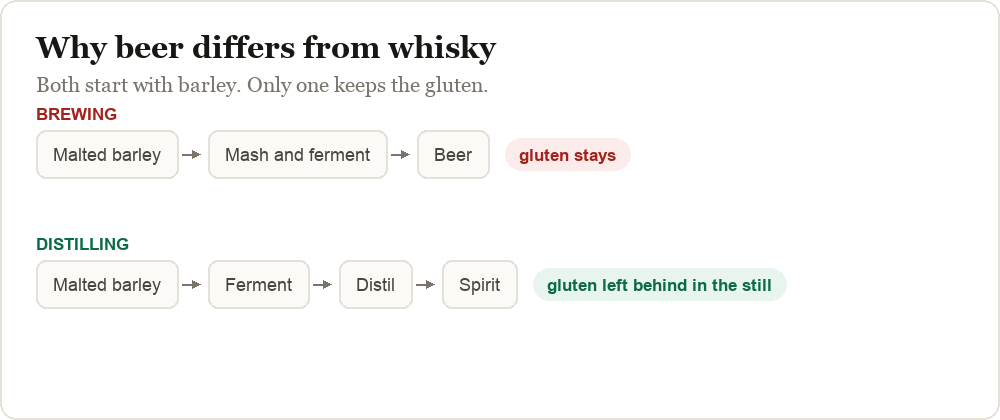
Gluten proteins are too large to evaporate, so they stay in the still, which is why grain whisky is gluten-free and grain beer is not.
The short answer
Gluten proteins are large and non-volatile, so they do not evaporate. In a still, ethanol and water vapour rise and the proteins stay behind in the spent mash. Coeliac UK's position is flat: "All spirits are distilled during the manufacturing process and this process removes any trace of gluten. Therefore, all spirit drinks (including malt whisky which is made from barley) are safe for people with coeliac disease." The risk lives after the still, not before it.
How it works
Distillation is a separation by boiling point, not a dilution or a filtration. Heat the fermented wash and ethanol (boiling point 78 °C) and water leave as vapour; gluten proteins (hordein from barley, gliadin from wheat, secalin from rye), are enormous molecules that do not vaporise at those temperatures. They remain in the pot with the spent grain. So the answer does not depend on how much gluten went in. It is not a "below the threshold" argument: the protein does not make the journey.
The three national celiac organisations agree, and two of them say why. The Celiac Disease Foundation's food label guide states: "Most distilled alcoholic beverages and vinegars are gluten-free. These distilled products do not contain any harmful gluten peptides even if they are made from gluten-containing grains, because the gluten peptide is too large to carry over in the distillation process." Coeliac UK covers spirits including barley malt whisky, as quoted above. Beyond Celiac treats distilled spirits as gluten-free including wheat-based vodka.
Brewing does not do this, and that is the whole contrast. Beer never goes through a still. The wort is made from malted barley, yeast eats the sugar, and the hordein is still there at the end. Coeliac UK: "Beer, lagers, stouts and ales contain varying amounts of gluten and are not suitable for a gluten free diet." The Celiac Disease Foundation says the same and extends it: "Beers, ales, lagers, malt beverages, and malt vinegars that are made from gluten-containing grains are not distilled and therefore are not gluten-free."
That single distinction, distilled versus merely fermented, decides almost every alcohol question on this site. Barley whisky: yes. Barley beer: no. Same grain, different equipment.
It also settles the vinegar aisle. Distilled (white) vinegar is gluten-free even when the feedstock was grain; malt vinegar is not, because it is fermented and never distilled.
The regulations encode the same physics. EU and UK allergen law makes "cereals containing gluten" a declarable allergen, and then explicitly exempts "cereals used for making alcoholic distillates including ethyl alcohol of agricultural origin." A wheat vodka sold in the UK need not declare wheat, because the law accepts that the wheat protein is not in the bottle.
Where this catches people
The US labelling history is the biggest source of confusion, and it has changed. Under TTB Ruling 2014-2, a spirit distilled from wheat, barley or rye was disqualified from a plain "gluten-free" claim regardless of what was in the finished product; such labels could only say "[Processed or Treated or Crafted] to remove gluten" with a qualifying statement. That rule was superseded on 13 October 2020. TTB Ruling 2020-2 revised the policy "to allow the term 'gluten-free' on labels and in advertisements for distilled spirits distilled from gluten-containing grains as long as good manufacturing practices are followed that prevent the introduction of any gluten-containing material into the final product."
It followed an FDA final rule which found that "distillation removes all protein (including gluten) if good manufacturing practices are followed," and that protein testing can confirm the absence of gluten in a distillate "regardless of whether it was distilled from fermented or hydrolyzed gluten-containing ingredients."
Crucially, the ruling did not change the position for beer. TTB states plainly: "The ruling does not change TTB's policy with regard to malt beverages fermented from gluten-containing grains." Those may still only say "[Processed or Treated or Crafted] to remove gluten," with a qualifier stating that the gluten content cannot be verified and that the product may contain gluten. This is exactly why gluten-removed beers are treated differently from grain spirits.
So why do so few bottles say "gluten-free"? The claim is voluntary, it requires the producer to substantiate good manufacturing practice on request, and most distillers have no commercial reason to bother. The absence of a gluten-free claim on a spirits bottle is not evidence of gluten. It is the default state of a category that mostly does not print ingredient lists at all. For the same reason, "no gluten ingredients are listed" tells you very little about a spirit: distilled spirits need not declare ingredients.
The real risk is everything added after distillation. This is where the corpus consistently lands:
- Flavoured spirits and liqueurs. Citrus, botanical and cream expressions are infused or blended post-distillation. The base is not the question; the addition is. Cream and biscuit liqueurs are the clearest case, where a cookie or barley-malt flavour component is a genuine gluten route, as are barley malt caramel colouring and malt extract in heavily formulated bottles.
- Flavoured malt beverages masquerading as spirit drinks. Canned "-ritas," most hard lemonades, hard teas and many hard seltzers are brewed from malted barley and then stripped of flavour, beer in a different costume. The ones built on a distilled vodka base are a different product with a different answer, and the can is the only way to tell.
- Mixers, sour mix and garnishes, which have their own labels and answers.
- The bar itself. A shared shaker, a jigger that just measured a beer cocktail, a soda gun line, a garnish tray next to the bar snacks. Ordering a vodka soda in a busy pub carries more gluten risk from the bar than from the vodka.
How to tell
Ask one question: was this distilled, or only fermented?
| Drink | Distilled? | Verdict |
|---|---|---|
| Whisky, whiskey, bourbon, Scotch, rye | Yes | Gluten-free, including single malt |
| Vodka, gin, grain neutral spirit | Yes | Gluten-free, including wheat- and rye-based |
| Rum, tequila, mezcal, brandy, cognac | Yes, and not from grain anyway | Gluten-free |
| Liqueurs on a distilled base | Yes, then flavoured | Check the additions, not the base |
| Beer, ale, lager, stout | No | Not gluten-free |
| Flavoured malt beverages, most hard seltzers and "-ritas" | No, brewed | Not gluten-free unless built on a distilled base |
| Malt vinegar | No | Not gluten-free |
| Distilled white vinegar | Yes | Gluten-free |
| Wine, cider, perry, sake | No, but no gluten grain either | Gluten-free |
For an unflavoured spirit, stop there. You do not need a certificate for a plain vodka, gin or whisky. Looking for one and failing to find it is the commonest way people talk themselves out of a drink all three celiac organisations have cleared.
For a flavoured spirit or a secret-recipe liqueur, one email settles it: "Is any ingredient derived from wheat, barley or rye, and is anything grain-derived added after distillation?" Naming the step gets a real answer instead of a boilerplate disclaimer.
Wheat allergy is a genuinely different question. Celiac disease is a reaction to gluten peptides; wheat allergy is an IgE response to wheat proteins more broadly, and it is not the same evidence base. EU allergen law exempts cereal-derived distillates from declaration, which is a regulatory judgement about risk rather than a guarantee for an individual. If you carry an adrenaline pen for wheat, drink a potato, corn, grape or agave-based spirit and skip the argument entirely.
Related questions
Is single malt Scotch gluten-free? Yes. Coeliac UK names malt whisky specifically, "including malt whisky which is made from barley", as safe for people with coeliac disease. The barley never leaves the still.
Why is beer different if both start with barley? Because beer is not distilled. Fermentation converts sugar to alcohol; it does not separate proteins from liquid. Everything the malt contributed is still in the glass. This is the one sentence that answers most alcohol questions.
Are gluten-removed beers the same thing as distilled spirits? No, and the regulator agrees. Gluten-removed beers are brewed from barley and enzyme-treated afterwards. TTB still bars them from a plain "gluten-free" claim because there is no scientifically valid method to verify gluten levels in a fermented product. Celiac organisations do not treat them as safe.
Is distilled vinegar gluten-free? Yes, the Celiac Disease Foundation lists distilled vinegar among ingredients that are safe on a gluten-free diet, on the same distillation logic. Malt vinegar is the exception, and it is a common one in dressings, brown sauces and crisp seasonings.
Is vodka made from wheat gluten-free? Yes. Beyond Celiac treats wheat-based vodka as gluten-free, and since October 2020 TTB even permits such a bottle to say so. Most do not, because the claim is optional and needs substantiating.
How we checked
| Source | Tier |
|---|---|
| Coeliac UK, Alcohol, "All spirits are distilled during the manufacturing process and this process removes any trace of gluten. Therefore, all spirit drinks (including malt whisky which is made from barley) are safe for people with coeliac disease"; "Beer, lagers, stouts and ales contain varying amounts of gluten and are not suitable for a gluten free diet" | B |
| Celiac Disease Foundation, 2024 Food Label Reading Guide, "Most distilled alcoholic beverages and vinegars are gluten-free… because the gluten peptide is too large to carry over in the distillation process. Beers, ales, lagers, malt beverages, and malt vinegars that are made from gluten-containing grains are not distilled and therefore are not gluten-free." Distilled vinegar listed as safe; malt, malt extract, malt flavor and malt syrup listed as not safe | B |
| Beyond Celiac, Is Vodka Gluten-Free?, distilled spirits including wheat-based vodka classed as gluten-free | B |
| TTB Ruling 2020-2, 13 October 2020, supersedes TTB Ruling 2014-2; revises policy "to allow the term 'gluten-free' … for distilled spirits distilled from gluten-containing grains as long as good manufacturing practices are followed"; "The ruling does not change TTB's policy with regard to malt beverages fermented from gluten-containing grains"; quotes FDA's finding that "distillation removes all protein (including gluten) if good manufacturing practices are followed" | C |
| Regulation (EU) No 1169/2011, Annex II, the gluten-cereals allergen entry expressly excepts "cereals used for making alcoholic distillates including ethyl alcohol of agricultural origin" | C |
Overall source tier: B. Three national celiac organisations classify distilled spirits as gluten-free, two stating the mechanism explicitly. The regulatory rows are tier C, they describe what a label may say, which is a separate matter from what is in the bottle, and this page does not treat a labelling permission as safety evidence in either direction.
Last verified: 13 August 2026. Producers add flavourings, and canned drinks change base spirits between runs. On anything flavoured, blended or canned, the label in your hand outranks this page, and a spirits label that says nothing about gluten is saying nothing, not saying no.
Pages that rest on this
- Are ciders gluten-free?
- Are maraschino cherries gluten-free?
- Are margaritas gluten-free?
- Are Sun Cruisers gluten-free?
- Are Surfside drinks gluten-free?
- Is A.1. steak sauce gluten-free?
- Is amaretto liqueur gluten-free?
- Is Asahi gluten-free?
- Is béarnaise sauce gluten-free?
- Is Bud gluten-free?
- Is Busch Light gluten-free?
- Is Clamato gluten-free?
- Is Fever-Tree ginger beer gluten-free?
- Is French dressing gluten-free?
- Is Grand Marnier gluten-free?
- Is grenadine gluten-free?
- Is guac gluten-free?
- Is Heineken gluten-free?
- Is horseradish gluten-free?
- Is Kettle One (Ketel One) gluten-free?
- Is kombucha gluten-free?
- Is limoncello gluten-free?
- Is liquid smoke gluten-free?
- Is Lucky One Lemonade gluten-free?
- Is Malört gluten-free?
- Is marinara sauce gluten-free?
- Is mead gluten-free?
- Is mezcal gluten-free?
- Is Miller Light beer gluten-free?
- Is Pacifico gluten-free?
- Is peach schnapps gluten-free?
- Is RumChata gluten-free?
- Is sake gluten-free?
- Is salsa gluten-free?
- Is Sapporo beer gluten-free?
- Is Smirnoff Ice gluten-free?
- Is Sriracha hot chili sauce gluten-free?
- Is Thousand Island dressing gluten-free?
- Is Belvedere vodka gluten-free?
- Is curaçao gluten-free?
- Is Stoli gluten-free?
- Is New Amsterdam vodka gluten-free?
- Is SVEDKA vodka gluten-free?
- Is cinnamon whiskey gluten-free?
- Is Southern Comfort gluten-free?
- Is Chambord gluten-free?