Alcohol · Brown-Forman
Is Chambord gluten-free?
Chambord's allergen statement says it is gluten-free, and the spirit base is cognac, distilled from grapes rather than grain.
- Evidence
- BNational celiac organisation
- Last checked
- 2026-08-23
- Varies by country
- No
Source aperol.com+4 more
Why
Most liqueurs on this site get cleared by a category rule because the producer has said nothing. Chambord is one of the few where an actual allergen declaration exists, and it is unusually specific.
What Chambord publishes. The brand's allergen text reads: "Chambord is gluten-free. There is currently no validated test to verify the gluten content (or absence thereof) in fermented products. We therefore encourage you to consult with your personal physician should you have sensitivity to gluten." Both halves belong here. The first is the claim. The second is Brown-Forman declining to guarantee it analytically, which is a standard piece of spirits-industry carefulness rather than a hint that something is wrong. Alongside it sits a negative list: Chambord does not contain cereals with gluten (wheat, rye, barley, oats and products made from them), crustaceans, eggs, fish, soya, milk and lactose, nuts, celery, mustard, sesame or peanuts.
One honest caveat about where that text lives. We could not open Chambord's own website to confirm the statement on the brand's domain; repeated attempts were refused. The wording appears verbatim, in the brand's own first-person voice, on independent UK retail listings including Ocado's, which also reproduce the same page's kosher and vegetarian answers. We are treating it as Chambord's own text carried by retailers, which is not the same thing as a statement read on the manufacturer's own site, and the sources table below says so.
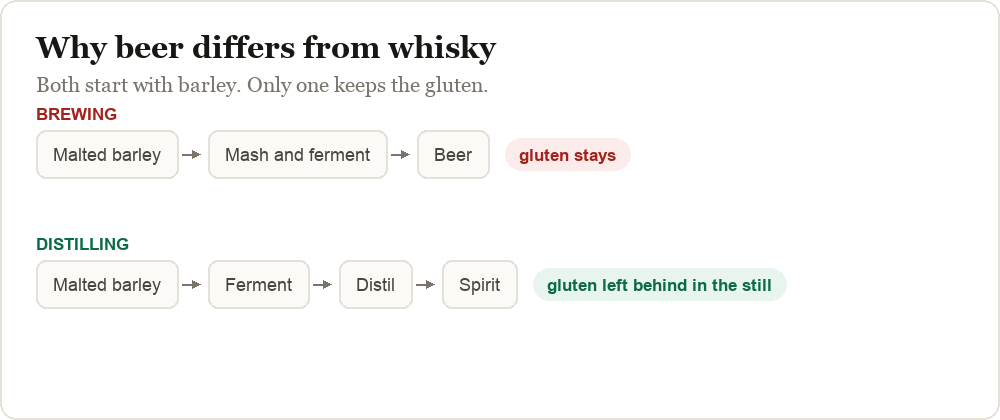
The composition supports it, and unusually for a liqueur it is not the base that needed explaining. Chambord is described by the brand as black and red raspberries, blackcurrant, Madagascan vanilla, Moroccan citrus peel, honey and XO cognac, bottled at 16.5% ABV. Cognac is distilled from grapes. Most liqueurs sit on a neutral spirit whose feedstock is undisclosed and often grain, so the answer has to run through the still. Here it does not have to: there is no cereal in the process to begin with.
And the category rule agrees. Coeliac UK's alcohol guidance states: "Cider, wine, sherry, spirits, port and liqueurs are gluten free", and separately that "All spirits are distilled during the manufacturing process and this process removes any trace of gluten." Coeliac UK names no brands and does not mention Chambord, so that ruling covers this product as a member of a class rather than by name.
The risk in a liqueur sits after the still, and Chambord's additions are fruit, honey and vanilla. The liqueurs that go wrong on this site do so because of something added at the end: an amaretti-biscuit infusion, a barley-malt caramel colour, a cereal-derived flavour carrier. Chambord's colour is derived from the fruit rather than added as a caramel, and its flavourings are berries, vanilla and citrus peel. There is no candidate here.
Why there is no ingredient list on the bottle. Article 16(4) of Regulation (EU) No 1169/2011 exempts drinks above 1.2% ABV from carrying a mandatory ingredient list, which is why a liqueur tells you so little. Allergen declaration is the partial safeguard, and only partial, because Annex II point 1(d) exempts "cereals used for making alcoholic distillates including ethyl alcohol of agricultural origin". For most liqueurs that exemption is the hole in the panel. For Chambord it is irrelevant, because the distillate is grape-based anyway.
How much risk is this?
Celiac disease: Chambord is a safe pour, and it is better documented than most of the bottles next to it. You have a producer statement addressing gluten by name, a class ruling from a national coeliac organisation, and a composition with no cereal in it. What you do not have is a certification from GFCO, Coeliac UK's Crossed Grain scheme or AOECS, and Brown-Forman explicitly declines to make an analytical guarantee. Treat the "consult your physician" line as the legal caution it is, not as a retraction.
Non-celiac gluten sensitivity: no issue.
Wheat allergy: no wheat is involved at any stage, and the base spirit is grape-derived rather than the usual unnamed neutral alcohol. That makes Chambord one of the easier liqueurs for this group, not one of the harder ones.
Other diets, since the same page answers them: Chambord is kosher certified and suitable for vegetarians, but not suitable for vegans, because of the honey.
Cross-contact: the cocktail, not the bottle. A French martini or a kir royale is assembled at a bar, and a shared shaker, a pre-batched syrup or a garnish from a tray next to the bar snacks is where the actual risk sits.
What to have instead
Chambord does not need replacing, so this is the shelf around it, which is unusually well documented for a liqueur aisle:
- AperolThe other liqueur in this cluster with a real published answer. Campari Group's FAQ says: "Aperol is suitable for celiacs and those who are gluten intolerant. It does not contain gluten, nor is it manufactured on any shared equipment." That shared-equipment line is stronger than anything Chambord publishes.
- CointreauWhich states: "Cointreau liqueur is gluten free. Cointreau is made from dried peels of sweet and bitter oranges and fresh peels of sweet oranges. The essences of sweet and bitter orange peels are magnified with just three other ingredients: pure water, sugar and neutral alcohol. Thus it does not contain any gluten."
- Grand MarnierGluten-freeAlso cognac-based, also cleared. Our Grand Marnier page rules it gluten-free on Campari's own statement.
- Crème de cassisIf you are making a kir and want the closest flavour match. Blackcurrant, sugar and spirit, with the same reasoning as any fruit liqueur. Our curaçao page covers how that reasoning works across the fruit-liqueur shelf.
- LimoncelloLemon zest, spirit, sugar and water. See our limoncello page.
- Prosecco or champagne on its ownWine is cleared by Coeliac UK in the same sentence as liqueurs, and a raspberry dropped into a glass of fizz is most of what a Chambord royale is doing.
One to handle with care rather than avoid: amaretto. Our amaretto page is depends, because some amarettos are flavoured with an infusion of amaretti biscuits added after distillation. Disaronno, which states it is gluten free, is the safe choice there. Genuinely avoid: anything labelled "malt beverage", including fruit-flavoured hard seltzers and canned cocktails, which are brewed from barley and never distilled.
Related questions
Is Aperol gluten-free? Yes, and Campari Group says so plainly on Aperol's own FAQ: "Aperol is suitable for celiacs and those who are gluten intolerant. It does not contain gluten, nor is it manufactured on any shared equipment." It adds that "Aperol Spritz does not contain gluten." That is a stronger statement than most of this category manages, because it addresses the equipment as well as the recipe.
Is an Aperol spritz gluten-free? Yes on the components: Aperol, prosecco and soda water. Campari's FAQ addresses the drink directly. The only variable is the glass and the orange slice, which is a bar-hygiene question rather than a recipe one.
Is a French martini gluten-free? The build is vodka, Chambord and pineapple juice, all three of which are fine. Vodka is cleared by distillation regardless of base grain, and pineapple juice is juice. The risk in this drink is the shaker it is made in, since a French martini is always shaken.
Is Chambord vegan? No. It is suitable for vegetarians but not vegans, because honey is part of the infusion. It is separately kosher certified. Not a gluten question, but it comes from the same allergen page and gets asked in the same breath.
Does Chambord contain cognac? Yes, the brand names XO cognac as the spirit component. Cognac is distilled from grapes, which is why this page does not have to run the usual argument about grain-based neutral spirit. It is also why Chambord is an easier answer than most liqueurs for anyone with a wheat allergy.
Why does Chambord say it is gluten-free and then tell me to ask my doctor? Because the two statements do different jobs. The first is a compositional claim: no gluten cereal is used. The second is a limit on verification, since there is no validated analytical method for gluten in fermented products, so the producer will not certify a number. Read together they say "we do not put gluten in this, and we are not going to promise you a lab result."
How we checked
| Source | Tier |
|---|---|
| Chambord allergen and gluten statement, brand text carried on a UK retail listing, "Chambord is gluten-free. There is currently no validated test to verify the gluten content (or absence thereof) in fermented products. We therefore encourage you to consult with your personal physician should you have sensitivity to gluten." The same text lists cereals with gluten (wheat, rye, barley, oats) among the fourteen allergens the product does not contain. Identical wording appears on other independent UK retailers, including Ocado. Chambord's own website could not be opened to confirm the statement on the brand domain | C |
| Coeliac UK, Alcohol, "Cider, wine, sherry, spirits, port and liqueurs are gluten free"; "All spirits are distilled during the manufacturing process and this process removes any trace of gluten." Coeliac UK names no brands | B |
| Aperol Ingredients and Nutrition FAQ, "Aperol is suitable for celiacs and those who are gluten intolerant. It does not contain gluten, nor is it manufactured on any shared equipment"; "Aperol Spritz does not contain gluten." Supports the Aperol answer and the alternatives list, not the Chambord verdict | A |
| Cointreau official FAQ, "Cointreau liqueur is gluten free… Thus it does not contain any gluten." Supports the Cointreau line in "What to have instead" | A |
| Regulation (EU) No 1169/2011, Annex II point 1(d) and Article 16(4), gluten cereals must be declared except cereals used for making alcoholic distillates; drinks above 1.2% ABV are exempt from the ingredient list | C |
Overall source tier: B. The verdict rests on Coeliac UK's ruling on liqueurs as a class plus a composition with no cereal in it, corroborated by Chambord's own allergen text. That text is tiered C rather than A for one reason and it is worth saying out loud: we read it on retail listings, not on Chambord's own site, which would not load. The wording is Chambord's, in its own voice, and it appears identically on independent retailers, but a retailer page is not the producer's page. The two tier-A rows on this table belong to Aperol and Cointreau, which are alternatives named here, not to Chambord.
Last verified: 23 August 2026. Producers reformulate without notice. The label in your hand outranks this page.