Alcohol · Category-wide: Senior & Co, Bols, DeKuyper, Marie Brizard
Is curaçao gluten-free?
Curaçao is bitter orange peel, sugar and a distilled spirit, and Coeliac UK classes liqueurs as gluten free.
- Evidence
- BNational celiac organisation
- Last checked
- 2026-08-23
- Varies by country
- Yes
Source cointreau.com+4 more
Why
Curaçao is one of the older liqueurs in the bar and one of the least mysterious. It is worth separating the three things people worry about, because only one of them is a real question and it is the least interesting.
The flavouring is fruit. Curaçao takes its name and its flavour from the laraha, a bitter descendant of the Valencia orange that grows on the island of Curaçao. Senior & Co, the island producer, describes it plainly: "A genuine Curaçao is made with the dried, bitter peels of the Laraha, known as the Golden Orange of Curaçao, that can only grow on the Caribbean island of Curaçao." The peels are dried, steeped and distilled with the spirit. Dried citrus peel is not a gluten risk under any circumstances.
The colour is a colour. Blue curaçao is not a different drink from clear curaçao. It is the same liqueur with blue food colouring in it, which is why producers routinely offer the identical liquid in clear, blue, orange, green and red. Synthetic food colours are not gluten carriers. If you have read that the blue is "artificial and therefore suspect", the artificiality is real and the gluten link is not.
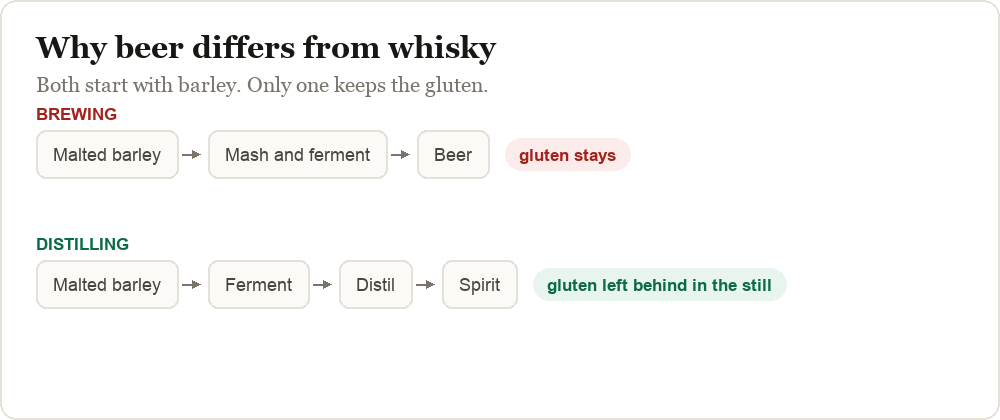
The base spirit is the only part of this that touches the question, and distillation settles it. Curaçao is built on a neutral spirit, which may be cane-derived or grain-derived depending on the producer, and producers do not generally say which. It does not matter. Coeliac UK's alcohol guidance states: "All spirits are distilled during the manufacturing process and this process removes any trace of gluten. Therefore, all spirit drinks (including malt whisky which is made from barley) are safe for people with coeliac disease." Gluten proteins are large and non-volatile; in a still they stay behind in the wash. A grain-based neutral spirit arrives in the bottle without them.
The real risk in any liqueur sits after the still, and here there is almost nothing there. Post-distillation additions are the one route by which gluten gets back into a spirit, which is why cream liqueurs, biscuit-flavoured liqueurs and heavily formulated bottles get flagged on this site while a citrus liqueur does not. Curaçao's additions are sugar, water and colour.
No curaçao producer publishes a gluten statement, and this is the honest limit of the page. Senior & Co's site has no allergen or FAQ section. DeKuyper's US site has no gluten or allergen statement. Lucas Bols publishes no consumer-facing gluten page for its blue curaçao. So the verdict rests on the category ruling and on the ingredients, not on a producer answering the question.
What a "no allergens" panel can and cannot tell you. European allergen law requires gluten cereals to be declared, and several curaçaos are sold in the UK and EU carrying a nil allergen declaration. Read that carefully, because Regulation (EU) No 1169/2011 exempts "cereals used for making alcoholic distillates including ethyl alcohol of agricultural origin" from declaration. So the panel cannot tell you what the still was fed. What it does rule out is a gluten-containing ingredient added after distillation, and that is precisely the risk in a liqueur, so the declaration is worth something. It is just worth a narrower something than it looks. Article 16(4) of the same regulation is why there is usually no ingredient list at all: drinks above 1.2% ABV are exempt from one.
The one adjacent product that is genuinely a different question is Cointreau, which is the only orange liqueur on the shelf that has actually published an answer. Its FAQ reads: "Cointreau liqueur is gluten free. Cointreau is made from dried peels of sweet and bitter oranges and fresh peels of sweet oranges. The essences of sweet and bitter orange peels are magnified with just three other ingredients: pure water, sugar and neutral alcohol. Thus it does not contain any gluten." That is a statement about Cointreau, not about curaçao, and this page does not borrow it. It does show what the paperwork looks like when a producer bothers.
Where it varies
"Curaçao" is sold in forms that are not all the same product, and one of them is not alcohol at all. The verdict is the same across the row, but what you are actually buying is not.
| What you are holding | What it is | Verdict |
|---|---|---|
| Genuine Curaçao (Senior & Co, "Curaçao of Curaçao"), made on the island | Laraha peel distilled with neutral spirit, sugar, water, colour optional | Gluten-free, no cereal ingredient, distilled base |
| European blue or clear curaçao (Bols, Marie Brizard, De Kuyper) | Bitter orange liqueur on a neutral spirit, coloured | Gluten-free, same reasoning; check the allergen panel, which will be nil |
| US blue curaçao (DeKuyper, Hiram Walker) | Neutral spirit, orange flavouring, sugar, FD&C Blue 1 | Gluten-free; screening databases list no gluten ingredient on the label |
| Blue curaçao syrup (Monin, Torani and bar-supply brands) | Non-alcoholic flavoured sugar syrup, sold for mocktails and slushes | Read the label. No alcohol means no distillation argument, so the ingredient list is the whole answer. These do carry ingredient lists |
| "Blue curaçao" premix, RTD cans and slush pouches | Frequently a flavoured malt beverage or a sugar syrup base | Read the class line. A malt beverage is brewed from barley and is not gluten-free |
Those last two rows are the ones that catch people. A curaçao liqueur is covered by everything above. A curaçao-flavoured syrup is a soft drink ingredient governed by ordinary food labelling, so it must list its ingredients and you should read them. A blue "cocktail" in a can may not contain curaçao at all.
How much risk is this?
Celiac disease: curaçao is a safe pour. The evidence is a national coeliac organisation's ruling on liqueurs as a class plus an ingredient set with no cereal in it. What you do not have is a producer confirming it in writing, which is normal for this category and is worth knowing rather than glossing over. If you want an individual answer, one email to the producer asking a named question gets past the boilerplate: "Is any ingredient derived from wheat, barley or rye, and is anything grain-derived added after distillation?"
Non-celiac gluten sensitivity: no issue.
Wheat allergy: worth one thought, because producers do not name the base spirit and it may be grain-derived. Distillation removes the protein, but allergy is a response to protein presence rather than accumulated dose and an EU nil allergen panel is silent on the base grain by law. Cointreau names its base as neutral alcohol without naming the source either; a cane-based liqueur or a grape-based one such as Grand Marnier is the way to avoid the question.
Cross-contact: the cocktail is a bigger variable than the bottle. Blue drinks tend to be shaken, batched and garnished heavily, and a shared shaker or a pre-made sour mix is where the gluten actually turns up.
What to have instead
You do not need to replace curaçao. This is the rest of the orange-liqueur shelf, ordered by how much documentation each one has:
- CointreauThe one with an actual published statement: "Cointreau liqueur is gluten free… Thus it does not contain any gluten." If you want paperwork rather than a class ruling, this is the bottle.
- Grand MarnierGluten-freeA cognac base with bitter orange essence. Our Grand Marnier page rules it gluten-free on Campari's own statement that it does not contain gluten.
- Triple sec, genericallySugar and orange on a neutral spirit, cleared on the same reasoning as curaçao. Our margarita page covers how it behaves in a drink.
- LimoncelloLemon zest, spirit, sugar and water. See our limoncello page.
- Peach schnappsGluten-freeIf the drink you were building just needs a fruit liqueur. Our peach schnapps page is a yes.
- Blue food colouring plus CointreauWhich is genuinely what a blue curaçao is, if you want a blue cocktail out of a bottle you have documentation for.
One to treat carefully rather than avoid: amaretto. Our amaretto page is depends, because some amarettos are flavoured with an infusion of amaretti biscuits added after distillation. Disaronno, which states it is gluten free, is the safe pick there. Genuinely avoid: anything labelled "malt beverage", including blue-coloured premixed cans and hard slushes, which are brewed from barley and never distilled.
Related questions
Is blue curaçao gluten-free? Yes, and it is the same liqueur as clear curaçao with colouring added. The blue is FD&C Blue 1 or an equivalent, which is a synthetic dye and not a gluten carrier. If a blue curaçao ever were a problem, the colour would not be the reason.
Is Bols blue curaçao gluten-free? Yes on the class reasoning. Bols publishes no consumer gluten statement, and UK and EU listings for it carry a nil allergen declaration, which rules out a gluten ingredient added after distillation but is silent on the base grain by law.
Is DeKuyper blue curaçao gluten-free? Yes on the same basis. DeKuyper's US site publishes no allergen or gluten information, and ingredient screening databases list no gluten ingredient on the label. Worth knowing that DeKuyper is dozens of separate liqueurs rather than one recipe, and base spirits differ between them, so this answer is about the blue curaçao rather than the whole portfolio.
Is blue curaçao syrup gluten-free? Different product, different rules. A non-alcoholic syrup is an ordinary food, so it must carry a full ingredient list and any gluten cereal must be declared. That makes it easier to check, not harder. Read the panel; most are sugar, water, citric acid, flavouring and colour.
Is a Blue Lagoon or a Blue Hawaii gluten-free? The build is. Vodka or rum, blue curaçao, and lemonade or pineapple juice are all fine. The variables are the sour mix, which is often a pre-batched house syrup nobody can give you the ingredients for, and the shaker. Ask for it built with fresh citrus.
Why can't I just read the ingredients on the bottle? Because there usually are none. Article 16(4) of Regulation (EU) 1169/2011 exempts drinks above 1.2% ABV from carrying an ingredient list, and US spirits labelling does not require one either. Allergen declaration is the partial safeguard, and only partial, because cereals used to make alcoholic distillates are exempt from that too.
How we checked
| Source | Tier |
|---|---|
| Coeliac UK, Alcohol, "Cider, wine, sherry, spirits, port and liqueurs are gluten free"; "All spirits are distilled during the manufacturing process and this process removes any trace of gluten." Coeliac UK does not use the word curaçao and names no brands | B |
| Cointreau official FAQ, "Cointreau liqueur is gluten free… Thus it does not contain any gluten." Supports the Cointreau line in "What to have instead", not the curaçao verdict | A |
| Senior Curaçao Liqueur, official site, "A genuine Curaçao is made with the dried, bitter peels of the Laraha, known as the Golden Orange of Curaçao, that can only grow on the Caribbean island of Curaçao." A production description; the site carries no allergen or gluten information | C |
| Regulation (EU) No 1169/2011, Annex II point 1(d) and Article 16(4), gluten cereals must be declared except "cereals used for making alcoholic distillates including ethyl alcohol of agricultural origin"; drinks above 1.2% ABV are exempt from the ingredient list | C |
| Spoonful screening, DeKuyper Blue Curacao, no gluten ingredient listed on the label | D |
| Senior & Co, Lucas Bols and DeKuyper, no published gluten statement located for any curaçao | n/a |
Overall source tier: B. A category verdict resting on Coeliac UK's ruling that liqueurs are gluten free, applied to a liqueur whose flavouring is dried citrus peel and whose only other additions are sugar, water and colour. Three limits, stated plainly. Coeliac UK does not use the word curaçao and names no brands, so this is an inference from the class rather than a mention. No curaçao producer publishes a gluten statement of any kind. And the Cointreau row is tier A for Cointreau only; it is carried here because Cointreau is the recommended alternative, not because it says anything about curaçao.
Last verified: 23 August 2026. Producers reformulate without notice, and blue drinks in cans and pouches change base more often than bottles do. On any premixed or non-alcoholic version, the label in your hand outranks this page.