Alcohol · Asahi Group Holdings
Is Asahi gluten-free?
Asahi Super Dry is brewed with malted barley, Asahi says so on its own site, and UK labels declare barley as an allergen.
- Evidence
- CPublished label or regulation
- Last checked
- 2026-08-10
- Varies by country
- Yes
Source asahibeer.eu+4 more
Why
Asahi attracts this question more than most lagers because of a persistent half-truth: that Japanese beer is "rice beer."
It is a rice-adjunct beer, not a rice beer. Sake is brewed from rice. Asahi Super Dry is not. Rice and corn are adjuncts used to lighten the body and produce the dry, clean finish the brand is named for, but the malt backbone is barley. Asahi's European brand page says the beer "contains malted barley and hops," and describes the criteria the company applies when selecting that barley: grain species, origin, germination method. That is the manufacturer telling you the answer, even though it is not framed as a gluten statement.
The UK label says it outright. Bottles sold in the UK, brewed under licence by Birra Peroni in Italy for Asahi UK, list water, barley malt, corn starch and hops, with the allergen advice "Contains Barley." Under UK and EU rules, drinks above 1.2% ABV don't have to list every ingredient, but they must declare gluten-containing cereals. Asahi declares barley.
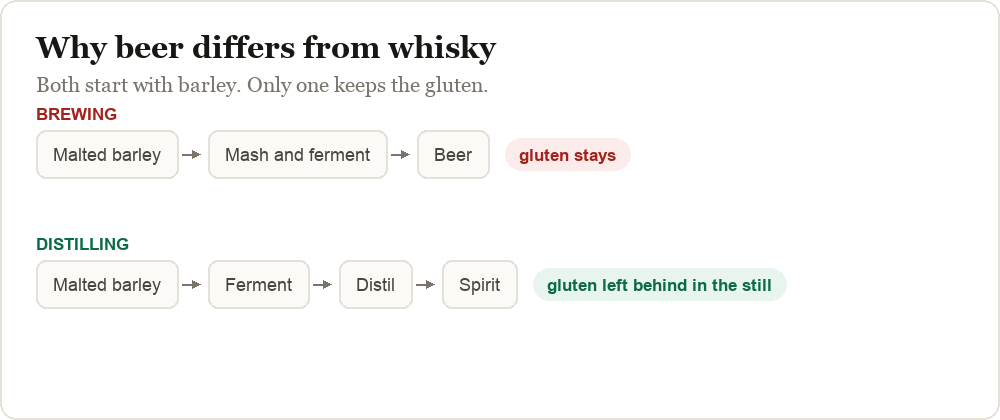
Fermented, not distilled, the distinction that decides this. Coeliac UK's position is that all spirit drinks, including malt whisky made from barley, are safe because distillation removes the gluten. Its position on the other side is just as flat: beer, lagers, stouts and ales contain varying amounts of gluten and are not suitable for a gluten-free diet. Asahi never goes near a still.
About the low-ppm claims. Independent testing enthusiasts have reported Asahi Super Dry at low gluten levels, sometimes cited as under 10 ppm, on the theory that heavy rice and corn adjuncts dilute the barley. Those figures are not Asahi's, Asahi publishes no ppm data, and the assays used to measure gluten in fermented beverages are not validated for hydrolysed gluten fragments. Beyond Celiac's advice on barley-based beer is to avoid it. A number you cannot check, on a product the maker will not certify, is not a basis for drinking it with celiac disease.
The confusing part of the range is the low- and no-alcohol tier. Asahi Super Dry 0.0% is still brewed with barley malt. Asahi Dry Zero is made differently, sources in the low-gluten testing community describe it as built without a barley wort, but Asahi publishes no gluten-free claim for it either, so it is unverified rather than confirmed.
Where it varies
| Market | Typical declared ingredients | Verdict |
|---|---|---|
| Japan | Malted barley, rice, corn, starch, hops | Not gluten-free |
| UK (brewed by Birra Peroni, Italy) | Water, barley malt, corn starch, hops, "contains barley" | Not gluten-free |
| Europe (asahibeer.eu) | "Contains malted barley and hops" | Not gluten-free |
| Asahi Super Dry 0.0% | Barley malt | Not gluten-free |
| Asahi Dry Zero (0.00%, Japan) | Reported as brewed without a barley wort | Unverified, no Asahi gluten-free claim located |
The adjunct grains shift by brewery and market. The barley does not. Wherever you are buying it, Asahi Super Dry is a barley beer.
How much risk is this?
Celiac disease: avoid. Barley malt is a primary ingredient and a declared allergen. The low-ppm folklore is not a licence.
Non-celiac gluten sensitivity: also avoid, though some people do report tolerating high-adjunct lagers better than heavily malted beer. That is a dose effect, not safety.
Wheat allergy: there is no wheat in the declared ingredients, so this is a different question, barley is the issue, and cross-reactivity is worth raising with your allergist rather than settling from a page.
Cross-contact: irrelevant here. The gluten is an intended ingredient.
What to have instead
Asahi's own parent group owns one of the most widely available low-gluten beers in Europe, and the Japanese-restaurant context has good answers too:
- Peroni Nastro Azzurro Gluten FreeYesSame Asahi group, sold in the UK specifically as a gluten-free lager, endorsed by the Italian Coeliac Association. Be clear about what it is: brewed from barley with an enzyme added at the end of brewing to break down the gluten. Legal to call gluten-free in the UK and EU under the 20 ppm rule; classed as gluten-reduced in the US, and Beyond Celiac advises against barley-based beers because the measurement method is unvalidated. Many coeliacs drink it happily; that is a decision to make deliberately, not by accident.
- SakeThe obvious swap in a Japanese restaurant, brewed from rice, water, koji and yeast, and listed as gluten-free by Beyond Celiac. Junmai grades have the shortest ingredient list.
- Shochu, or any distilled spirit with a mixerDistillation removes gluten even from barley-based mugi shochu, per Coeliac UK's rule on spirits.
- Naturally gluten-free beersYesRedbridge (sorghum), Green's, Ghostfish or Holidaily, brewed from sorghum, millet, rice or buckwheat, or made in a dedicated gluten-free brewery. These avoid the gluten-removed debate entirely. Note that Celia Organic does not belong on this list even though it is sold as a gluten-free lager: its ingredient panel reads water, barley malt and Saaz hops, and the gluten is broken down by an added enzyme. It sits with Peroni above, not here.
- Hard cider, wine, or a cane-sugar hard seltzerGluten-freeReliable, widely stocked, and no barley anywhere.
Also skip Sapporo and Kirin if you were about to substitute one Japanese lager for another. Both are barley-based, and neither carries a gluten-free claim.
Related questions
Is Asahi Super Dry made from rice? Partly. Rice and corn are adjuncts that lighten the body and dry the finish, but malted barley is the base malt. "Japanese beer is rice beer" is a myth that comes from confusing beer with sake.
Is Asahi Dry Zero gluten-free? Unconfirmed. It is reported to be made without a barley wort, using added alcohol and flavouring to simulate beer, but Asahi publishes no gluten-free claim we could locate. Treat it as unverified and check the current Japanese label or contact Asahi.
Is Asahi Super Dry 0.0% gluten-free? No. It is brewed with barley malt. The naming here is genuinely dangerous, "0.0%" refers to alcohol only, and the two zero-alcohol Asahi products are not made the same way.
Are Sapporo and Kirin gluten-free? No. Both are barley-malt lagers with no gluten-free claim. Japanese lagers as a category are not a safe harbour.
Is Asahi safe at a sushi restaurant if I only have a small glass? No. And the beer is the least of the problems, standard soy sauce is brewed with roughly equal parts wheat and soybean, and tempura, imitation crab and shared fryers are the bigger risks. Order sake and ask for tamari.
Does Asahi publish gluten test results? No. The ppm figures circulating online come from independent testers, not from Asahi, and there is no official validation of them.
How we checked
| Source | Tier |
|---|---|
| Asahi Beer Europe, Asahi Super Dry, "Contains malted barley and hops" | A (ingredient statement; no gluten claim either way) |
| Tesco, Asahi Super Dry 12x330ml, label transcription: water, barley malt, corn starch, hops; allergen advice "Contains Barley" | C |
| Beyond Celiac, Is Beer Gluten-Free?, barley-based beer is not safe for celiac disease | B |
| Coeliac UK, Alcohol, beer is not suitable for a gluten-free diet; spirits are | B |
| Asahi UK, Peroni Nastro Azzurro Gluten Free, the group's gluten-removed alternative | A |
| Asahi, no gluten-free or gluten-content statement located for Super Dry | n/a |
Overall source tier: C. Asahi confirms the barley in its own marketing and UK labels declare it as an allergen, which settles the verdict, but Asahi has never published a gluten statement or a ppm figure for Super Dry, so this rests on the ingredient declaration rather than a direct manufacturer gluten claim. The verdict would not change with one.
Last verified: 10 August 2026. Asahi Super Dry is brewed under licence in several countries and adjunct grains vary by brewery. The label on the bottle in your hand outranks this page.