Why it contains gluten
What 20 ppm actually means
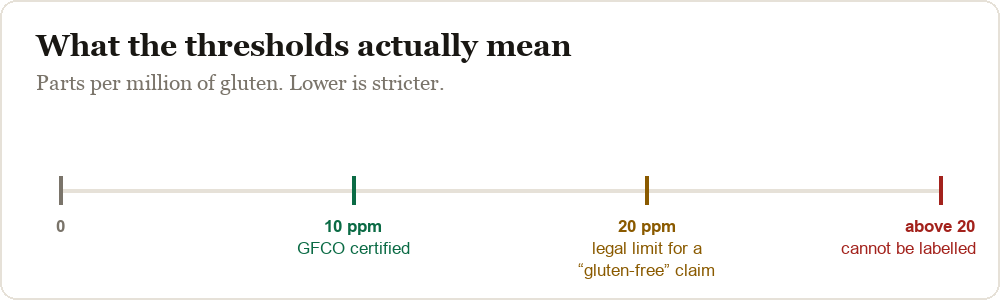
20 ppm is the legal ceiling for making a gluten-free claim, not a measure of what any individual can safely eat.
The short answer
20 ppm is the ceiling for making a claim, not a statement about safety. A product labelled gluten-free must contain fewer than 20 milligrams of gluten per kilogram of food. It is not a threshold below which gluten stops mattering, not a measure of what any individual tolerates, and not a target manufacturers aim for, most gluten-free products sit far beneath it. The number exists because it was the lowest level that could be reliably measured and enforced when the rules were written.
How it works
The number comes from Codex, and everyone else adopted it. The Codex Alimentarius standard for foods for people intolerant to gluten sets 20 mg/kg as the limit for a gluten-free designation. Coeliac UK is explicit that UK law "is based on the Codex Alimentarius standard," and that "only foods that contain 20 parts per million (ppm) or less of gluten can be labelled gluten free." The US arrived at the same place through its own rulemaking: the FDA's 2013 final rule, codified at 21 CFR 101.91, defines gluten-free as a food with no gluten-containing grain ingredient, no ingredient derived from one that has not been processed to remove gluten, and no such processed ingredient whose use "results in the presence of 20 parts per million (ppm) or more gluten in the food", with any unavoidable gluten below 20 ppm.
ppm is a concentration, so serving size does the rest of the work. 20 ppm is 20 mg per kilogram. A 50 g portion at the legal ceiling carries 1 mg of gluten; a 500 g day's worth carries 10 mg. That arithmetic is the bridge to the clinical literature.
The clinical figure is about 10 mg a day. Akobeng and Thomas's 2008 systematic review in Alimentary Pharmacology & Therapeutics concluded: "Although there is no evidence to suggest a single definitive threshold, a daily gluten intake of <10 mg is unlikely to cause significant histological abnormalities." Put the two numbers together and the design intent of 20 ppm becomes visible: a realistic day's intake of food at or below the threshold keeps total gluten under the level at which measurable intestinal damage becomes likely.
Two caveats. The review's own framing is that tolerance varies between individuals and that no single definitive threshold exists. And the arithmetic assumes products sit at the ceiling; in practice many labelled products test at or below the limit of quantification, which is why the diet works as well as it does.
GFCO halves it. The Gluten-Free Certification Organization certifies at 10 ppm, the Gluten Intolerance Group describes the FDA's standard as "twice as lenient" as its own, and pairs the number with ingredient review, quarterly testing, annual on-site plant audits and random retail surveillance sampling. The lower number gets the attention; the audit is what adds the assurance.
Some foods cannot be assayed at all. Gluten tests detect intact gluten proteins. Fermentation and hydrolysis break those proteins into fragments, and the standard antibody assays are not validated against fragments, so a number produced for beer, soy sauce or yoghurt is not a trustworthy number. The regulation solves this by changing the evidence: where methods are unavailable, the manufacturer must keep records showing the food met gluten-free requirements before processing and that cross-contact was adequately evaluated, retained two years and produced to FDA on request. The proof moves from the assay to the paperwork.
Where this catches people
"Under 20 ppm" gets read as "contains up to 20 ppm." It is a maximum, and real products cluster well below it. Reading the ceiling as the typical value makes the diet sound far more marginal than it is.
"20 ppm is safe" gets read as a promise to an individual. It is a population-level line drawn where measurement was reliable and where the clinical evidence supported it for most people. A minority react below it. If you are symptomatic on a correctly followed diet, or have persistent villous atrophy, the honest answer is that the threshold may not be low enough for you, and the response is certification and purity-protocol sourcing, not despair.
People try to compare products by ppm. They can't. Almost no manufacturer publishes a figure, and any figure that circulates is usually third-party testing of a single lot. Treat published ppm numbers as trivia rather than as permission.
Gluten-removed beer is the sharpest case. These beers (Omission, Estrella Damm Daura, Peroni Nastro Azzurro Gluten Free), are brewed from barley and then treated with an enzyme that cleaves the gluten into fragments. The Celiac Disease Foundation is blunt: "The effectiveness of 'removing' gluten by breaking it down into smaller fragments has not been validated or accepted by the scientific and medical communities. This is because currently available gluten testing methods are not sufficiently reliable/accurate when it comes to fermented and hydrolyzed products." Research it cites found that while no one reacted to a genuinely gluten-free beer, "some persons with celiac disease did have an immune response to the GR beer."
The mechanism that blocks the US claim follows from the records rule above: the route to a gluten-free claim on a fermented product is documenting that the food was gluten-free before fermentation, and a beer brewed from malted barley fails at the first step. No clean starting point to document, no validated assay to substitute for one. For alcohol under the Federal Alcohol Administration Act, TTB Ruling 2020-2 governs, and it does not permit a gluten-free claim on a product made from gluten-containing grain and processed to remove gluten; the permitted alternative is wording along the lines of "processed to remove gluten" with a qualifying statement.
The UK and EU allow the label, at the same 20 ppm. Coeliac UK: "By law, manufacturers can only label their beer gluten free if it contains 20 ppm or less of gluten," and "a gluten removed beer made from barley must, by allergen labelling law, state on the label that it 'contains barley.'" So the identical bottle can be gluten-free in Europe and gluten-reduced in America. Neither jurisdiction is lying; they have made different calls about how much weight an unvalidated assay should carry. This site treats gluten-removed beers as a separate personal decision, never as gluten-free beers.
"Very low gluten" is not gluten-free. Coeliac UK describes products with specially processed wheat starch "with a gluten level between 21 and up to 100 ppm" as eligible for that label. Different claim, different number.
How to tell
- Act on the claim, not on a number. "Gluten free" on an FDA- or UK-regulated pack is the enforceable statement. You do not need a ppm figure.
- If you want lower than 20 ppm, buy certified. GFCO's 10 ppm plus audits is the available step down; there is no consumer route to verifying a product's ppm yourself.
- Ignore third-party ppm results for unlabelled products. Single lots, unvalidated methods, no commitment to stay true next quarter.
- For fermented or hydrolysed foods, the claim rests on records. Legitimate for yoghurt, vinegar, cheese and soy sauce made from gluten-free inputs. Not available to something brewed from barley.
- If you are still symptomatic on a strict diet, escalate the standard rather than the anxiety: certified products, purity-protocol oats, and a dietitian review of trace sources.
Related questions
Is 20 ppm safe for celiac disease? For most people, on a normal day's intake, yes. That is what the threshold was calibrated to achieve. It is a population standard, and a minority react below it.
How much gluten is 20 ppm in a real serving? 20 mg per kilogram. A 50 g serving at the ceiling contains 1 mg of gluten; you would need roughly half a kilogram of food sitting exactly at the limit to reach the 10 mg daily figure from the literature.
Why 20 and not zero? Because zero cannot be measured or enforced. Gluten assays have limits of detection and quantification in the low single-digit ppm range, so a "zero gluten" rule would be one nobody could verify.
Why can't they just test the beer? Because the assays detect intact gluten proteins, and fermentation destroys the intact protein while leaving immunologically active fragments. A low reading means the test could not see the gluten, not that the gluten is gone.
Does a "gluten-free" claim cover cross-contact as well as ingredients? Yes, the limit applies to the finished food, including any unavoidable gluten present. That is the main practical advantage of a claim over a clean panel.
How we checked
| Source | Tier |
|---|---|
| Celiac Disease Foundation, Label Reading & the FDA, "the FDA only allows packaged foods with less than 20 parts per million (ppm) of gluten to be labeled 'gluten-free'" | B |
| Coeliac UK, gluten free labelling law, 20 ppm or less to be labelled gluten free; law "based on the Codex Alimentarius standard"; "very low gluten" is 21 to 100 ppm | B |
| Akobeng AK, Thomas AG, Aliment Pharmacol Ther 2008, PMID 18315587, "a daily gluten intake of <10 mg is unlikely to cause significant histological abnormalities" | B |
| 21 CFR 101.91, the 20 ppm definition and the records requirement for fermented or hydrolyzed foods. Cited via the Legal Information Institute mirror: ecfr.gov and fda.gov redirected to an access-control page and could not be verified directly | C |
| Celiac Disease Foundation, The Truth About Gluten-Free Beer, gluten removal "has not been validated or accepted by the scientific and medical communities" | B |
| Coeliac UK, gluten free beer FAQ, 20 ppm rule for a gluten free beer label; a gluten-removed barley beer must state that it "contains barley" | B |
| GFCO, how certification works, 10 ppm, ingredient review, annual audits, quarterly testing, retail surveillance | A |
| Gluten Intolerance Group, label reading, FDA's standard is "twice as lenient" as GFCO's 10 ppm | B |
| Codex standard CXS 118-1979, 20 mg/kg, named by number; the FAO-hosted PDF returned an access error. Coeliac UK's confirmation that UK law rests on Codex is cited above | n/a |
| TTB Ruling 2020-2 (gluten statements on FAA Act alcohol), named by number; ttb.gov did not respond within the fetch timeout | n/a |
Overall source tier: B. Every figure here is attributed to a named regulator, standards body, celiac organisation or peer-reviewed review, and the arithmetic linking 20 ppm to the 10 mg daily figure is presented as arithmetic rather than as a sourced claim. Where a US government source would normally carry the citation, the instrument is named by number and the row is marked.
Last verified: 13 August 2026. Thresholds are stable but the rules around them are not; the treatment of fermented and gluten-removed products is the part most likely to change if a validated assay is developed. The label on the pack in your hand outranks this page.
Pages that rest on this
- Are Ball Park hot dogs gluten-free?
- Are crab cakes gluten-free?
- Are gnocchi gluten-free?
- Are Golden Grahams gluten-free?
- Are Honey Bunches of Oats gluten-free?
- Are hops gluten-free?
- Are jimmies gluten-free?
- Are Kix cereal gluten-free?
- Are maraschino cherries gluten-free?
- Are Nestlé chocolate chips gluten-free?
- Are onion rings gluten-free?
- Are peach rings gluten-free?
- Are Reese's PB cups gluten-free?
- Are Surfside drinks gluten-free?
- Are sweet potato fries gluten-free?
- Are Whataburger fries gluten-free?
- Is a 100 Grand candy bar gluten-free?
- Is A.1. steak sauce gluten-free?
- Is almond bark gluten-free?
- Is almond butter gluten-free?
- Is Asahi gluten-free?
- Is au jus gluten-free?
- Is Baby Ruth gluten-free?
- Is bean curd gluten-free?
- Is beef jerky gluten-free?
- Is Bud gluten-free?
- Is Busch Light gluten-free?
- Is candy floss gluten-free?
- Is Carmex gluten-free?
- Is chocolate powder gluten-free?
- Is chocolate pudding gluten-free?
- Is dark chocolate gluten-free?
- Is eel sauce gluten-free?
- Is Emergen-C gluten-free?
- Is French dressing gluten-free?
- Is Frosted Flakes cereal gluten-free?
- Is gluten-free pizza healthy?
- Is Heineken gluten-free?
- Is Heluva Good dip gluten-free?
- Is Hillshire Farm kielbasa gluten-free?
- Is Hubba Bubba gluten-free?
- Is instant vanilla pudding gluten-free?
- Is kettle corn gluten-free?
- Is marinara sauce gluten-free?
- Is matcha gluten-free?
- Is mead gluten-free?
- Is Miller Light beer gluten-free?
- Is Mrs. Butterworth's syrup gluten-free?
- Is Orbit chewing gum gluten-free?
- Is Pacifico gluten-free?
- Is paleo gluten-free?
- Is peanut brittle gluten-free?
- Is Philly cream cheese gluten-free?
- Is Sapporo beer gluten-free?
- Is Smirnoff Ice gluten-free?
- Is Snack Pack pudding gluten-free?
- Is Special K gluten-free?
- Is toffee gluten-free?
- Is white chocolate gluten-free?
- Is Estrella Damm Daura gluten-free?
- Is Busch Light Apple gluten-free?
- Is Peroni Nastro Azzurro gluten-free?
- Is Pabst Blue Ribbon gluten-free?
- Is Michelob Ultra Pure Gold gluten-free?
- Are IPAs gluten-free?
- Are Corona beers gluten-free?
- Are sour beers gluten-free?
- Is cream of tartar gluten-free?
- Is Arm & Hammer baking soda gluten-free?
- Is Fleischmann's yeast gluten-free?
- Is granulated sugar gluten-free?
- Is natamycin gluten-free?
- Is shoyu gluten-free?
- Is Ragú spaghetti sauce gluten-free?
- Are Haribo gummies gluten-free?
- Are Junior Mints gluten-free?
- Is Laughing Cow gluten-free?