Candy & chocolate · Category-wide
Is toffee gluten-free?
Depends on the brand. The base recipe is gluten-free, but malt extract and biscuit inclusions put gluten in a real minority of toffees.
- Evidence
- BNational celiac organisation
- Last checked
- 2026-08-10
- Varies by country
- Yes
Source werthers-original.co.uk+7 more
Why
Toffee is worth being careful about because it fails differently from most candies. There is no single answer for the category, and the risky ingredient is one most people don't scan for.
The base is clean. Toffee is a cooked-sugar confection: sugar and glucose syrup boiled with butter and usually condensed or evaporated milk, taken to firm-crack or hard-crack. Flour has no function in it, it would wreck the texture, so the folk claim that "toffee uses wheat flour as a stabiliser" is not how commercial toffee is made. If you see wheat flour on a toffee panel, you are looking at a toffee-flavoured baked product, not toffee.
Barley malt extract is the actual risk. Malt extract is a standard confectionery flavouring, used in small quantities in chocolate, cereals, sauces and, relevantly, caramel and toffee sweets, where it deepens colour and adds a roasted note. Malt is made by germinating barley, so it is not gluten-free. But quantity decides the outcome: Coeliac UK's position is that a product containing a small amount of barley malt extract can still be suitable if the finished product tests under 20 ppm, and that products above that threshold are not. The practical rule follows directly: a toffee listing barley malt extract is only reliably safe if the pack carries a gluten-free claim or the product appears in the Coeliac UK Food and Drink Directory. A toffee listing plain "malt", "malted barley" or "malt syrup" should be treated as unsuitable.
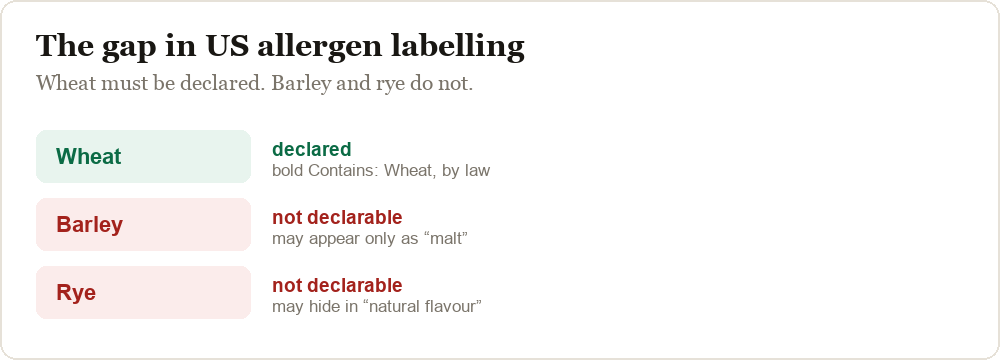
Under UK and EU rules barley malt extract must be declared in the ingredients list whatever the amount, usually in bold, so on a British pack it is always visible. Under US rules it is not: only wheat must be declared as an allergen, so barley-derived malt flavouring can legitimately sit inside "natural flavors" on a US label. That asymmetry is why an American toffee needs a manufacturer statement in a way a British one often doesn't.
Inclusions are the second risk. Toffee is a natural carrier for crunchy things. Cookie pieces, pretzel bits, biscuit crumb, malted-milk pieces and cereal crisps all appear in toffee bars and toffee bark, and all of them can bring wheat or barley with them. Rice crisps in particular are frequently treated with barley malt flavouring.
The good news is documentation. More toffee brands publish gluten statements than you'd expect. Hershey states that HEATH bars (all sizes, plus Heath Milk Chocolate Toffee Bits), and SKOR butter toffee bars are gluten free. Storck's UK site states all Werther's Originals suit a gluten-free diet, and tackles the glucose syrup head-on: it may be wheat-derived, and the Coeliac Society accepts that on a gluten-free diet. See's Candies states that candies made in its own facilities are gluten free, naming its bought-in and wheat-containing exceptions. Its toffee is on neither list. Walkers Nonsuch labels its toffees gluten free.
Where it varies
| Product / market | Status |
|---|---|
| Heath bar, Heath toffee bits (US, Hershey) | Stated gluten free by Hershey |
| Skor bar (US, Hershey) | Stated gluten free by Hershey |
| Werther's Original (UK/EU, Storck) | Storck: all variants suitable for a gluten-free diet; wheat-derived glucose syrup accepted |
| Werther's Original (US, Storck) | Tests under 20 ppm but Storck chooses not to label it gluten-free, same sweet, weaker claim |
| Walkers Nonsuch (UK) | Labelled gluten free; milk and soya allergens, may contain nuts |
| Daim (Mondelēz) | No gluten grain on the panel, but not certified and made in facilities handling gluten |
| Supermarket own-brand and pick-and-mix toffee (UK) | Check the pack, malt extract is common and weigh-out sweets carry counter cross-contact |
| Generic US "English toffee bits" / bark / toffee-topped desserts | Treat as unverified, barley malt can hide in "natural flavors" |
How much risk is this?
Celiac disease: stick to toffees with a published statement or a gluten-free label. That's not a small pool: Heath, Skor, Werther's (UK), See's and Walkers Nonsuch cover most of a shelf between them. Avoid outright: toffee with biscuit or cereal inclusions, toffee bark and crumb toppings, and ice-cream-counter toffee bits, where the scoop is shared with cookie dough and brownie pieces. Pick-and-mix is its own hazard, sweets weighed to order pick up whatever else went through the scoop. And if you're among the coeliacs who react below the Codex threshold, treat "barley malt extract" as a no regardless of the 20 ppm rule.
Non-celiac gluten sensitivity: the malt-extract quantities are small and most people here tolerate them. If malt is a known trigger, use the coeliac rule.
Wheat allergy: the base recipe is the safest part of the shelf. Wheat-derived glucose syrup is highly refined and generally tolerated, but ask your allergist rather than reading across from coeliac guidance.
What to have instead
Toffee you can buy without an investigation:
- Heath bar and Heath Milk Chocolate Toffee BitsGluten-freeHershey states both are gluten free, the bits matter, because they let you top your own ice cream instead of trusting a shared topping bin.
- SkorAlso Hershey, also stated gluten free; drier and more buttery.
- Werther's Original (UK packs)Storck states all variants suit a gluten-free diet. In the US the same sweet tests clean but isn't labelled, a labelling decision, not a recipe difference.
- Walkers NonsuchLabelled gluten free across the range, including treacle and liquorice. The pick for proper English twist-wrapped toffee.
- See's Candies toffeeCovered by See's own-facility gluten-free statement. Contains milk; nut cross-contact declared.
- DaimFor the almond-caramel crunch, no gluten grain on the panel, but Mondelēz certifies nothing here and the facility handles gluten, so it's the weakest option on this list.
- Honeycomb / cinder toffeeSugar, syrup and bicarbonate of soda; check only the chocolate coating on bar versions.
Avoid unless the pack says otherwise: toffee with biscuit, cookie, pretzel or cereal pieces, toffee bark, sticky toffee pudding and toffee sauce made with a flour roux, and anything whose panel says malt, malted barley or malt syrup without a gluten-free claim alongside it.
Related questions
Are Heath and Skor bars gluten-free? Yes, Hershey states that Heath bars in all sizes, the Heath toffee bits, and Skor butter toffee bars are gluten free. They're the two most reliably documented toffee bars on a US shelf. The caveat is service, not product: Heath bits used as an ice-cream topping sit next to cookie dough and brownie chunks.
Are Werther's Originals gluten-free? Storck's UK site says all Werther's Originals suit a gluten-free diet, including the wheat-derived glucose syrup, which Coeliac guidance accepts. Storck's US arm says the products meet the under-20 ppm standard but has chosen not to print a gluten-free label, read that as caution about the claim, not about the sweet.
Is Daim gluten-free? Its ingredient list holds no gluten grain, but Mondelēz doesn't certify it and it is made in facilities that handle gluten. No gluten ingredient, no confirmation.
Is English toffee gluten-free? In the US "English toffee" means buttery almond toffee, Heath-style, and is generally gluten-free. In Britain it means the twist-wrapped chewy stuff, where malt extract is more common. Same words, different products, different checks.
Is toffee sauce or sticky toffee pudding gluten-free? The sauce usually is (butter, sugar, cream), unless it's thickened with a flour roux. Sticky toffee pudding is a sponge cake and contains wheat flour. So does most toffee-flavoured baking.
Is toffee popcorn gluten-free? Often, but not automatically. The corn and the toffee coating are fine; the risks are a malt-flavoured caramel and shared fryers or coating drums in facilities that also run malted or biscuit products.
How we checked
| Source | Tier |
|---|---|
| Werther's Original UK FAQ, "All Werther's Originals are suitable for a gluten free diet"; wheat glucose syrup accepted per the Coeliac Society | A |
| Werther's Original US FAQ and Storck US consumer service, under 20 ppm, deliberately unlabelled | A |
| Hershey, HEATH and SKOR product pages, stated gluten free | A |
| See's Candies allergen statement, own-facility candies gluten free, exceptions named | A |
| Coeliac UK, barley malt extract, the 20 ppm rule that governs this whole category | B |
| Walkers Nonsuch Liquorice Toffee panel, gluten-free labelling, milk and soya allergens | C |
| Gluten Free Dietitian, malt extract and gluten-free foods | D |
| Thorntons, Riley's and supermarket own-brand toffees, no manufacturer gluten statement located; treat as unverified | n/a |
Overall source tier: B, verdict depends. Several major toffee makers publish direct gluten statements (Hershey answers the question outright for HEATH and SKOR, Storck for Werther's on both sides of the Atlantic, See's for its own-facility candies), and that is why the named brands above get a firm answer. Those documents are tier A for their own rows and nothing more: a Werther's statement tells you about Werther's, not about toffee. What actually supports the category verdict is Coeliac UK's ruling on barley malt extract and the 20 ppm threshold, which is where the depends comes from and which sets the page at tier B. The verdict stays depends because malt extract is a legitimate toffee ingredient, is invisible inside "natural flavors" on US labels, and no celiac organisation has cleared toffee as a class.
Last verified: 10 August 2026. Recipes and "may contain" advisories change, and a US pack and a UK pack of the same brand can differ. The label in your hand outranks this page.