Snacks · Category-wide
Is almond butter gluten-free?
For plain almond butter, almonds and salt contain no gluten. Flavoured and mix-in versions are where it breaks down.
- Evidence
- BNational celiac organisation
- Last checked
- 2026-08-10
- Varies by country
- No
Source support.barneybutter.com+5 more
Why
There is no version of this question where the almond is the problem. Gluten is a storage protein found in wheat, barley and rye; almonds are not grasses and do not contain it. A jar reading "dry roasted almonds, sea salt" is gluten-free by composition, and no manufacturer statement is needed to establish that.
Three things can still put gluten in an almond butter jar.
1. Flavour systems built on malt. This is the real hazard, and it is under-discussed. Barley malt, malt extract, malt syrup and "malt flavour" are barley-derived and contain gluten. They turn up in chocolate, honey, maple and "cookie" flavour blends, sometimes several layers down as a sub-ingredient of a purchased inclusion rather than as a top-level ingredient. Gluten Free Watchdog has reported barley malt extract hiding inside a component of a product that was itself labelled gluten-free, secondary reporting rather than a manufacturer or celiac-organisation finding, but a plausible failure mode and a reason to read compound ingredients. If a flavoured nut butter lists malt in any form, put it down.
2. Physical inclusions. Almond butters blended with cookie butter, speculoos, pretzel pieces, granola or biscuit crumb contain actual wheat. Cookie butter is built on speculoos biscuits made from wheat flour. Treat any nut butter with crunchy add-ins as containing gluten unless the jar is explicitly labelled gluten-free.
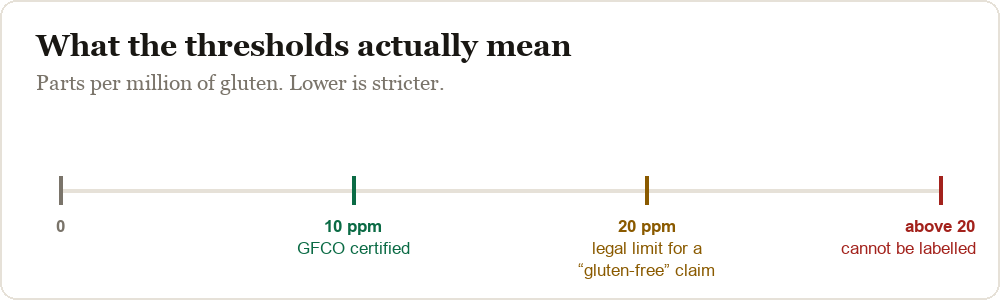
3. Shared facilities. An ingredient list can be clean while the line is not. Some almond butters are ground in plants that also handle wheat, barley or rye. US "gluten-free" labelling means under 20 ppm; GFCO certification is stricter at under 10 ppm. A "may contain wheat" or "made in a facility that also processes wheat" advisory is voluntary in the US, so its absence proves nothing.
One ingredient that people wrongly panic about: maltodextrin. It carries "malt" in the name but is a different substance. Both Beyond Celiac and the National Celiac Association treat maltodextrin as gluten-free, in the US it is almost always corn-derived, and when it is made from wheat starch, "wheat" must be declared on the label under allergen rules. Maltodextrin is not the reason to reject a jar. Barley malt is.
Named brands with published positions. Barney Butter states that all its almond butters are free of gluten-containing ingredients and produced in a facility that does not process gluten-containing ingredients, with a gluten-free seal on every pack. Once Again Nut Butter holds a gluten-free certificate and describes dedicated equipment and segregated allergen areas, though it does run other nuts, sesame, sunflower and soy in the same plant, which is an allergen consideration rather than a gluten one. Justin's and MaraNatha almond butters are labelled certified gluten-free.
How much risk is this?
Celiac disease: plain almond butter is fine, and a certified jar removes the remaining doubt. The two habits worth building are reading flavoured varieties properly, and keeping your own jar. A knife that has been in wheat toast and back into the jar is a far more common source of a reaction than the manufacturing line ever is, label your jar and don't share it.
Non-celiac gluten sensitivity: the same rules, with more latitude on shared facilities.
Wheat allergy: the gluten question and the allergy question separate here. Wheat must be declared on US labels; the tree-nut warnings on almond butter jars are about other nuts, not wheat.
Restaurants and smoothie bars: bulk almond butter in a café is dispensed with a shared spoon next to granola and oats. The jar may be safe; the counter isn't.
What to have instead
If you want almond butter and want the gluten question closed, these are the options that publish something.
- Barney ButterGluten-free seal on all packaging, and the company states its facility does not process gluten-containing ingredients. The strongest published position of the mainstream almond butters.
- Once Again Nut ButterHolds a gluten-free certificate; organic and fair-trade lines widely stocked.
- Justin's Classic Almond ButterCertified gluten-free and Non-GMO Project Verified. Shared equipment with other tree nuts and peanuts, a nut-allergy caveat, not a gluten one.
- MaraNathaLabelled certified gluten-free, non-GMO and kosher; usually the cheapest certified option in a US supermarket.
- Store-brand "almonds only" jarsA single-ingredient grind is gluten-free by composition. Fine if you are not reacting to trace amounts.
- Grind your ownMost health-food shops with a nut-butter mill will let you see the machine. Ask what else goes through it.
Different nut, same logic: sunflower seed butter (SunButter is certified gluten-free and nut-free), tahini, and cashew butter are all safe when plain. What to avoid: cookie-butter and speculoos blends, anything with pretzel, granola or biscuit inclusions, and any flavoured nut butter listing malt, malt extract or malt syrup.
Related questions
Is peanut butter gluten-free? Same answer and same exceptions. Plain peanut butter is gluten-free; the risk is in flavoured and inclusion-heavy varieties and in shared lines. Most major US peanut butters are gluten-free, but check flavoured ones.
Does maltodextrin in almond butter mean it has gluten? No. Beyond Celiac and the National Celiac Association both classify maltodextrin as gluten-free. It is usually corn-derived in the US, and any wheat-derived version must declare wheat on the label.
Is Barney Butter gluten-free? Yes. Barney Butter states all its almond butters are free of gluten-containing ingredients and made in a facility that does not process gluten-containing ingredients, with a gluten-free seal on the pack.
Is honey- or chocolate-flavoured almond butter safe? Only after you read it. These are the flavour families where barley malt turns up most often, sometimes buried inside a compound ingredient. A certified gluten-free mark settles it; the word "malt" anywhere rules it out.
Does "no gluten ingredients" mean the same as "gluten-free"? No. In the US, "gluten-free" on a label is a regulated claim meaning under 20 ppm. "No gluten ingredients" is a recipe statement that says nothing about the line the product ran on.
Is almond flour gluten-free? Yes by composition. It is ground almonds. Same caveat about shared milling equipment, so buy it certified if you are sensitive to trace amounts.
How we checked
Overall source tier: B. Barney Butter and Once Again publish gluten-free statements and certifications, and those rows are tier A, but they are documents about two brands, and this page rules on a category. A brand's statement supports its own row, not the verdict, so the page cannot take an A from them. What the page-level verdict actually rests on is composition, almonds are not a cereal grain, plus celiac-organisation guidance on the ingredient people most often misread, with Beyond Celiac, the Celiac Disease Foundation and the National Celiac Association covering maltodextrin and US label rules. That is tier B, and it is the honest figure. This page cannot vouch for a jar it hasn't read.
Last verified: 10 August 2026. Manufacturers reformulate and change co-packers without notice, and flavoured lines change most often. The jar in your hand outranks this page.