Explainers · Category-wide
Is paleo gluten-free?
Yes. Paleo excludes every grain, so paleo eating contains no gluten, but paleo certification does not test for it.
- Evidence
- BNational celiac organisation
- Last checked
- 2026-08-10
- Varies by country
- No
Source nationalceliac.org+3 more
Why
Paleo excludes a superset of what a gluten-free diet excludes. The paleo framework is built on meat, fish, eggs, vegetables, fruit, nuts and seeds, and excludes grains, legumes, dairy and processed food. Gluten lives in three grains. Cut all grains and the three go with them. It also removes the gluten-free diet's own staples (rice, corn, oats), and the pseudo-grains quinoa, millet and buckwheat, which are gluten-free but not paleo.
So the relationship is one-directional: all paleo food is gluten-free; most gluten-free food is not paleo. A bowl of rice, a Schär roll and a certified gluten-free oat porridge are all fine on a gluten-free diet and all out on paleo.
Paleo baking is grain-free but not gluten-tested. Almond, coconut, cassava and tapioca flour are the paleo baker's toolkit, and every one is gluten-free by botany. The gluten in a paleo product, if any, will not have come from an ingredient. It will have come from the facility.
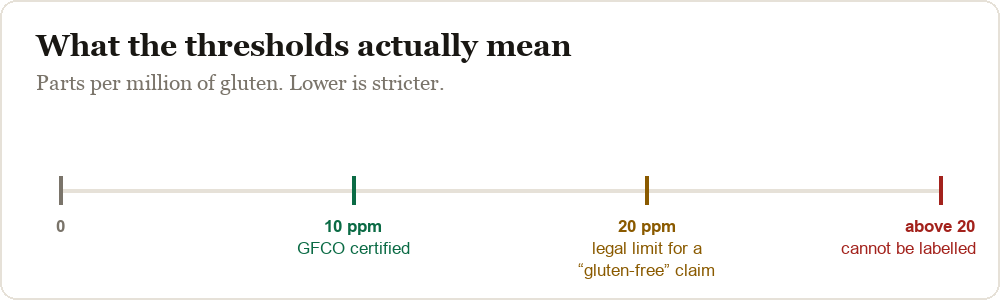
This is where the National Celiac Association draws a hard line. Its position is that paleo-certified products from the paleo certifiers currently operating in the US do not test for gluten, and are therefore not necessarily safe for people with celiac disease. Paleo certification means the product is free of grains as ingredients; it says nothing about cross-contact during sourcing, milling or packing, and because no testing is done, whether a product meets the 20 ppm threshold is simply unknown.
One paleo-adjacent seal does test. The Paleo Foundation's separate "grain-free" certification does test for gluten, at a 10 ppm cutoff, stricter than the 20 ppm regulatory limit in both the US and UK. A Certified Grain-Free product has therefore been verified in a way a Certified Paleo product has not. The two seals come from the same organisation and look similar; they mean different things.
The specific ingredient to watch is grass. Wheatgrass and barley grass are common in paleo-positioned green powders and shots. The grass leaf itself contains no gluten, but if the plant has begun to go to seed at harvest the product can carry gluten from the developing grain. The National Celiac Association advises avoiding these, and there is no reliable way to judge harvest timing from a label.
Certified gluten-free remains the only claim that answers the question. Any product carrying a gluten-free certification has been tested to below 20 ppm. That mark on a paleo product resolves everything above.
What this means in practice
If you have celiac disease and eat paleo: whole-food paleo (meat, fish, eggs, vegetables, fruit, nuts), is naturally celiac-safe and needs no verification. Everything packaged does. Look for the gluten-free mark, or the Paleo Foundation's Certified Grain-Free seal, and treat a bare "Certified Paleo" logo as an ingredient claim rather than a safety claim. The categories worth checking first are almond and cassava flours, paleo granolas and bars, and anything containing nut flours milled in a shared facility.
If you have celiac disease and are considering paleo: it will work, and it removes the whole substitute-food problem in one move. But recognise what you are giving up. The grains and legumes paleo excludes are significant sources of fibre, vitamins, minerals and phytonutrients, and people with celiac disease already run low on fibre, calcium, iron and B vitamins. Stacking two restrictive diets narrows the plate considerably. This is a case for a dietitian rather than a blog.
If you have no diagnosis and are choosing between them: there is no health reason to go gluten-free without celiac disease or wheat sensitivity. Harvard Health finds no compelling evidence that a gluten-free diet improves health or prevents disease in people who tolerate gluten. If paleo appeals for other reasons, fine, but "it's gluten-free" is a side effect, not a benefit.
If you cook for someone with celiac disease: a paleo menu is one of the easiest ways to feed them safely, because the entire risk surface (flour dust, shared toasters, breadcrumbs, soy sauce, thickened sauces), disappears when there is no grain in the kitchen that day.
What to have instead
Where paleo and celiac-safe genuinely overlap, and what to look for:
- Anything carrying the Paleo Foundation's Certified Grain-Free sealTested to 10 ppm, stricter than the legal gluten-free threshold. This is the seal to learn to recognise.
- Certified gluten-free almond and coconut floursYes(Bob's Red Mill offers certified gluten-free lines). Nut flours are the highest-risk paleo staple for shared-facility cross-contact, so certification matters most here.
- Cassava flourGrain-free, paleo, and the closest single-flour substitute for wheat in texture. Otto's Naturals is the widely used brand; check the gluten-free statement on the specific bag.
- Julian Bakery Paleo Bread and Base Culture breadsAlmond-flour based, grain-free, and the two most established options in this niche.
- Coconut aminosIn place of soy sauce. Paleo, soy-free, and gluten-free, and it also solves the single most common gluten slip in home cooking, since standard soy sauce is brewed with roughly equal parts wheat and soybean.
- TamariIf you're gluten-free but not paleo. Soy-based, usually wheat-free, and better tasting than most coconut aminos.
- Skip wheatgrass and barley grass productsEntirely, the one paleo-shelf category the National Celiac Association names as an active risk.
- Whole-food defaultMeat, fish, eggs, vegetables, fruit, nuts, olive oil. No label needed, no certification needed, no cross-contact question.
Related questions
Is gluten-free paleo? No, in the other direction. Rice, corn, certified oats, quinoa and every gluten-free bread made from them are grain-based and therefore not paleo. Paleo is the stricter diet.
Is certified paleo the same as certified gluten-free? No, and this is the whole point of the page. Paleo certification verifies the absence of grain ingredients and does not test for gluten. Gluten-free certification tests to below 20 ppm. Only the second answers a celiac question.
Is paleo bread gluten-free? By ingredient, yes. It is made from almond, coconut or cassava flour. Whether it has been tested is a separate matter. Look for a gluten-free mark on the packet.
Is the Whole30 diet gluten-free? Whole30 excludes grains, so it is gluten-free by the same logic as paleo, and inherits the same packaged-product caveat.
Is the keto diet gluten-free? Not automatically. Keto restricts carbohydrate, not grains, and several popular low-carb breads (Sola, BFree, ThinSlim) reach their numbers using wheat protein isolate. Keto is often gluten-free by accident and never by rule.
Does paleo cure or treat celiac disease? No diet cures celiac disease. Strict lifelong gluten avoidance is the only effective treatment, and paleo qualifies as one way of achieving it, but it is not superior to a well-managed gluten-free diet, and it removes more nutrient sources.
Are legumes a problem for celiac disease? Legumes contain no gluten. They are excluded on paleo for unrelated reasons. The one genuine celiac caveat is that dried pulses are frequently processed alongside wheat, so certified or well-sorted product is worth choosing.
How we checked
Overall source tier: B. The central claim, that paleo eating is inherently gluten-free while paleo certification is not a gluten guarantee, comes directly from the National Celiac Association, corroborated by the Gluten Intolerance Group. This is a diet-level question, so no manufacturer statement applies and tier A is unavailable by nature.
Last verified: 10 August 2026. Certification programmes change their testing requirements from time to time. If a paleo certifier adds gluten testing, this page moves. The seal on the packet in your hand outranks this page.