Sauces & condiments · Conagra Brands
Is Mrs. Butterworth's syrup gluten-free?
No gluten ingredient is listed and wheat would have to be declared, but Conagra publishes no gluten-free claim for it.
- Evidence
- CPublished label or regulation
- Last checked
- 2026-08-10
- Varies by country
- No
Source smartlabel.conagra.com+4 more
Why
This is a product where the ingredients are reassuring and the paperwork isn't.
What the label says. Published panels for Original Syrup list high fructose corn syrup, corn syrup and water, then 2% or less of: cellulose gum, salt, cane syrup, caramel color, sodium hexametaphosphate, sodium benzoate and potassium sorbate as preservatives, natural and artificial flavors, citric acid, molasses, lactic acid, and mono- and diglycerides. Some retail listings show a slightly different run: corn syrup, water, sugar, salt, sodium hexametaphosphate, preservatives, caramel color, natural flavors, phosphoric acid and mono- and diglycerides. Neither version contains a gluten grain.
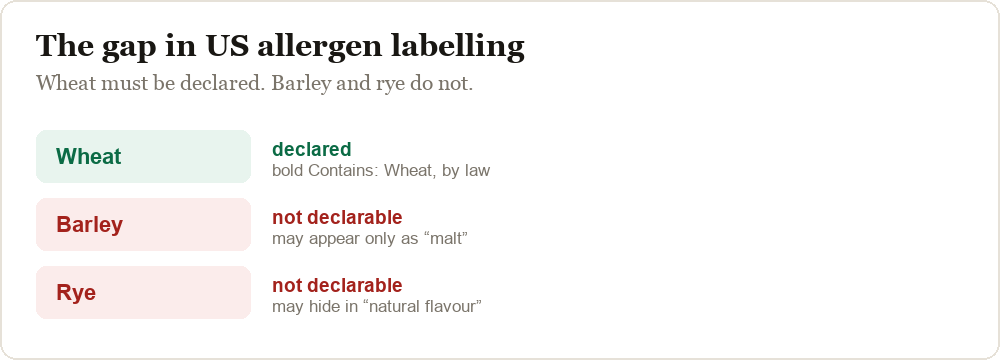
Note the thing that is not in there: malt. Barley malt and malt extract do turn up in breakfast products, and barley is not a FALCPA allergen, so it would not trigger a "contains" warning. It would simply be listed by name. It is not listed here. That is the single most useful check you can make on any pancake syrup, and this one passes it.
Wheat is effectively ruled out by law. Under US allergen labelling rules, a wheat-derived ingredient has to be declared plainly. There is no such statement on Mrs. Butterworth's, and the brand's own site points readers to the FDA's major-allergen list (milk, peanuts, eggs, fish, crustacean shellfish, soy, tree nuts and wheat), as ingredients it discloses. Conagra's stated policy for its syrup brands is that major allergens appear in the ingredient list and/or a "Contains" statement after it.
So what is actually unresolved? Two things. First, "natural and artificial flavors" has no stated source; it is the ingredient screening databases flag when they decline to clear the product. In a corn-syrup product the realistic risk is very low, but it is genuinely undeclared. Second, there is no gluten-free claim and no third-party certification, so nothing has been tested against the 20 ppm threshold for public disclosure. Gluten Free Watchdog lists a test report on this product, but the results sit behind a subscriber wall (we have not seen them, so they are not evidence we can use), and the public listing only records that it is not labeled gluten-free, which is a statement about the packaging, not a failed test.
"Not labeled gluten-free" is not the same as "contains gluten." Plenty of manufacturers decline to make the claim purely to avoid the testing and legal obligations that come with it. That is very likely what is happening here.
How much risk is this?
Celiac disease: low practical risk, unconfirmed status. Syrup is not a category where gluten routinely hides, and this specific panel is clean. If you want it resolved, Conagra's consumer line is on the bottle, ask specifically about the source of the natural and artificial flavors and whether the line runs any wheat-containing product. If you want a syrup you never have to think about, switch to pure maple.
Non-celiac gluten sensitivity: a non-issue.
Wheat allergy: the strongest position of the three. Wheat is a declarable allergen, it is not declared, and Conagra states it discloses major allergens.
The real risk is on the plate, not in the bottle. Syrup goes on pancakes, waffles and French toast, all wheat by default. The bottle is rarely what gets you; the shared toaster, the pancake griddle and the diner's batter are.
What to have instead
If you want a syrup where the answer is unambiguous:
- Pure maple syrup, any brandOne ingredient: maple sap, boiled. It is the cleanest possible answer to this question and the whole category is safe. Look for "100% pure maple syrup" rather than "maple-flavored syrup," which is the same kind of corn-syrup product as Mrs. Butterworth's.
- Log CabinThe direct competitor, also Conagra, same table-syrup category, check the specific bottle, because the range includes an all-natural line with a shorter panel.
- Certified gluten-free pancake syrupsYesSeveral smaller brands carry a GFCO seal; the seal is worth more than any ingredient panel because it means the finished product was tested.
- Honey, agave, date syrup, golden syrupAll single-ingredient or near-single-ingredient sweeteners with nothing to hide.
And the part that actually matters: pair whatever you pour with certified gluten-free pancake mix (Pamela's, King Arthur Measure for Measure, Bob's Red Mill and Birch Benders all make one), and a clean pan. Any conventional pancake or waffle mix is wheat flour, full stop.
Related questions
Is maple syrup gluten-free? Yes, universally. Pure maple syrup is boiled tree sap and nothing else. Flavoured or infused maple syrups are a separate check, and "pancake syrup" is not maple syrup at all.
Is Log Cabin syrup gluten-free? Same manufacturer, same category, same situation: corn-syrup based with no gluten grain listed. Check the specific bottle for a gluten-free claim rather than assuming it carries one.
Is Aunt Jemima / Pearl Milling Company syrup gluten-free? Also a corn-syrup table syrup with no gluten grain in the standard formulation. Treat it exactly as this page treats Mrs. Butterworth's: read the panel, look for malt, and note whether a gluten-free claim is present.
Is caramel color gluten-free? In North America it is made from corn, and even where barley malt is used as a starting material, the processing leaves gluten below detectable levels. It is not considered a risk ingredient by the major celiac organisations.
Why doesn't Conagra just say it's gluten-free? A gluten-free claim is a regulated statement that obliges the manufacturer to verify ingredients and test finished product against a 20 ppm limit. Many companies skip the claim on products where it isn't a selling point, rather than carry the compliance burden. Silence usually means indifference, not risk.
Are the pancakes the bigger problem? Yes, by a wide margin. The syrup question is almost always the wrong question, the batter, the shared griddle and the same-toaster waffle are where a gluten-free breakfast actually fails.
How we checked
| Source | Tier |
|---|---|
| Conagra SmartLabel entry for Mrs. Butterworth's Original Syrup, manufacturer's own ingredient/allergen disclosure page, but an ingredient listing rather than a gluten statement; no gluten-free claim retrieved | C |
| Gluten Free Watchdog, Mrs Butterworth's Original Syrup, NOT LABELED GF, public screening listing, test result subscriber-only | D |
| Gluten Free Watchdog, Mrs. Butterworth's manufacturer page, public screening listing | D |
| Published ingredient panel; FDA allergen labelling rule requiring wheat to be declared | C |
| Spoonful and AllergenInside ingredient databases | D |
| Conagra, no published gluten-free statement located for this product | n/a |
Overall source tier: C, verdict unverified. Everything on this page is a label. Conagra's SmartLabel entry is the manufacturer's own page, but it discloses ingredients and allergens without ever addressing gluten, which makes it tier C rather than tier A. No national celiac organisation has ruled on this product, and the Gluten Free Watchdog entries (a paywalled screening database, not a celiac organisation), tell us only what the packaging already says. So we are not going to print "yes" on the strength of an ingredient panel alone when the manufacturer has declined to make the claim itself. The evidence supports "no gluten ingredient"; it does not support "gluten-free." If Conagra issues a gluten-free statement or adds the claim to the label, this page moves to tier A and the verdict changes.
Last verified: 10 August 2026. Conagra reformulates and relabels without notice, and this product already ships in more than one ingredient configuration. The bottle in your hand outranks this page.