Ingredients · Category-wide
Is natamycin gluten-free?
A soil bacterium ferments it on a sugar and starch medium, not on grain. Read the anti-caking agent next to it.
- Evidence
- CPublished label or regulation
- Last checked
- 2026-08-23
- Varies by country
- No
Source sargento.com+6 more
Why
For anything made by fermentation, the honest question is never "does the organism contain gluten." It is "what was the organism grown on." That is the right instinct, it is the reason brewer's yeast is unsafe and baker's yeast is not, and it deserves a real answer here rather than a shrug.
What natamycin is. A polyene macrolide, also called pimaricin, with the formula C33H47NO13. It inhibits yeasts and moulds by binding ergosterol in fungal cell membranes, and it is the only antifungal food additive with GRAS status in the US. In Europe it is E235. The same molecule is used medically as an eye drop for fungal keratitis, sold as Natacyn.
How it is made. Submerged fermentation in stirred tanks. A 2019 paper in Bioresource Technology puts it flatly: "At present, submerged fermentation (SmF) is the unique approach for natamycin production." Several Streptomyces species are used: S. natalensis, S. gilvosporeus, S. chattanoogensis and S. lydicus.
What the medium is made of, which is the part that matters. A production patent for the process specifies "about 80-250 g/l of a metabolizable carbon source," which "may be supplied in any expedient form such as glucose, polysaccharide, corn and potato starches, etc.," and a protein nitrogen source built from soy protein products, beef extract or protein hydrolysates such as peptones. It does not mention wheat, barley or rye anywhere. A published laboratory medium for S. natalensis is glucose, yeast extract, beef extract and DL-asparagine. After fermentation the broth is filtered and the natamycin extracted, purified and dried to a crystalline powder.
Corn starch, potato starch, glucose, soy, beef extract, yeast extract. None of the named media components is a gluten grain, which is why natamycin sits in a different category from brewer's yeast even though both are fermentation products.
The edge worth naming, since we said we would answer this properly. That same 2019 paper is the reason to be careful with the word "never." It set out to produce natamycin by solid-state fermentation on cheap agro-industrial residues instead, and its best result came from "a substrate mixture containing wheat bran, rapeseed cake, rice hull and crude glycerol." The authors are explicit about what that is: "To our best knowledge, this is the first report on natamycin production through SSF process." So a wheat-fed route exists in the literature, it is a research route rather than a production route, and the same paper states that submerged fermentation is the approach actually used. It is not how the natamycin on a bag of shredded cheese was made. The point of mentioning it at all is that the substrate question is a real question with a real answer, and if you are formulating a certified gluten-free product rather than shopping for one, the answer you want is a supplier's certificate rather than a general article.
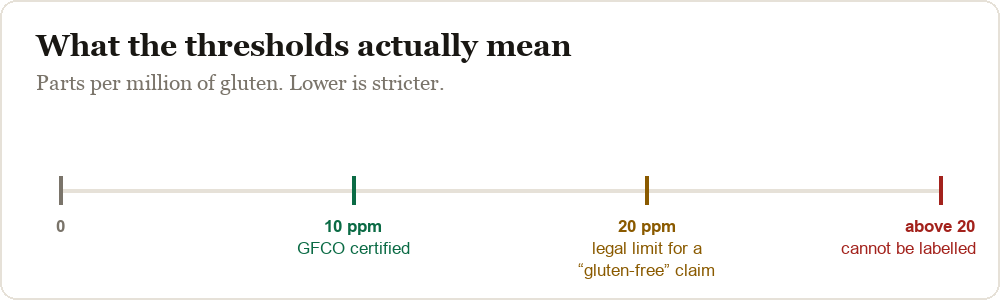
Where it is allowed and at what level. In the US, 21 CFR 172.155 permits natamycin on cheese as an antimycotic at up to 20 milligrams per kilogram, that is 20 parts per million, in the finished product. The earlier version of that rule spelled out two delivery methods, and one of them matters here: it could be applied as a dry mix containing the additive together with safe and suitable anti-caking agents, or by dipping or spraying with an aqueous solution at 200 to 300 ppm. The FDA later replaced the method-specific limits with a single limit on what remains in the finished cheese.
The carrier, which is where the question actually lives
That dry-mix delivery is the reason natamycin almost never appears alone on a label. It arrives blended with a bulking or anti-caking agent, and on a bag of shredded cheese it sits in a list alongside one.
In practice those agents are powdered cellulose, potato starch, corn starch, calcium sulfate or salt. dsm-firmenich's DelvoCid Salt, one of the standard commercial formats, is 50% natamycin with a sodium chloride bulking agent.
Named brands publish on this, and it is the strongest evidence available:
- Sargento states that it uses powdered cellulose or potato starch as anti-caking agents on some of its cheeses, that powdered cellulose is "not derived from wheat, rye, barley, or their cross-bred hybrids", and that gluten is found in wheat, rye and barley, ingredients not generally found in natural cheeses. It also names which of its products do contain gluten, the Balanced Breaks varieties with crackers, which is the sort of specificity worth rewarding.
So on a shredded cheese panel, natamycin is not the risk and the anti-caking agent is not usually the risk either. What genuinely deserves a look on a cheese label is a flavoured or blended product, where seasonings and coatings come in, and any "may contain" statement.
One more place you will meet it. Natamycin is also used on the casings of dried cured sausage, and in some jurisdictions in yogurt, wine and juice. Same molecule, same answer, and the same instruction to read the rest of the panel.
How much risk is this?
Celiac disease: natamycin is not a gluten risk. On the products it appears in, the useful attention goes to flavoured shreds, cheese blends and the "may contain" line rather than to the preservative.
Non-celiac gluten sensitivity: no gluten issue.
Wheat allergy: no wheat in the standard commercial process. If you are sourcing bulk natamycin as a manufacturer, ask for the substrate and the allergen declaration in writing.
Soy allergy and vegan diets, which are the real ingredient questions here: the nitrogen source in the published media is soy protein, beef extract or a peptone hydrolysate, depending on the process. The natamycin is purified out of that broth, but if soy or animal-derived inputs matter to you, this is the additive where the question is legitimate. It is a different question from gluten and it gets a different answer.
Cross-contact: natamycin is produced in fermentation plants and used at parts per million. The realistic cross-contact question belongs to the cheese packaging line, not to the preservative.
What to have instead
There is nothing to avoid here on gluten grounds. If you want to avoid the additive itself, which some people do for taste or for a shorter ingredient list, these are the routes.
- Shred it yourself from a blockThe single most effective swap. Block cheese is milk, cultures, salt and enzymes, with no anti-caking agent and no mould inhibitor, and it melts better. It is also cheaper per kilo.
- Fresh mozzarella, wedges, and cheese cut at a counterSame principle.
- Brands that publish an anti-caking positionSargento names its agents and addresses gluten directly, which is more than most. When a brand tells you what is on the cheese and why, that is worth choosing.
- Cheeses sold without potato starch, cellulose or natamycinA small number of dairies market on exactly this, and their shredded products carry a short panel.
- Waxed or rindless hard cheeseAvoidIf what you actually want to avoid is the natamycin used as a surface treatment on a rind. The rind is where it sits, and most people do not eat it.
Genuinely check on a cheese label: flavoured and seasoned shreds, cheese blends and dips, and any "may contain wheat" statement. Those are the real gluten questions in the dairy aisle, and none of them are the natamycin.
Related questions
Is E235 gluten-free? Yes. E235 is natamycin, the same substance under its European number, permitted as a surface treatment on hard, semi-hard and semi-soft cheese and on dried cured sausage.
Is the natamycin on shredded cheese a gluten risk? No. It is present at up to 20 parts per million and is fermentation-derived. What deserves the attention is the anti-caking agent (usually powdered cellulose or a potato or corn starch, all gluten-free) and, more than either, whether the cheese is flavoured.
Is natamycin vegan? The molecule is bacterial, but the fermentation medium is a fair question: a production patent lists soy protein products, beef extract or peptones as the protein nitrogen source, and one published laboratory medium uses beef extract. Purification removes the medium, and different manufacturers use different media. If this matters to you, ask the supplier rather than assuming either way.
Is natamycin an antibiotic, and does that matter? It is an antifungal antibiotic in the technical sense, active against yeasts and moulds and not against bacteria. Because it is not used systemically in human medicine for bacterial infection, it is not part of the antibiotic resistance argument people sometimes attach to it. It is also poorly absorbed from the gut. None of this is a gluten question.
Is cheese gluten-free generally? Plain natural cheese is: milk, cultures, salt and rennet. The gluten questions in a dairy aisle are flavoured and blended cheeses, cheese spreads and dips, anything with a coating or a crumb, and beer- washed or beer-flavoured cheeses, which are a real category and genuinely are not safe.
How do I confirm this for a product I am manufacturing? Ask the natamycin supplier for the fermentation substrate, the carrier or bulking agent in the specific grade, an allergen declaration and a certificate of analysis. The carrier is the part that varies between grades; the fermentation is the part that does not.
How we checked
| Source | Tier |
|---|---|
| Sargento FAQ: "We use powdered cellulose or potato starch as anti-caking agents on some of our cheeses"; powdered cellulose is "not derived from wheat, rye, barley, or their cross-bred hybrids"; "Gluten is found in wheat, rye and barley; ingredients not generally found in natural cheeses" | A |
| Celiac Disease Foundation, Sources of Gluten, natamycin absent from both the gluten-containing and the questionable lists | B |
| 21 CFR 172.155, Natamycin (pimaricin) (eCFR), permitted on cheese at not more than 20 mg/kg in the finished product; the superseded text permitted application as a dry mix with anti-caking agents, or by dip or spray at 200 to 300 ppm | C |
| US5231014A, fermentation process for producing natamycin, carbon source "may be supplied in any expedient form such as glucose, polysaccharide, corn and potato starches, etc."; protein nitrogen from soy protein products, beef extract or peptones; no mention of wheat, barley or rye | C |
| Enhanced natamycin production by Streptomyces natalensis (PMC6636160), production medium of glucose, yeast extract, beef extract and DL-asparagine | C |
| dsm-firmenich Delvo Cid, natamycin from Streptomyces natalensis; the DelvoCid Salt format is 50% natamycin with a sodium chloride bulking agent | C |
| Zeng et al., Bioresour Technol 2019 (PMID 30453252): "At present, submerged fermentation (SmF) is the unique approach for natamycin production"; best solid-state result from "a substrate mixture containing wheat bran, rapeseed cake, rice hull and crude glycerol"; "this is the first report on natamycin production through SSF process" | C |
| EU additive number E235, permitted as a surface treatment on cheese and dried cured sausage | C |
Overall source tier: C. No national celiac organisation publishes a dedicated ruling on natamycin, so there is no tier-B document to point at. The verdict rests on the published commercial fermentation route, the US regulation that governs its use, and a brand-level gluten statement from one of the largest users of it. We have named the one published route that does involve a gluten grain rather than leaving it out, because the substrate is the reader's actual question and the answer holds anyway.
Last verified: 23 August 2026. Fermentation media and carrier blends are supplier decisions and can change. Cheese products get reformulated often. The label in your hand outranks this page, and on a bulk ingredient the supplier's certificate outranks both.