Alcohol · Sapporo Holdings
Is Sapporo beer gluten-free?
Sapporo's own site states barley malt is used in all Sapporo beers and that it is unsuitable for celiac disease.
- Last checked
- 2026-08-10
- Varies by country
- Yes
Source sapporobeer.com+3 more
Why
Sapporo is unusual among the beers people ask about, because the brewer has pre-empted the question on its own website rather than staying silent.
The manufacturer's statement is explicit. Sapporo's "How Sapporo Beer Is Made" page lists four core ingredients (barley malt, hops, water and yeast), describes barley malt as providing the beer's body and subtle sweetness, and states that barley malt is used for the grains of all Sapporo beers. It then says directly that barley contains gluten and Sapporo is not suitable for those with celiac disease or gluten sensitivity. There is nothing left to interpret.
Sapporo also debunks its own rice myth. Sapporo Premium is routinely described in bars and beer lists as a "rice lager," and that description is doing real harm to people who assume rice means gluten-free. Sapporo's site says plainly that its beer is not brewed with rice. Even where a Sapporo product in another market does include rice as an adjunct, rice would sit alongside the barley malt rather than replace it, and the malt is the problem.
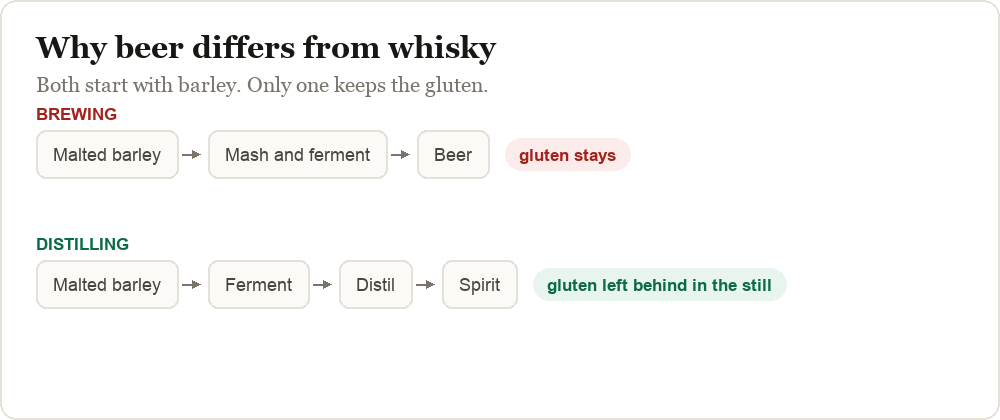
Brewing does not remove gluten. Distilled spirits made from barley are considered gluten-free because gluten proteins do not vaporise and stay behind in the still. Beer is never distilled. Whatever barley protein went into the mash is still in the glass.
Independent testing points the same way. A beer-testing project ran a North American-brewed Sapporo Premium and logged a "very high positive" result at the 20 ppm threshold, well above the gluten-free limit. That is consistent with a conventional barley lager, and unlike the borderline readings that circulate for some other light lagers, it is not a result anyone is arguing about.
A specific piece of misinformation to discard. You may find pages claiming Sapporo uses a "unique gluten-free strain of barley malt," or that a sorghum-based gluten-free Sapporo exists. Neither is supported by anything from the brewer. No barley malt is gluten-free.
Where it varies
Sapporo is brewed in several countries and the adjunct grains genuinely differ. The verdict does not.
| Market | Reported grain bill | Verdict |
|---|---|---|
| United States / Canada | Barley malt, hops, water, yeast, brewer states no rice | Not gluten-free |
| Japan (e.g. Black Label) | Malt plus rice, corn and starch adjuncts | Not gluten-free, malt still present |
| Vietnam-brewed export stock | Barley malt base | Not gluten-free |
Sapporo products sold in the US are brewed in the US, Canada and Vietnam, so the can in front of you may not have come from Japan. It makes no difference to the answer: every version starts with malted barley.
How much risk is this?
Celiac disease: avoid entirely. This is a full-gluten beer with a manufacturer warning attached.
Non-celiac gluten sensitivity: avoid, for the same reason.
Wheat allergy: Sapporo's grain is barley, not wheat, so strictly this is a different question, but barley cross-reactivity is common enough that this is one for your allergist.
Gluten-free by preference: entirely your call, but there is no low-gluten angle here to lean on.
What to have instead
The realistic scenario is that you are in a Japanese restaurant or an izakaya holding a menu with four beers on it, none of them safe. Here is what actually works:
- Sake, order it with confidenceRice, water, koji and yeast. Beyond Celiac lists sake as gluten-free. Junmai grades have the shortest ingredient list of all. This is the single best swap in a Japanese restaurant.
- ShochuAvoidDistilled, so gluten-free whatever the base. If you would rather avoid barley at source entirely, ask for imo (sweet potato) or kome (rice) shochu rather than mugi (barley).
- Umeshu (plum wine)For something sweeter, usually built on a distilled or sake base.
- Glutenberg Blonde or Ghostfish BrewingDedicated gluten-free breweries using millet and buckwheat, if what you actually want is beer.
- New Grist Pilsner (Lakefront)Sorghum and rice; the most lager-like of the widely stocked gluten-free options and the nearest thing to a Sapporo shape.
- Hard ciderGluten-freeNaturally gluten-free and stocked almost everywhere.
Asahi and Kirin, which are also barley beers with the same verdict, and any "gluten-removed" beer. Enzyme-treated barley beers are not certified by GFCO and the Celiac Disease Foundation does not consider them established as safe. And the bigger point in a Japanese restaurant: the beer is not the main hazard. Standard shoyu soy sauce is brewed with roughly equal parts wheat and soybean, and it is in the dipping bowl, the teriyaki, the ramen broth and the eel sauce. Ask for tamari and ask about the fryer.
Related questions
Is Sapporo a rice beer? No, not the US product. Sapporo's own site says it is not brewed with rice, despite the reputation. Some Japanese-market Sapporo products do use rice as an adjunct, but always alongside malted barley.
Is Asahi gluten-free? Is Kirin? No to both. All the major Japanese lagers are barley-based, and none carry a gluten-free claim.
Is Sapporo Premium Black different? No. Sapporo states barley malt is used across the entire range, and Premium Black is described on the official site as crafted from select barley and hops.
Is Sapporo Non-Alcoholic gluten-free? No. Removing the alcohol does not remove the barley protein, dealcoholised beers generally start life as ordinary beer.
Does the Japanese "happoshu" or low-malt category help? Not for celiac purposes. Happoshu reduces the proportion of malt for tax reasons, not the presence of gluten, and the remaining grain bill still typically includes malt.
What about the 20 ppm figure people quote for light lagers? It does not apply here. The independent test on Sapporo came back very high positive, and in any case gluten testing on fermented barley products is not considered reliable by the FDA.
How we checked
| Source | Tier |
|---|---|
| Sapporo, How Sapporo Beer Is Made, "Barley contains gluten, which means Sapporo isn't suitable for those with celiac disease or gluten sensitivity" | A |
| Celiac.com, Is Sapporo Gluten-Free?, a commercial publisher and forum, not a celiac organisation | D |
| Difford's Guide, Sapporo Premium, allergen declaration "contains cereals containing gluten" | C |
| Gluten in Beer, Sapporo, independent test, very high positive at 20 ppm | D |
Overall source tier: A. Sapporo publishes both the grain bill and an explicit celiac warning on its own website. That is as clean as evidence on this site gets, and it stands on its own: no celiac organisation has needed to rule on Sapporo, and the secondary sources below (a commercial gluten-free publisher, a drinks reference and a testing blog), only agree with the brewer.
Last verified: 10 August 2026. Sapporo is brewed in multiple countries and recipes differ by market. The label on the can in your hand outranks this page.