Candy & chocolate · Category-wide: Great Value, Plymouth Pantry, store brands
Is almond bark gluten-free?
Unconfirmed. No brand publishes a gluten statement. Buy only a block printed gluten free, or melt certified Pascha or Enjoy Life chips.
- Evidence
- CPublished label or regulation
- Last checked
- 2026-08-10
- Varies by country
- No
Source paschachocolate.com+4 more
Why
First, clear up what you are buying. Almond bark in a supermarket usually contains no almonds and no chocolate. It is a melting coating sold in a scored block or in discs, designed to set hard at room temperature without tempering. The name describes the finished look, a slab you snap like tree bark, not the contents. Homemade "almond bark" (real chocolate plus toasted almonds) is a different thing entirely, and its gluten status is whatever the chocolate's is.
The base formula has no gluten in it. The Great Value vanilla block, the most widely bought version in the US, lists sugar, hydrogenated palm kernel oil, nonfat dry milk, soy lecithin and natural flavour, with milk as the only declared allergen. Nothing there is wheat, barley or rye. Walmart's own product listing describes the block as gluten-free and kosher.
But the evidence is not clean, and you should know that. Instacart's listing for the same 24 oz vanilla block does not flag it gluten-free, and at least one ingredient-screening database rates it "may or may not be" because "natural flavour" has no stated source. Two retail listings for one product disagreeing is exactly the situation where a page should not round up to "yes." The manufacturer, Walmart's private-label supplier, publishes no gluten statement of its own.
The real variables are three:
- Chocolate versions are riskier than vanilla. Chocolate-flavoured coating adds cocoa and, in some formulations, malt or a chocolate flavour blend. Malt is barley. It is uncommon in coating but not unheard of.
- "Natural flavour" and "artificial flavour" are unsourced. In practice these are almost never gluten carriers in a fat-based coating, but they are the reason screening tools hedge.
- Shared lines. Coating is made in plants that also run cookie coatings, pretzel coatings and yogurt-covered products. A "may contain wheat" advisory on some brands is a live signal, not boilerplate.
Nobody in this category is certified. There is no GFCO-certified mainstream almond bark. The strongest evidence available is a retailer descriptor and an ingredient panel, tier C, not tier A. That is why this page is unverified rather than depends: there is no axis to sort the category by, no brand that reliably passes and no brand that reliably fails. There is simply nobody who has answered.
How to resolve this yourself, two routes, in order.
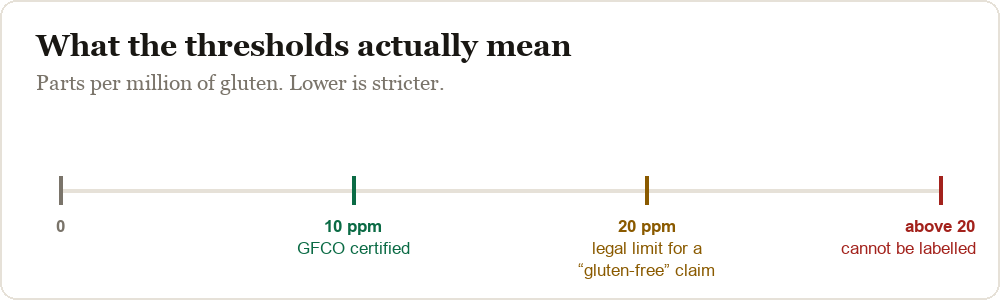
- Read the front of the block, not the ingredient panel. A printed "gluten free" claim on a US pack is legally binding under the FDA rule at under 20 ppm, and it is the only thing in this category that carries a commitment. The panel tells you what went in; the claim tells you the maker stands behind it. If the claim is there, you are done. This is the one case where an
unverifiedpage resolves at the shelf. - If it isn't there, ask the brand owner, not the shelf. For Great Value that is Walmart, whose consumer care number is printed on the block itself; Walmart's help centre at walmart.com/help is the online route. Quote the UPC and the lot code, private-label coating is made by contract manufacturers and the answer can differ by plant, and ask three things: is the "natural flavour" derived from wheat, barley or rye; is the block made on a line that also runs wheat-containing coatings, biscuit pieces or cookies-and-cream coating; and has the finished product been tested below 20 ppm? Ask which co-packer made your lot, too: if they name one, you can ask them directly.
Anything short of those two is guesswork, and this page will not dress guesswork up as a verdict.
How much risk is this?
Celiac disease: the ingredient risk is low, the disclosure is absent. If the block in front of you carries a printed "gluten free" claim, that claim is legally binding under the FDA rule (under 20 ppm) and you can rely on it. If it does not, you are relying on the absence of a gluten ingredient, which does not cover shared equipment, and nobody has told you what runs on that equipment. Almond bark is also usually eaten in quantity, coated pretzels, a whole tray of dipped things: so this is not a trace-exposure-once scenario. For a bake sale or a coeliac child, use a certified coating rather than an unverified one.
Non-celiac gluten sensitivity: the plain vanilla and chocolate coatings are fine in practice.
The bigger practical hazard is what you dip. Almond bark is a coating. The pretzels, biscuits, wafers and cereal going into it are far more likely to be the gluten source than the bark itself. Coat gluten-free items and you have removed most of the risk in this recipe.
Milk allergy: note that almost every commercial almond bark contains nonfat dry milk. It is not dairy-free, despite the name suggesting a nut product.
What to have instead
If you want a melting coating with better documentation:
- Enjoy Life Semi-Sweet Mega Chunks or Mini ChipsDependsMade in a dedicated gluten-free facility and free from the major allergens. Melt with a teaspoon of neutral oil per cup and they behave close enough to coating for dipping.
- Pascha chips, including the vegan white baking chipsUnverifiedPascha states its white baking chips are gluten free and "free from peanuts, tree nuts, gluten, wheat, soy, dairy, sesame, refined sugar, palm oil, and emulsifiers", a manufacturer statement addressing gluten directly, which is exactly what almond bark lacks. Rice-based, so they melt and set like a coating.
- Ghirardelli melting wafersWidely stocked and made for dipping, check the bag, because the range is large and not every item carries the claim.
- Real chocolate plus coconut oilA certified gluten-free dark chocolate bar chopped and melted with a spoonful of refined coconut oil sets nearly as firmly as coating and tastes considerably better.
- Wilton Candy MeltsSame functional category as almond bark, and the packs do carry allergen labelling, read the specific colour, as they differ.
cookies-and-cream or "birthday cake" flavoured coating discs, which contain biscuit pieces, and any coating whose pack carries a "contains wheat" or "may contain wheat" advisory.
Related questions
Is Great Value almond bark gluten-free? Unverified. Walmart's listing describes the vanilla block as gluten-free and the ingredient panel contains no gluten, but another retail listing for the identical item does not carry the flag and there is no manufacturer gluten statement. Retail metadata is not a label. Read the physical package: if the printed claim is there it is reliable, and if it isn't, call the number on the block and ask about the natural flavour and the shared line.
Is chocolate almond bark gluten-free? More often than not, but check for malt, malt extract or malt flavouring in the ingredient list. Those are barley-derived and rule the product out.
Is almond bark the same as white chocolate? No. White chocolate must contain cocoa butter; almond bark uses palm kernel oil instead, which is why it costs less and melts more forgivingly. Neither contains gluten by nature.
Does almond bark contain almonds? Usually not. The commercial vanilla and chocolate blocks are almond-free coatings. If you have a tree-nut allergy, still check, some brands run the same line as nut products and carry a "may contain tree nuts" advisory.
Is almond bark dairy-free? No. Nonfat dry milk is a standard ingredient in the mainstream blocks.
Can I use almond bark for a gluten-free bake sale? Only if the pack carries a printed gluten-free claim and you dip only gluten-free items. Without the printed claim you are serving an unverified product to people who cannot check it themselves, use a certified coating instead. The dipped pretzels are the thing that will get you, not the coating.
How do I settle this for the block I'm holding? Look at the front first: a printed "gluten free" claim is binding under the FDA rule and ends the question. If there is none, ring the consumer care number printed on the block (for Great Value that is Walmart, also reachable at walmart.com/help), quote the UPC and lot code, and ask whether the natural flavour is wheat-, barley- or rye-derived, whether the line also runs wheat-containing or biscuit coatings, and whether the finished block is tested below 20 ppm.
How we checked
| Source | Tier |
|---|---|
| Great Value Almond Bark Vanilla, Walmart listing, described as gluten-free and kosher | C |
| Published ingredient panel, sugar, hydrogenated palm kernel oil, nonfat dry milk, soy lecithin, natural flavour; milk the only declared allergen | C |
| Instacart listing for the same product, does not carry the gluten-free flag | C |
| Glutenfreeda, secondary coverage | D |
| Pascha vegan white baking chips, manufacturer states "Gluten Free" and free from gluten and wheat; cited as the documented alternative, not as evidence about almond bark | A |
| Manufacturer gluten statement for almond bark, none located for any mainstream brand; no GFCO or other certification in the category | n/a |
| Source of the "natural flavour" in the Great Value block, not declared, and not published by the private-label supplier | n/a |
Overall source tier: C, verdict unverified. No brand in this category publishes a gluten statement and none is third-party certified. Two retail listings for the identical product disagree on the gluten-free flag, and retail metadata is not a label. That is missing evidence, not a variation. There is no axis here that would let a reader sort good brands from bad, which is why this is unverified rather than depends. The ingredient panel is clean; the disclosure does not exist. The one thing that does resolve it is a printed gluten-free claim on the block, because that claim is legally enforceable at 20 ppm. If a mainstream almond bark brand publishes a gluten statement, this page changes.
Last verified: 10 August 2026. Coating formulations and plant allocations change between seasons. This is a heavily seasonal product. The block in your hand outranks this page.