Candy & chocolate · Category-wide
Is white chocolate gluten-free?
Unconfirmed for mainstream bars. Buy Lily's (GFCO certified), Pascha or Nestlé Toll House Premier White, which are labelled gluten-free.
- Evidence
- CPublished label or regulation
- Last checked
- 2026-08-10
- Varies by country
- Yes
Why
This page has to separate two things that readers constantly merge: whether gluten is in the product, and whether the factory can keep it out. The first is settled. The second is unanswered for every big-name bar, and an unanswered question is unverified, not depends, because there is no rule the recipe gives you that sorts the safe brands from the rest. Only the brand's own paperwork does that, and below is how to get it.
The composition is unambiguous. Cocoa beans are ground to a liquor, which is pressed into cocoa butter and cocoa solids. White chocolate takes the cocoa butter, leaves the solids behind, and adds sugar, milk solids, an emulsifier, usually soy lecithin, and vanilla. Ghirardelli's white chocolate baking bar panel, for instance, reads sugar, cocoa butter, nonfat dry milk, milkfat, soy lecithin and vanilla extract. Nothing on that list has ever been near a cereal grain.
So why is white chocolate the awkward one? Because of what it gets paired with. White chocolate is the standard coating and inclusion medium for biscuit, wafer, cookie-and-cream, pretzel and cereal-crisp products. A plant making plain white bars very often makes cookies-and-cream bars on the same enrobing line the next shift. Milk chocolate has this problem too; white chocolate has it more, because the pale, sweet flavour profile suits biscuit pairings.
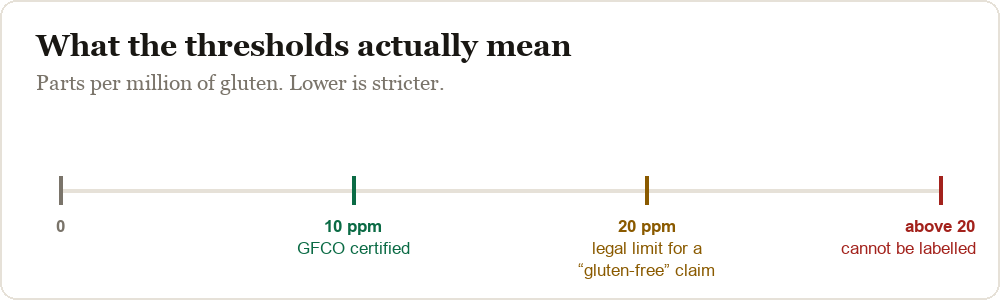
Rice crisps are the sleeper ingredient. Crisped-rice white chocolate looks gluten-free on the face of it, but crisped rice is very commonly malted with barley for flavour. Under UK and EU rules barley malt extract must be declared, so it will be visible; under US rules only wheat is a mandatory allergen declaration, so barley-derived malt can sit inside "natural flavors". Coeliac UK's guidance is that a product with a small amount of barley malt extract can still be suitable if the finished product is under 20 ppm, but that only helps you if the pack carries a gluten-free claim or is listed in their directory.
The big brands mostly won't confirm. This is the honest finding, and it differs by brand rather than by recipe:
- Ghirardelli certifies nothing gluten-free. Its plain chocolate generally carries no gluten ingredient, but it produces on shared equipment that also handles wheat and says so in its allergen statement. Its double and triple chocolate hot cocoa mixes contain wheat flour outright. One gluten-free blog also reports wheat-derived maltodextrin on the classic white baking bar; the retail panel we found doesn't list it, so check the bar in front of you.
- Lindt is the most contested. Its US white bar panel lists sugar, cocoa butter, milk, skim milk, soy lecithin and artificial flavour, clean. But UK coeliac community reports describe barley malt extract across parts of the range and a letter from the company saying none of its chocolate is gluten-free. We could not obtain that letter, so we report it as an unverified user account, not a manufacturer statement, but it's why we won't call Lindt white chocolate safe.
- Milkybar (Nestlé, UK). No gluten-containing ingredients in the original, but a may-contain advisory for gluten, so it is not confirmed suitable for coeliacs. Nestlé designates some other Milkybar products gluten-free.
- Green & Black's and Tony's Chocolonely. Both reported to carry may-contain-wheat statements on a number of items. No brand-level gluten-free statement located for either.
A "may contain" line is not a gluten declaration. It is a voluntary advisory about the production line. It does not mean the bar exceeds 20 ppm, and it is not evidence that gluten is present. It is a manufacturer telling you it hasn't validated the absence.
How to resolve this yourself, two ways, and the first is easier.
- Switch to a brand that has already answered. Lily's states that "all of LILY'S chocolate bars, baking chips and bars, and gummies are certified Gluten-Free by GFCO", which covers its white chocolate style range. Pascha states its vegan white baking chips are gluten free and "free from peanuts, tree nuts, gluten, wheat, soy, dairy, sesame, refined sugar, palm oil, and emulsifiers". Nestlé Toll House Premier White Morsels carry a gluten-free claim on pack. That is the whole resolution for most readers: three products whose makers have gone on record, versus a category that hasn't.
- Make your brand answer, in writing. Every big chocolate maker publishes a consumer contact route, and the wrapper carries one. Ask three questions about the specific bar, quoting the barcode, vague questions get the standard "we cannot guarantee" reply:
- Is this bar produced on a line or in a facility that also runs wheat-containing product (biscuit, wafer, cookies-and-cream), and is the line cleaned and verified between runs?
- Do the flavourings or any crisped-rice inclusion contain barley malt extract? In the US this need not be declared, so the panel cannot tell you; in the UK and EU it must be.
- Is the finished bar tested to below 20 ppm gluten? A yes with a number is the only thing that converts this page's verdict for that brand.
In the UK there is a shortcut: search the barcode in Coeliac UK's Food and Drink Information, a members' database of over 185,000 products built from manufacturer responses. If a bar is listed as suitable there, a manufacturer has answered for it. If it is absent, no answer exists, which is the position Milkybar, Lindt and Green & Black's white chocolate are in today.
Where it varies
| Product | Status |
|---|---|
| Lily's white chocolate style bars and baking chips | Certified gluten-free (GFCO), strongest documentation available |
| Nestlé Toll House Premier White Morsels | Labelled gluten free on pack; a manufacturer claim, not third-party certified, and we have it from the pack as shown in retail listings, not from a Nestlé gluten statement |
| Pascha organic vegan white baking chips and bar | Stated gluten free by Pascha, and stated free from gluten and wheat; rice-based rather than dairy-based |
| Ghirardelli white bars, chips, baking bars | No gluten ingredient on the panel; shared equipment with wheat, no certification |
| Lindt white chocolate (US panel) | No gluten ingredient listed; brand-level assurance disputed, treat as unverified |
| Milkybar original (UK) | No gluten ingredient; may-contain advisory for gluten |
| Cookies-and-cream, biscuit, crisp or pretzel white chocolate | Assume not gluten-free unless labelled |
| White chocolate coatings on bakery, ice cream and pretzel counters | Assume cross-contact |
How much risk is this?
Celiac disease: plain white chocolate is not something to fear, but buy a brand that has done the work. There are three, so there is no reason to gamble. Certified is best; a printed "gluten free" claim is next; a clean panel with a shared-equipment advisory is unverified, and you are deciding for yourself. What you should not do is treat "cocoa butter is gluten-free" as settling the question for a specific bar, that reasoning is about the ingredient, and your exposure is about the line.
Non-celiac gluten sensitivity: a clean ingredient panel is almost certainly enough. Shared-equipment traces are unlikely to be symptomatic at this level.
Wheat allergy: the panels are clean, so this comes down to how you weigh may-contain statements, which for allergy, unlike coeliac disease, is dose-independent and worth taking seriously.
Baking with it: chips are the higher-risk format, sharing equipment and bulk handling with cookie and brownie production far more than bar chocolate does. This is where a certified brand earns its price.
What to have instead
If you want white chocolate with the question actually answered:
- Lily's white chocolate style bars and baking chipsUnverifiedAll Lily's chocolate is GFCO certified. Stevia- and erythritol-sweetened, so it tastes different, but it's the cleanest documentation in the category.
- Pascha organic vegan white baking chips and white barPascha states they are gluten free and "free from peanuts, tree nuts, gluten, wheat, soy, dairy, sesame, refined sugar, palm oil, and emulsifiers", a manufacturer statement addressing gluten head-on. Rice-based rather than dairy-based, so the flavour is different, but it is the pick if cross-contact rather than the ingredient list is your concern.
- Nestlé Toll House Premier White MorselsDependsAn on-pack gluten-free claim, widely stocked and cheap, the practical baking choice. A manufacturer claim, not a third-party seal, and one we can only show you through the pack itself: Nestlé's product page for these morsels doesn't address gluten, so read the bag.
- Ghirardelli white baking bars and chipsIf you want the flavour and can accept a shared-equipment advisory. No gluten ingredient; no certification.
- Compartés and other small-batch makersThat publish an explicit gluten-free collection.
Skip: any white chocolate with cookie, biscuit, wafer, pretzel, malt or crisped-rice inclusions unless the pack says gluten-free, white chocolate coatings applied in-store, and white chocolate hot cocoa and drinking-chocolate mixes, which routinely contain wheat flour or malt.
Related questions
Are white chocolate chips gluten-free? By ingredient, yes. By brand, check, baking chips are made in plants that also handle cookie and brownie production. Lily's is GFCO certified; Nestlé Toll House Premier White Morsels carry an on-pack gluten-free claim, which is the pack speaking rather than a published Nestlé statement.
Is Milkybar gluten-free? Not confirmed. The original contains no gluten-containing ingredient but carries a may-contain advisory for gluten, so Nestlé does not present it as suitable for coeliacs. Some other Milkybar products are designated gluten-free, check the specific one.
Is Ghirardelli white chocolate gluten-free? No gluten ingredient, no certification. Ghirardelli certifies nothing gluten-free and notes shared equipment with wheat in its allergen statement. Its hot cocoa mixes are a separate matter, several contain wheat flour.
Is Lindt white chocolate gluten-free? Unverified, and we'd avoid it if you're strict. The US panel is clean, but UK coeliac community reports describe barley malt extract in parts of the range and a company reply declining to call any Lindt chocolate gluten-free. We could not confirm that reply directly.
Does "may contain wheat" mean I can't eat it? It means the manufacturer hasn't validated the absence of gluten on that line. It is not a statement that gluten is present, and it doesn't imply the product exceeds 20 ppm. For celiac disease it's the conservative default to choose a product without one when a good alternative exists.
How we checked
| Source | Tier |
|---|---|
| Lily's FAQs, all bars and baking chips certified gluten-free by GFCO | A |
| Pascha organic vegan white baking chips, manufacturer gluten-free and dedicated-facility allergen statement | A |
| Coeliac UK, Food and Drink Information, members' database of manufacturer-confirmed products; the UK route to resolving an unconfirmed brand | B |
| Nestlé Toll House Premier White Morsels, product page, no gluten statement on it, and its retail listing carrying the on-pack gluten-free claim | C |
| Coeliac UK, barley malt extract, governs malted crisp inclusions | B |
| Ghirardelli white chocolate baking bar panel, no gluten ingredient listed | C |
| Lily's white chocolate style chips retail listing, GFCO mark | C |
| Tasting Table, is white chocolate gluten-free | D |
| Coeliac community reports on Lindt and Green & Black's, user accounts, including a reported letter from Lindt we could not obtain | D |
| Lindt, Green & Black's, Nestlé (Milkybar), no direct gluten-free statement for their white chocolate located | n/a |
Overall source tier: C, verdict unverified. The compositional case is airtight and the tier-A evidence is real but very narrow: Lily's GFCO certification and Pascha's own gluten-free and dedicated-facility statement, two brands, neither of them the bar most people are holding. Nestlé's gluten-free claim for the Premier White Morsels is real too, but it lives on the pack and reaches us through a retail listing rather than through anything Nestlé publishes about gluten, tier C evidence for a genuine manufacturer claim. Nothing here covers the category, and no celiac organisation has ruled on white chocolate as a class; Coeliac UK's barley-malt-extract guidance governs the crisp-inclusion question and its directory is a route to an answer, not an answer. For the mainstream bars the honest position is that the ingredient list is clean and the manufacturer has chosen not to confirm. That distinction is the entire answer to this question and most pages collapse it into a "yes". It is also why the verdict is unverified rather than depends: composition is not the variable, so there is no rule a reader can apply at the shelf. The variable is which companies have published, and three have.
Last verified: 10 August 2026. Recipes, co-packers and may-contain advisories change without notice, and the same brand differs between the US and UK. The wrapper in your hand outranks this page.