Sauces & condiments · Category-wide: Kikkoman, Yamasa, Marukin and restaurant house bottles
Is shoyu gluten-free?
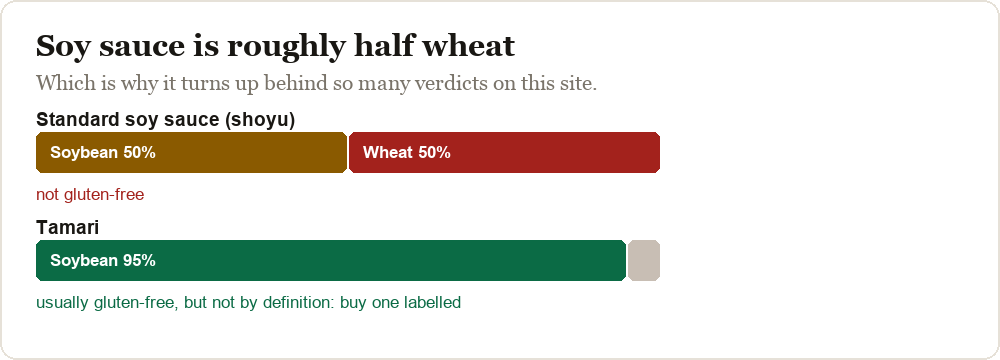
Standard shoyu is brewed from roughly equal parts soybeans and wheat. Tamari is the swap, but the word tamari alone is not a guarantee.
- Last checked
- 2026-08-23
- Varies by country
- No
Source kikkoman.co.uk+5 more
Why
If you have arrived here from a Japanese menu or a recipe, the first thing worth saying is that shoyu and soy sauce are the same thing. Shoyu is not a speciality product sitting beside soy sauce on the shelf. It is the category. So the question "is shoyu gluten-free" is the soy sauce question, and it has the same answer.
The wheat is structural. Shoyu is brewed, not blended. Soybeans and cracked roasted wheat are inoculated with Aspergillus mould to make koji, then mixed with brine into a mash and fermented for months. The wheat is not a thickener or a filler that a producer could quietly drop. It is half the substrate, and it is what gives shoyu its aroma and its faint sweetness. San-J, which sells the wheat-free alternative and therefore has every reason to be precise about the comparison, puts typical soy sauce at "about 40-60% wheat" against its own tamari made "using 100% soybeans, with no wheat."
The manufacturers publish this plainly. Kikkoman's US ingredient panel for its standard soy sauce is four words long: water, soybeans, wheat, salt. There is no ambiguity to resolve, no "natural flavour" to interrogate, no starch of unstated origin. The second ingredient is wheat.
The types of shoyu, and which one you are holding
Japanese soy sauce is classified into five types under the Japanese Agricultural Standard, and they differ mainly in the ratio of wheat to soybean.
| Type | What it is | Gluten status |
|---|---|---|
| Koikuchi (濃口) | The default. Around 80% of Japanese production and almost every bottle sold in the West | Not gluten-free. Brewed with wheat |
| Usukuchi (淡口) | Lighter in colour, saltier, common in Kansai cooking | Not gluten-free. Brewed with wheat |
| Tamari (たまり) | Soybean-dominant, thicker, darker | Check the label. Often wheat-free, not always |
| Saishikomi (再仕込み) | Twice-brewed, refermented in soy sauce instead of brine | Not gluten-free. Brewed with wheat |
| Shiro (白) | "White" shoyu, pale and sweet | Not gluten-free. The highest wheat proportion of the five |
Two honest limits on that table. The per-type wheat proportions are reported by trade and importer sources rather than published by manufacturers, so treat the ratios as background and the panel on the bottle as the fact. And the classification tells you what the sauce is, not what any specific bottle contains. Only the ingredient list and a gluten-free claim settle it.
The tamari trap, which is the thing most people get wrong
"Buy tamari" is the advice everyone gives, and it is broadly right. Tamari originated as the liquid pressed from fermenting soybean paste, so its traditional recipe has no wheat in it at all. But tamari is a style, not a guarantee, and the clearest proof is sold by the biggest name in the category.
Kikkoman Tamari Soy Sauce, the standard one, lists: "Water, Soybeans, Salt, Wheat, Alcohol, Glucose. (Contains: Soy, Wheat.)" That is a bottle labelled tamari, with wheat as the fourth ingredient and a wheat allergen declaration on the panel. It is not the gluten-free product. Kikkoman sells a separate one.
San-J says the same thing in its own words: "Tamari is brewed with all soybeans or only very small amounts of wheat added," and "Some tamari brands can contain wheat, so always check the label to make sure it is certified gluten-free."
So the rule is not "buy tamari." It is "buy a bottle that says gluten-free." Two that do, from the two manufacturers cited above:
- Kikkoman Gluten-Free Tamari Soy Sauce: water, soybeans, salt, sugar, certified gluten-free by the Gluten Intolerance Group.
- San-J Tamari: brewed from 100% soybeans with no wheat, certified gluten-free by the Gluten-Free Certification Organization.
Kikkoman's UK arm states the distinction directly for its gluten-free tamari: it "contains no wheat at all, so it is suitable for those with a wheat or gluten allergy or coeliac disease."
"But fermentation breaks the gluten down"
It does, partly, and that is why this question keeps getting muddled. Long brewing degrades gluten proteins, and residual gluten in finished shoyu is far lower than the wheat content would suggest. It is still not reliably under 20 ppm, no producer of conventional shoyu certifies it as gluten-free, and no celiac organisation treats brewed shoyu as safe. A partial reduction of a large amount is not the same as an absence.
How much risk is this?
Celiac disease: treat every unlabelled shoyu as unsafe, including the bottle on the restaurant table, the sachet with a takeaway, and the splash the kitchen used in a marinade you cannot see. This is one of the few gluten sources that is genuinely invisible: there is no crumb, no crust, no batter, just a dark liquid in food that otherwise looks safe.
Non-celiac gluten sensitivity: some people tolerate brewed shoyu in dipping quantities because the residual gluten is low. That is a personal judgement, not a safety claim, and it does not extend to cooked-down sauces where the shoyu has been concentrated.
Wheat allergy: avoid conventional shoyu outright, and avoid Kikkoman's standard Tamari too, since it carries a "Contains: Wheat" declaration. Fermentation does not remove an allergen.
Eating out: the practical script is to assume every sauce in a Japanese, Chinese, Korean or Thai kitchen starts with wheat-brewed shoyu until someone shows you a bottle. Carrying single-serve tamari packets is normal and no chef objects.
What to have instead
- San-J Tamari100% soybeans, no wheat, GFCO certified. The default replacement, and it behaves like shoyu in almost every use.
- Kikkoman Gluten-Free Tamari Soy SauceYesFour ingredients, certified by the Gluten Intolerance Group, and the easiest one to find in a mainstream US supermarket. Note this is a different bottle from Kikkoman Tamari Soy Sauce, which contains wheat.
- Kikkoman Gluten-Free Soy SauceYesBrewed with rice in place of wheat. The closest flavour match to the standard bottle if tamari tastes too round to you.
- Coconut aminosIf you want to drop soy as well. Noticeably sweeter and less salty, so use less sugar in anything you build with it.
- Salt and dashiFor seasoning a broth, if all you needed from the shoyu was savouriness. Check the dashi: instant dashi powders frequently contain soy sauce.
Do not substitute: regular shoyu, "lite" or reduced-sodium shoyu, which is the same brew with less salt, teriyaki, ponzu, hoisin, oyster sauce and eel sauce, all of which are built on wheat-brewed shoyu unless labelled otherwise, and Kikkoman Tamari Soy Sauce, which declares wheat.
Related questions
Is shoyu the same as soy sauce? Yes. Shoyu is simply the Japanese word. Chinese light and dark soy sauces are made differently, but they are also normally brewed with wheat, so the answer does not improve by switching cuisine.
Is tamari always gluten-free? No, and this is the single most common mistake in this cluster. Kikkoman's standard Tamari Soy Sauce lists wheat and carries a "Contains: Wheat" statement. Buy a bottle with a gluten-free claim on it, ideally a certified one.
Is white shoyu (shiro) gluten-free? No. Shiro shoyu is the wheat-heaviest of the five types, which is exactly what makes it pale and sweet. It is the worst choice in the category, not a light option.
Is the soy sauce at a sushi restaurant gluten-free? Assume not. House bottles are koikuchi shoyu. Ask for a sealed gluten-free packet or bring your own, and remember the eel sauce, spicy mayo, tempura, imitation crab and crunch toppings are separate wheat sources on the same menu.
Does gluten-free shoyu taste different? Tamari is rounder, less sharp and slightly thicker, because the aroma compounds that wheat fermentation produces are absent. Rice-brewed gluten-free soy sauce sits closer to the original. Most people stop noticing within a week.
Is miso gluten-free? Often, but not automatically. Miso is fermented with koji that can be cultured on barley (mugi miso) or rice (kome miso). Rice miso is the safe default, and the same "read the label" discipline applies.
How we checked
| Source | Tier |
|---|---|
| Kikkoman UK, tamari versus regular soy sauce, gluten-free tamari "contains no wheat at all, so it is suitable for those with a wheat or gluten allergy or coeliac disease" | A |
| San-J, Is Soy Sauce Gluten Free?, "Some tamari brands can contain wheat, so always check the label to make sure it is certified gluten-free" | A |
| San-J, Our Tamari, typical soy sauces "contain about 40-60% wheat"; San-J tamari is 100% soybeans and GFCO certified | A |
| Kikkoman Gluten-Free Tamari Soy Sauce, water, soybeans, salt, sugar, certified by the Gluten Intolerance Group | A |
| Kikkoman Soy Sauce, published panel "Water, Soybeans, Wheat, Salt." | C |
| Kikkoman Tamari Soy Sauce, published panel "Water, Soybeans, Salt, Wheat, Alcohol, Glucose. (Contains: Soy, Wheat.)" | C |
| Japanese Agricultural Standard classification of soy sauce into koikuchi, usukuchi, tamari, saishikomi and shiro | C |
| Per-type wheat proportions (shiro highest, tamari lowest), reported by importers and trade guides, not published by manufacturers | D |
Overall source tier: A. Both major producers have spoken directly to the gluten question, and both agree: standard shoyu is brewed with wheat, and the wheat-free version is a separate certified product. The one part of this page that rests on thinner evidence is the ranking of wheat content between the five JAS types, which comes from trade reporting rather than manufacturer disclosure. It does not affect the verdict, because four of the five types contain wheat and the fifth has to be checked anyway.
Last verified: 23 August 2026. Producers reformulate without notice, and "tamari" on a front label tells you less than the panel on the back. The bottle in your hand outranks this page.