Prepared dishes · Category-wide
Are gnocchi gluten-free?
Traditional gnocchi is bound with wheat flour. The potato is only part of the recipe.
- Evidence
- CPublished label or regulation
- Last checked
- 2026-08-10
- Varies by country
- No
Source delallo.com+5 more
Why
The dangerous assumption here is a completely reasonable one: gnocchi look like potato, taste like potato, and are sold next to the potato products. Many people with celiac disease have eaten them for years on that basis.
Wheat flour is a structural ingredient, not a trace. Boiled potato is wet and starchy. On its own it will not hold a shape in simmering water. It will dissolve. Wheat flour supplies the gluten network that holds the dumpling together while keeping it tender. A typical recipe runs somewhere around two-to-four parts potato to one part 00 or all-purpose wheat flour. That is not a dusting; it is a defining ingredient. Commercial dried and chilled gnocchi almost always list wheat flour second or third on the panel, immediately after potato or rehydrated potato flake.
Some gnocchi are not potato at all. Gnocchi alla romana is made from semolina, durum wheat, ground coarse and cooked into a firm porridge, then cut into discs. There is no potato in it whatsoever. Gnudi and ricotta gnocchi swap some potato for cheese but still need flour to bind. If a menu says "gnocchi" and nothing else, you do not yet know which of these you are being offered.
"Gluten-free gnocchi" is a real and separate product. It is not a marketing gloss on the ordinary version. Certified brands rebuild the dough around rice flour, potato starch, cassava flour or almond flour, sometimes with a gum to replace the gluten's elasticity. DeLallo's gluten-free gnocchi, for instance, is made from rehydrated potato and rice flour and produced in a dedicated gluten-free facility. Those are meaningfully different manufacturing decisions, and they are why the certified product costs more.
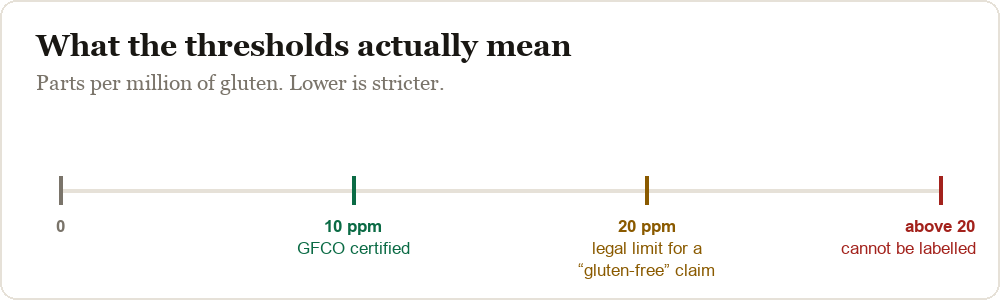
The restaurant problem is the pot, not just the recipe. Even where a kitchen genuinely uses gluten-free gnocchi, they are frequently dropped into the same boiling water as the wheat pasta. That is measurable, not theoretical. A University of Nebraska Food Allergy Research and Resource Program study of restaurant-scale pasta cooking found that gluten-free penne boiled in shared water with regular pasta reached roughly 40 ppm gluten by the fifth restaurant-sized batch, double the 20 ppm gluten-free threshold. The researchers' recommendation was blunt: cook gluten-free pasta in a separate vessel. Usefully, the same work found that rinsing the cooked pasta under running water for a few seconds brought levels back under 20 ppm.
How much risk is this?
Celiac disease: ordinary gnocchi is a hard no. This is a wheat-flour dough, not a cross-contact question. For certified gluten-free gnocchi at home, you are fine, the only variable is your own pot and colander. In a restaurant, the shared-water issue means "we have gluten-free gnocchi" is not the end of the conversation.
Non-celiac gluten sensitivity: the same reasoning applies to the standard product. Where you might have more latitude is the restaurant shared-water scenario, which involves parts-per-million rather than a wheat-based dough.
Wheat allergy: avoid the standard product entirely. Note that some gluten-free gnocchi are almond-flour based, which trades one allergen for another, read the box.
Preference only: the amount of wheat in gnocchi is lower per serving than in an equivalent plate of pasta, since most of the mass is potato. That is irrelevant for celiac disease and may matter to you.
What to have instead
Named products that actually work, rather than "look for a gluten-free option":
- DeLallo Gluten Free GnocchiYes(and the Mini version). Rehydrated potato and rice flour, made in a dedicated gluten-free facility in Italy, egg- and nut-free. Cooks in about two minutes. The closest texture match to the classic.
- Cappello's Gluten-Free GnocchiYesPotato flakes, almond flour, eggs and tapioca flour, grain-free and paleo-friendly, sold frozen. Contains tree nuts and egg, so not a universal swap.
- Trader Joe's Cauliflower GnocchiRoughly 75% cauliflower plus cassava flour, potato starch, olive oil and sea salt. No wheat at all. Best pan-fried rather than boiled, boiling makes it gummy.
- Tuscanini, Sanniti and Le VenezianeGluten-free gnocchi and potato pastas are the other widely stocked import options.
- Make itRiced baked potato, egg yolk, and a 1:1 gluten-free flour blend gets you there in half an hour, and you control the pot. In-house gnocchi is almost always wheat-bound. Say "wheat flour", not "gluten", kitchen staff answer the ingredient question more accurately. water, or the shared pasta water?"* This is the question that matters most and the one nobody asks. thickened with flour, or anything finished with a roux, is not.
What to ask the restaurant. Ask these three, in this order: 1. "Is the gnocchi made in-house, and does the dough contain wheat flour?" 2. "If it's your gluten-free gnocchi, is it boiled in a separate pot of fresh 3. "What's in the sauce?"* A gorgonzola or tomato sauce is usually fine; a ragù If the answer to (2) is "the same water," order something else. A risotto, a grilled protein with vegetables, or polenta are the reliable Italian-restaurant fallbacks.
Related questions
Is potato gnocchi gluten-free? No, "potato gnocchi" is the ordinary kind, and it is potato plus wheat flour. The name describes the main ingredient, not the whole ingredient list. This is the single most common misreading in the category.
Is cauliflower gnocchi gluten-free? Trader Joe's version is: cauliflower, cassava flour, potato starch, olive oil, salt. Other brands' cauliflower gnocchi are not automatically the same, some use wheat flour alongside the cauliflower. Read the panel rather than trusting the vegetable in the name.
Is gnocchi alla romana gluten-free? Definitely not. It is made from semolina, which is durum wheat, with no potato involved at all.
Is store-bought gnocchi safer than restaurant gnocchi? For a certified gluten-free product, yes. The label is enforceable and you control the cookware. Restaurant gluten-free claims are not federally regulated in the US, and shared pasta water is a genuine and measured contamination route.
Does frying gluten-free gnocchi change anything? Only if the pan is clean. Pan-frying in your own skillet is fine. A restaurant deep-fryer shared with breaded items is a different problem entirely, see our pages on fried sides.
Is sweet potato gnocchi gluten-free? Usually no, for exactly the same reason as the potato version: it still needs a flour binder, and that flour is normally wheat.
How we checked
| Source | Tier |
|---|---|
| DeLallo Gluten Free Gnocchi, potato and rice flour, dedicated gluten-free facility | A |
| Trader Joe's Cauliflower Gnocchi, published ingredient list on a retailer's own-brand page; no gluten statement | C |
| Beyond Celiac, Cross-Contact | B |
| Gluten Cross-Contact in Restaurant-Scale Pasta Cooking, shared boiling water study | C |
| University of Nebraska summary of the shared-water findings | C |
| Club Gluten Free, secondary corroboration | D |
Overall source tier: C. This is a category verdict about a traditional recipe, so there is no single manufacturer statement to cite. The evidence is the published ingredient lists of the mainstream products, the existence of a separate certified gluten-free category, and peer-reviewed data on shared cooking water. DeLallo's gluten-free statement is tier A for DeLallo's own gnocchi, but it says nothing about the ordinary wheat-bound product this page rules on, and no national celiac organisation has published a gnocchi verdict, the Beyond Celiac page cited here covers cross-contact generally, not this dish.
Last verified: 10 August 2026. Manufacturers reformulate without notice. The panel on the packet in your hand outranks this page, and a restaurant's answer about its pasta water outranks its menu.