Candy & chocolate · Category-wide
Is dark chocolate gluten-free?
Plain dark chocolate is naturally gluten-free. Barley malt, crisped rice and biscuit pieces are what make specific bars unsafe.
- Evidence
- BNational celiac organisation
- Last checked
- 2026-08-13
- Varies by country
- Yes
Source beyondceliac.org+4 more
Why
Dark chocolate starts from the best possible position of any confectionery. The core recipe has four to five ingredients and none of them is a grain. Beyond Celiac's guidance reflects this, gluten in chocolate comes from added ingredients and from cross-contact, not from the chocolate. So the useful skill is not "is dark chocolate safe" but "what did they put in this bar." Four things to look for.
1. Malt, the one that actually catches people. Malt, malt extract, malt flavouring, malted barley and barley malt syrup all come from barley. Malt turns up in dark chocolate as a sweetener and flavour rounder, and it is invisible if you are only scanning for "wheat." Brands are inconsistent about it within their own ranges: it is normal to find a seasonal shape listing barley while the plain bar does not.
2. Crisped or puffed rice. Rice is gluten-free. Crisped rice usually is not, because the puffing and toasting process for commercial crisps commonly uses barley malt or malt flavouring. This is why most mainstream "crunch"-style bars fail, and why some specialist brands advertise gluten-free crisped rice specifically.
3. Inclusions and fillings. Cookie pieces, brownie chunks, wafer, pretzel, shortbread, digestive biscuit, speculoos, cookies-and-cream. All wheat. Also watch caramel and toffee fillings with flour or unspecified "flavouring," and anything with a biscuit base.
4. Unsourced starch and syrups. Modified food starch, dextrin, maltodextrin and glucose syrup can be wheat-derived. A minor risk in practice, in the US these are usually corn, and in the EU wheat-derived glucose syrup is processed past the gluten-free threshold and needs no warning. Check if you are strict; not a red flag.
Then there is cross-contact, which the ingredient list will not tell you. Chocolate factories run wafer bars, biscuit-filled bars and cookie inclusions on shared lines. Some manufacturers control for this and label accordingly; some, including Mars across its entire chocolate portfolio, decline to make any gluten-free claim precisely because they will not guarantee the line. A clean ingredient list plus no claim is a weaker position than a clean list plus a claim, and this page grades them differently.
A useful shortcut: the higher the cocoa, the shorter the list. A 70–85% bar is typically cocoa mass, cocoa butter, sugar and maybe vanilla or lecithin. A 45–55% "dark" bar has more room for sugar-side additions.
Where it varies
| Situation | Position |
|---|---|
| Plain bar, cocoa mass / cocoa butter / sugar / lecithin / vanilla | Gluten-free by composition |
| Bar carrying a printed gluten-free claim (US) | Gluten-free, under 20 ppm, legally binding |
| Bar carrying GFCO certification | Gluten-free, under 10 ppm, stricter |
| Bar listing malt / malt extract, US | Not gluten-free |
| Bar listing barley malt extract, UK/EU, with a gluten-free claim | Gluten-free, malt extract at trace levels can test under 20 ppm, which is why some UK bars carry both |
| Bar with crisped rice, no gluten-free claim | Assume not, crisps are commonly malted |
| Bar with biscuit, wafer, cookie or brownie pieces | Not gluten-free |
| Clean list, no claim, large shared-line manufacturer | Unverified, ingredients fine, factory unstated |
That UK/EU row is the one that looks like a contradiction and is not. A British bar can name barley malt extract in the ingredients and still carry a legal gluten-free claim, because the claim is a measured threshold rather than an ingredient rule. In the US, the same ingredient without a claim is a no.
How much risk is this?
Celiac disease: dark chocolate is one of the easiest treats to eat safely and you do not need to give it up. Prefer a printed gluten-free claim or GFCO certification. Where there is no claim, a high-percentage plain bar from a small maker with a five-word ingredient list is a low-risk choice; a mainstream filled or crisp bar without a claim is not.
Non-celiac gluten sensitivity: plain bars are fine. Skip anything with malt or biscuit, which you would notice anyway.
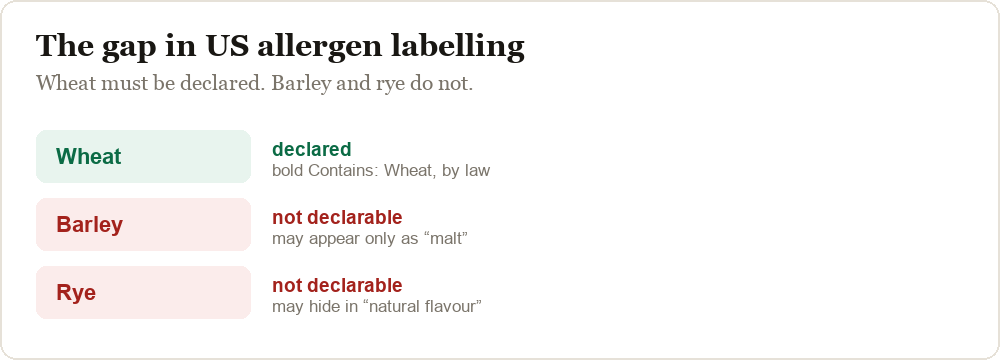
Wheat allergy specifically: better placed than coeliacs here. Wheat is a declared allergen on both US and EU labels, so a bar with no "contains wheat" line does not contain wheat as an ingredient. Barley malt is your remaining question, and barley is not wheat.
Advent calendars, seasonal shapes and minis: the highest-failure part of the category. Beyond Celiac makes this point directly, mini and seasonal versions frequently differ from the standard bar, and a gluten-free claim on the full-size bar may not carry over. Re-read every Christmas and Easter, and treat each flavour as a separate product rather than a variant you have already cleared.
What to have instead
Named bars with real documentation, rather than "look for one with a short list":
- Endangered Species dark chocolateUnverifiedGFCO-certified across the range, including the 72%. Widely stocked and the easiest certified dark chocolate to actually find. Its almond and sea salt bar is made on equipment also handling milk and nuts.
- Enjoy Life chocolate chips and morselsUnverifiedDedicated gluten-free facility, free from fourteen common allergens. The strongest option if cross-contact rather than ingredients is your concern.
- Pascha 55%, 70% and 85%Certified gluten-free, dedicated allergen-free facility. Good for baking as well as eating.
- Hu Simple Dark 70%Very short ingredient list; the company states its products are gluten-free but does not publicly name a certifier.
- Any single-origin bar with a four-ingredient listCraft makers usually run one product type, which quietly solves cross-contact too.
Skip: crisp bars without a gluten-free claim, anything with biscuit, wafer, cookie or pretzel, malted dark chocolate, and, for anyone strict, seasonal shapes and advent calendars, where formulation changes are the norm.
Related questions
Is 70% or 85% dark chocolate gluten-free? Almost always. Higher cocoa percentages leave less room for added ingredients, so the list is typically cocoa mass, cocoa butter, sugar and vanilla. Still check for malt on flavoured versions.
Is Dove dark chocolate gluten-free? Different question, different answer, Mars declines to make a gluten-free claim on any of its chocolate. See Is Dove dark chocolate gluten-free? and Is Dove milk chocolate gluten-free?.
Is dark chocolate safer than milk chocolate? Generally yes, because the ingredient list is shorter and malt is less commonly used to round out a high-cocoa bar. It is a tendency, not a rule, plenty of milk chocolate is gluten-free and plenty of dark chocolate is not.
Is cocoa powder gluten-free? Yes, plain unsweetened cocoa is a single ingredient. Sweetened drinking chocolate and hot chocolate mixes are the risky relatives, see Is chocolate powder gluten-free?.
Why does a bar with no gluten ingredients still say "may contain wheat"? Because the manufacturer runs wheat-containing products in the same plant and will not guarantee the line. That advisory is voluntary in most markets, so its absence does not prove a dedicated line, but its presence is a genuine signal.
Is dark chocolate with crisped rice gluten-free? Assume not unless the pack says so. Commercial crisped rice is frequently made with barley malt, which is the single most common way rice ends up carrying gluten.
How we checked
| Source | Tier |
|---|---|
| Beyond Celiac, Is Candy Gluten-Free?, malt as a barley derivative; cross-contact; mini and seasonal versions differ from the original | B |
| Endangered Species 72%, GFCO certified gluten free | C |
| Glutafin, Why isn't all chocolate gluten free?, barley malt, wheat flour and wheat-derived syrups as the culprits; UK trace-level malt extract under 20 ppm | D |
| Food Republic and Healthline, corroborating secondary coverage on inclusions and crisped rice | D |
Overall source tier: B. This is a category verdict, so by nature it carries no single manufacturer statement. It rests on a national celiac organisation's guidance on chocolate and malt plus the composition of dark chocolate itself, with brand-level certification cited for the specific bars recommended above.
Last verified: 10 August 2026. Seasonal and mini versions of a bar you have already cleared are the most common failure point in this category. The wrapper in your hand outranks this page.