Ingredients · Category-wide: Hershey's, Cadbury, Nestlé/Nesquik, own-brand
Is chocolate powder gluten-free?
Plain cocoa powder is gluten-free. Sweetened drinking and hot chocolate mixes are where barley malt and unsourced starch appear.
- Evidence
- CPublished label or regulation
- Last checked
- 2026-08-10
- Varies by country
- Yes
Source thehersheycompany.com+5 more
Why
"Chocolate powder" covers three different products that get shelved together, and they carry three different risk profiles.
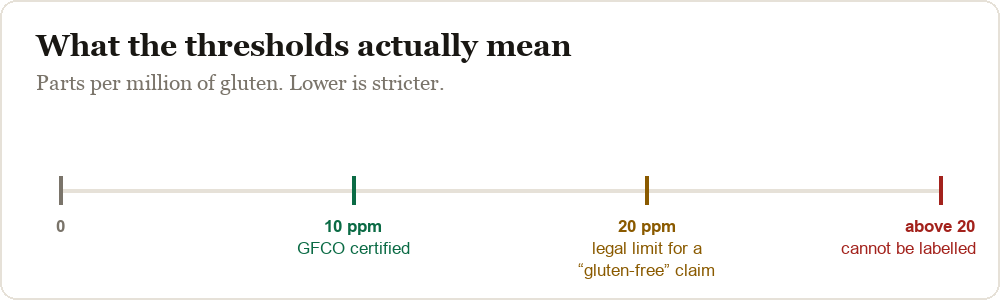
1. Unsweetened cocoa powder, the safe end. Cocoa is pressed from roasted cacao beans; the fat is removed and the cake is milled. The ingredient list on a tin of Hershey's 100% Cacao Natural Unsweetened Cocoa is one word: cocoa. Hershey lists its cocoa products on its published gluten-free list, and Hershey's policy is that anything carrying that claim contains under 20 ppm gluten, the FDA threshold. That is a tier-A manufacturer statement, and it is the strongest evidence available in this category.
Two Hershey-specific footnotes worth carrying, both from Gluten Free Watchdog's free-tier database rather than from Hershey, secondary reporting, though both are easy to check against Hershey's own list: Hershey's Special Dark cocoa is not labelled gluten-free, and Cacao Reserve is not on the list. Hershey's claims are product-by-product and sometimes size-by-size, do not generalise from one tin to the whole shelf.
2. Drinking chocolate, usually fine, rarely certified. Cadbury Drinking Chocolate is listed as sugar, cocoa powder, an acidity regulator (sodium carbonate) and flavouring. Nothing there is gluten. That panel comes off the pack, though, not from any Mondelēz gluten document. There isn't one. Mondelēz does not carry a gluten-free claim on this product, and the powder may be produced in a plant handling gluten products. Clean list, no guarantee.
3. Hot chocolate and malted mixes, where the gluten actually is. This is the category that earns the "depends." Instant hot chocolate sachets commonly add malt or malt flavouring, and malted milk drinks (Horlicks, Ovaltine and their supermarket equivalents), are built on barley malt as a defining ingredient. Malt is barley. Also watch for wheat starch, hydrolysed wheat protein, and maltodextrin or modified food starch with no stated source. Ingredient-screening databases flag Cadbury Highlights sachets as ambiguous for exactly this reason: one ingredient could be gluten-derived depending on source, and a screening database is secondary reporting, not a manufacturer position.
How well evidenced is this half of the page? Less well than the other half, and it matters enough to say plainly. The safe end above rests on Hershey's own published gluten-free policy and product list: a direct manufacturer statement. The risky end has nothing of that grade behind it. Neither Horlicks nor Ovaltine publishes a gluten statement we could locate, Mondelēz publishes none for Cadbury Drinking Chocolate, and the US Nesquik "may contain wheat" advisory reaches us at second hand rather than from a Nestlé document. What carries the malted-drinks call is the ingredient panel, barley malt named on the pack, plus secondary reporting. That is more than enough to put a malted drink back on the shelf, because malt is barley and the label says so. It is not the same class of evidence as the Hershey claim, and this page will not present it as though it were.
4. Cacao powder and cacao nibs. Raw cacao powder is the same proposition as cocoa, one ingredient, naturally gluten-free. Certified options exist here more often than in the mainstream baking aisle.
Where it varies
| Market / product | Position |
|---|---|
| Hershey's cocoa (US) | Gluten-free, on Hershey's published list, under 20 ppm |
| Hershey's Special Dark cocoa / Cacao Reserve (US) | Not labelled gluten-free, no gluten ingredients, no claim |
| Nesquik chocolate powder (UK) | Gluten-free, Nestlé UK states the milkshake powders have no added gluten-containing ingredients |
| Nesquik powders and syrups (US) | Carry a "may contain wheat" advisory, same brand, different answer (reported second-hand; verify on the pack) |
| Cadbury Drinking Chocolate (UK) | No gluten ingredients on the panel; no gluten-free claim, and no Mondelēz gluten statement |
| Malted drinks (Horlicks, Ovaltine, malted hot chocolate) | Not gluten-free, barley malt is the point of the product (ingredient panel; neither brand publishes a gluten statement) |
The Nesquik split is the one that catches people. A powder that is declared gluten-free by Nestlé in the UK carries a wheat advisory on the US pack. Same brand name, different plant, different answer, check the country you are actually shopping in. Note the asymmetry in our own evidence here: the UK statement is Nestlé's own and published; the US advisory is something we have at second hand, so read the American tub before you rely on it.
The UK also handles barley malt extract differently in practice: where malt extract is present at very low levels, a product can still test under 20 ppm and carry a gluten-free claim. A UK product listing barley malt extract and a gluten-free claim is not a contradiction. A US one listing malt without a claim is a no.
How much risk is this?
Celiac disease: plain cocoa is safe and there is no reason to avoid it. For mixes, the rule is simple, scan for malt, malt extract, malt flavouring, barley, wheat starch, and modified food starch or maltodextrin with no source given. If a mix carries a printed gluten-free claim, rely on it. If it lists malt without one, put it back.
Non-celiac gluten sensitivity: the same scan, with more latitude on the unsourced-starch cases, which are almost always corn in the US.
Cross-contact: cocoa is milled and packed in facilities that often handle flour-based baking products. This is the reason a brand with a clean list still declines a claim. Buy claim-carrying cocoa if you are strict.
Cafés are the blind spot. Hot chocolate and mocha syrup behind a coffee counter comes from a catering-size mix that nobody in the shop has read. Ask them to show you the tub. Coeliac UK maintains a list of gluten-free hot drinks that is worth having on your phone for exactly this situation. We have that via Glutafin rather than from Coeliac UK directly, so go to the source for the current list.
What to have instead
If you want documentation rather than deduction:
- Hershey's Cocoa (100% Cacao Natural Unsweetened)On Hershey's own gluten-free list. The default reliable baking cocoa in the US.
- Anthony's Organic Cocoa PowderCertified gluten-free, widely available online, large bags for baking.
- BetterBody Foods Organic Cacao PowderCertified gluten-free; raw cacao rather than Dutch-processed cocoa.
- Nesquik chocolate powder in the UKNestlé UK states it is gluten-free. Do not carry this over to the US pack.
- Make your own drinking chocolateTwo teaspoons of certified cocoa, sugar to taste, hot milk. This removes every ambiguity in the mix category at once and costs less than sachets.
- Certified gluten-free dark chocolate, gratedDependsEndangered Species is GFCO-certified; melt a few squares into hot milk for a real drinking chocolate.
Avoid unless the pack says gluten-free: malted drinks of any kind (Horlicks, Ovaltine, malted hot chocolate), instant sachets with "flavouring" plus an unsourced starch, and vending-machine hot chocolate, which is never traceable.
Related questions
Is cocoa powder gluten-free? Plain unsweetened cocoa is a single ingredient and is gluten-free. Buy one carrying a gluten-free claim if you want the cross-contact question closed too.
Is Hershey's cocoa gluten-free? Hershey's Cocoa appears on Hershey's published gluten-free list, which commits it to under 20 ppm. Note that Special Dark cocoa and Cacao Reserve are not on that list. The claim is product-specific.
Is hot chocolate gluten-free? Not automatically. This is the riskiest form of chocolate powder because malt and starch thickeners are common. Check for malt first, then for an unsourced modified starch.
Is Nesquik gluten-free? In the UK, Nestlé states the chocolate milkshake powders have no added gluten-containing ingredients, that one is published by the manufacturer. In the US the powders and syrups carry a "may contain wheat" advisory, which we have as secondary reporting rather than from Nestlé USA. Answer depends on your country; read the American pack.
Is drinking chocolate the same as cocoa powder? No. Cocoa powder is unsweetened; drinking chocolate is cocoa pre-mixed with sugar and often other ingredients. The extra ingredients are where the risk sits.
Is cacao powder gluten-free? Yes, by nature. It is unroasted or low-temperature-processed cacao, one ingredient. Certified options are common in this part of the aisle.
What about "chocolate malt" powder? No. Malt means barley. A chocolate malt powder or malted milk drink is a gluten-containing product by design, not by accident.
How we checked
| Source | Tier |
|---|---|
| The Hershey Company, Gluten Free, policy: products carrying the claim are evaluated against the FDA standard, under 20 ppm | A |
| Hershey's gluten-free product list | A |
| HERSHEY'S Cocoa 100% Cacao Natural Unsweetened, sole ingredient: cocoa | A |
| Nesquik UK, manufacturer gluten-free statement for the UK powder | A |
| Gluten Free Watchdog, Hershey, notes Special Dark cocoa is not labelled gluten-free; free-tier database entry, secondary reporting | D |
| Glutafin, Why isn't all chocolate gluten free?, barley malt, wheat flour and wheat-derived syrups as the usual culprits; Coeliac UK's hot-drinks list | D |
| Horlicks, Ovaltine, Cadbury Drinking Chocolate, Nesquik US, no manufacturer or celiac-organisation gluten statement located; the risk half of this page rests on ingredient panels and secondary reporting | n/a |
Overall source tier: C. The two halves of this page are not evidenced to the same standard and it would be dishonest to average them into an A. Hershey's published gluten-free policy and product list, and Nestlé UK's statement on Nesquik, are direct manufacturer statements, tier A, and they carry the "plain cocoa is fine" half. The half that actually produces the depends, the malted and instant mixes, has no manufacturer or celiac-organisation document behind it at all: it rests on barley malt appearing on ingredient panels (tier C) and on secondary reporting (tier D). A page spanning four brands cannot take tier A from one brand's document in any case, and no celiac organisation has ruled on chocolate powder as a class. C is the honest page-level figure, read the Hershey and Nesquik-UK rows as stronger than that, and the malted-drink rows as weaker.
Last verified: 10 August 2026. Formulations differ by country and change without notice, the Nesquik UK/US split on this page is a live example. The tin in your hand outranks this page.