Ingredients · Category-wide
Is bean curd gluten-free?
Plain bean curd is soybeans, water and a mineral coagulant, no gluten grain is involved at any stage.
- Evidence
- CPublished label or regulation
- Last checked
- 2026-08-13
- Varies by country
- No
Source morinu.com+3 more
Why
Bean curd is a legume product, not a grain product. Soybeans are pressed into soy milk, a coagulant is added, the curds separate, and they are pressed into blocks. That is the whole process, and there is no step at which a wheat, barley or rye ingredient would be introduced.
The coagulants are minerals. Calcium sulfate (gypsum) and magnesium chloride (nigari) are the two standard ones, with glucono delta-lactone used for silken styles. All are gluten-free. A gluten-free-labelled block of House Foods Premium Extra Firm tofu lists water, soybeans, calcium sulfate and calcium chloride, four ingredients, none of them a concern.
Gluten-free labelling exists on shelf, which is unusual for a fresh product. House Foods markets several SKUs explicitly as "Gluten Free Firm Tofu". The words are in the product name and the retail listing repeats "Gluten free" in the allergen section. No certifier is named anywhere we could check, so do not read a GFCO seal into it; an earlier version of this page did, and that was wrong. We are also evidencing it from a retail listing rather than from House Foods directly: the company's own gluten-free filter page returns 404, and its product pages are JavaScript-rendered and could not be read.
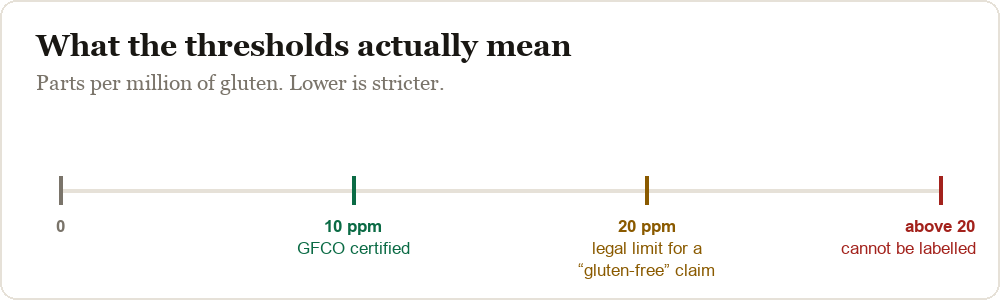
Mori-Nu is the one that speaks in full sentences, and both halves ship. It says its tofu "tests at less than 5 parts per million (ppm) gluten", which "more than qualifies us for the FDA's <20ppm standard for gluten-free, as well as the <10ppm limit for certification by the Gluten-Free Certification Organization (GFCO)", qualifies for, not is certified by, and worth reading precisely. It then tells shoppers to "look for the 'Gluten Free Certified' label on the front of the package", without saying who certified it. So: a tested number and a company statement, yes; a named third-party certification, no.
Where it genuinely goes wrong: soy sauce. Traditional Japanese and Chinese soy sauce is brewed from roughly equal parts soybean and wheat. Any tofu that has been marinated, baked, braised or glazed has a strong chance of containing it, and this is the single most common way a celiac gets caught out by a tofu dish. The gluten-free equivalent is tamari, which is brewed with little or no wheat.
Nasoya's baked teriyaki tofu is a clean illustration of both sides. The older 8 oz formulation used organic soy sauce made with organic wheat and was not gluten-free. The current 7 oz product is built on organic tamari (water, organic soybeans, salt, organic alcohol), and carries a gluten-free badge and Non-GMO Project Verified on Nasoya's product page. Same brand, same product name, opposite answers. Read the ingredient panel, not the brand's reputation.
Three other flavoured-tofu traps. Breaded or battered tofu is coated in wheat flour or panko. Deep-fried tofu puffs (aburaage, tau pok) are usually just tofu and oil, but the oil is often shared with breaded items in a restaurant fryer. Braised, five-spice and "smoked" pressed tofu almost always contains soy sauce.
Bean curd skin (yuba, tofu skin, bean curd sheets) is also plain soy, it is the film that forms on heated soy milk, but the dried rolls and sticks sold in Asian groceries are sometimes seasoned, and the seasoning is where to look.
How much risk is this?
Celiac disease: plain tofu is a staple you can rely on. Buy a brand that puts a gluten-free claim on the pack if you want the shortest route to certainty; otherwise look for an ingredient list that reads soybeans, water and a coagulant and nothing else.
Non-celiac gluten sensitivity: same, with more latitude on restaurant dishes.
Soy allergy: a different question entirely, and tofu is obviously out.
The restaurant is the risk, not the packet. In a Chinese, Japanese, Korean or Thai kitchen, tofu arrives in a sauce. Mapo tofu, agedashi tofu, braised bean curd, tofu in black bean sauce and almost every stir-fry contain soy sauce or oyster sauce, and both are commonly wheat-containing. Agedashi tofu is also dusted in starch (sometimes potato, sometimes wheat), and fried. Ask specifically about soy sauce and the fryer, not "is it gluten-free."
Cross-contact in manufacturing is low. Tofu plants are wet-process facilities that generally do not run bakery ingredients. Mori-Nu goes further than most and says it uses no gluten-containing ingredients anywhere in the factory.
What to have instead
Bean curd is already a yes, so this is the safe-shopping list, the brands and forms that hold up, and what to use in place of the versions that don't.
- House Foods plain tofu (Premium Firm, Extra Firm, Medium Firm, Organic Cutlet)Sold under a "Gluten Free" product name and Non-GMO Project Verified. No certifier is named on the listing, so this is a label claim rather than a seal. The default recommendation.
- Mori-Nu silken tofuThe maker states it tests under 5 ppm gluten (below even the GFCO threshold, though it stops short of claiming GFCO certification), and shelf-stable cartons make it useful for sauces, smoothies and desserts.
- Any block listing only soybeans, water and a coagulantStore brands included. Composition is the point, not the badge.
- Nasoya TofuBaked Teriyaki (current tamari formulation)The published panel is built on organic tamari and the product page carries a gluten-free badge, though Nasoya says nothing about gluten in words. Confirm the panel says tamari rather than soy sauce with wheat.
- Tamari instead of soy sauceSan-J and Kikkoman both make gluten-free tamari. This one swap makes most home tofu cooking safe.
- Coconut aminosSoy- and gluten-free, sweeter than tamari, works in glazes.
Approach with suspicion: marinated, teriyaki, braised, five-spice and smoked pressed tofu; breaded or battered tofu; tofu skin/yuba products sold pre-seasoned; and tempeh, which is a different fermented soy product that is frequently made with a grain component, check each brand separately.
Related questions
Is tofu the same as bean curd? Yes. "Bean curd" is the direct translation used on many Asian-market packages and restaurant menus; "tofu" is the Japanese term. Same product, same answer.
Is fried bean curd gluten-free? The tofu puffs themselves usually are: tofu and oil. The risk is a shared restaurant fryer that has cooked battered food, and any sauce served with them. At home, frying your own is safe.
Is bean curd skin (yuba) gluten-free? Plain yuba is just the skin from heated soy milk, so yes. Dried bean curd sticks and sheets sold seasoned or marinated need the label read.
Is tempeh gluten-free? Not automatically. Tempeh is fermented soybeans, but many commercial tempehs include barley, wheat or other grains in the cake, and flavoured tempeh often contains soy sauce. Check brand by brand.
Is miso gluten-free? Sometimes. Miso is fermented with koji, and koji can be cultured on barley (mugi miso) or rice (kome miso). Rice miso is the safer choice, and some misos also include added barley.
Why do gluten-free eaters get sick after tofu dishes? Almost always the sauce. Standard soy sauce is brewed with wheat, and it is in nearly every savoury tofu preparation in East and Southeast Asian cooking. The tofu is rarely the culprit.
How we checked
| Source | Tier |
|---|---|
| Mori-Nu, certifications, "Mori-Nu tofu tests at less than 5 parts per million (ppm) gluten… This more than qualifies us for the FDA's <20ppm standard for gluten-free, as well as the <10ppm limit for certification by the Gluten-Free Certification Organization (GFCO)", and directs shoppers to a "Gluten Free Certified" label on the pack. Note: qualifying-for, not certified-as, and the pack certifier is not named | A |
| Nasoya Teriyaki TofuBaked, the ingredient list confirms the current formulation is built on organic tamari rather than wheat-containing soy sauce. The only gluten content on the page is an unlabelled gluten-free badge graphic; the word "gluten" appears nowhere in the page's prose, so this is an ingredient list, not a manufacturer gluten statement, tier C, downgraded from A | C |
| House Foods Gluten Free Firm Tofu retail listing, "Gluten free" in the allergen section and in the product name. No "GFCO" and no named certifier appear on the page; the only other gluten wording is the retailer's own wellness-icon definition. House Foods' own site is JavaScript-rendered and its gluten-free filter page returns 404, so this is evidenced from a retail listing rather than from the manufacturer | C |
| Good For You Gluten Free, corroborating secondary coverage on soy sauce as the real risk | D |
Overall source tier: C. Exactly one document here is tier A: Mori-Nu's certifications page, which addresses gluten in prose and publishes a test figure. It covers Mori-Nu silken tofu and nothing else. The House Foods and Nasoya rows are label evidence (a product name and an allergen line in one case, an ingredient list and an unattributed badge graphic in the other), and no celiac organisation has published a ruling on tofu. No brand on this page is shown to hold a third-party gluten-free certification; earlier versions said House Foods was GFCO-certified and that Mori-Nu was "certified gluten-free", and neither source supports that. What supports the verdict itself is composition: soybeans, water and a mineral coagulant leave no route for gluten. The verdict applies to plain bean curd; every flavoured version is its own label-reading exercise.
Last verified: 13 August 2026. Formulations change, the Nasoya teriyaki switch from wheat-containing soy sauce to tamari is a live example of a product changing its gluten answer without changing its name. The package in your hand outranks this page.