Explainers · Category-wide
Is gluten-free pizza healthy?
Only if you have celiac disease. Nutritionally a gluten-free base is no better than ordinary dough, and often worse.
- Evidence
- BNational celiac organisation
- Last checked
- 2026-08-10
- Varies by country
- No
Source dominos.com+4 more
Why
Two questions get tangled together here, and they have different answers.
The nutrition question: no advantage
A store-bought gluten-free crust runs roughly 120–150 calories, 24–30 g carbohydrate, 2–4 g protein and 1.5–3 g fat per eighth of a 12-inch base. One database lists half of a 9-inch gluten-free crust at 31 g total carbohydrate, 30 g net, 179 calories and 2.1 g protein. Ordinary pizza dough sits in the same range. Calorie counts between the two come out about level once toppings dominate.
The gluten-free base is not lower carb, because gluten is a protein and what replaces it is starch. Most commercial crusts are built on rice flour with tapioca, potato and corn starch: refined, rapidly digestible, and low in fibre. Some are worse than wheat dough, not better: refined starch blends give the texture closest to real crust but tend toward higher glycaemic response and, in some products, added sugar to help browning.
The category studies agree. The Norwegian survey of 423 gluten-free products against 337 gluten-containing equivalents found the gluten-free versions carried less protein and fibre and more saturated fat, carbohydrate and salt. The Italian survey of 235 gluten-free versus 349 regular products found lower protein in every category tested.
And there is no benefit to avoiding gluten if you don't need to. Harvard Health's position is that no compelling evidence shows a gluten-free diet improves health or prevents disease in people who tolerate gluten. A Harvard-led analysis of 64,714 women and 45,305 men followed from 1986 to 2010 found no association between gluten intake and coronary artery disease, and noted that restricting gluten tends to reduce whole-grain intake, which runs the wrong way for cardiovascular risk. Ordering the gluten-free base "to be healthier" buys nothing.
The safety question: this is the one that matters
If you have celiac disease, the real issue isn't the crust's macros. It's whether the pizza in front of you is actually gluten-free.
Columbia's data is uncomfortable. Benjamin Lebwohl and colleagues at the Columbia Celiac Disease Center analysed 5,624 portable gluten-sensor tests submitted by 804 users over 18 months. 32% of dishes labelled gluten-free had detectable gluten, and pizza was among the worst categories at 53%, with gluten-free pasta close behind at 51%. Dinner was worse than breakfast (34% vs 27%), and quick-service restaurants worse than fast-casual (33% vs 22%).
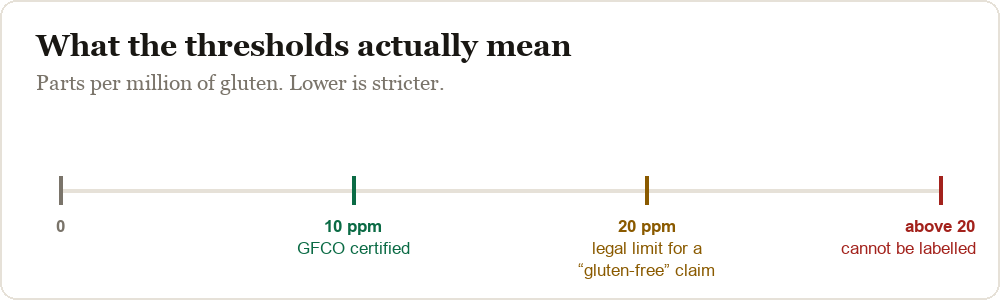
Read the limitations honestly: people with a testing device are more likely to test food they already suspected, and more likely to upload a positive result. The sensor also detects below the 20 ppm regulatory threshold. The true rate is plausibly lower than 53%. It is not plausibly zero.
The shared oven is probably not the culprit. A controlled study by Vincentini and colleagues in the Journal of Food Protection examined gluten-free pizzas in shared-production pizzerias. Results varied by venue: several samples from one pizzeria exceeded the limit of quantification with two between 15 and 20 ppm, all samples from two other pizzerias were below the limit of quantification, and one sample cooked following a traditional procedure hit 23 ppm. A 2024 review of the literature concluded that shared ovens, and even shared utensils, do not necessarily produce significant contamination when protocols are followed, while shared pasta water reliably does. The likelier vectors in a pizzeria are aerosolised wheat flour, shared prep surfaces, and the sauce ladle.
Some chains say this out loud. Domino's own site states that pizza made with its gluten-free crust is prepared in a common kitchen with risk of gluten exposure, and that Domino's does not recommend it for customers with celiac disease. The crust itself is made in a dedicated gluten-free facility and tests under 20 ppm; everything that happens after it arrives in-store is the problem. That disclosure is genuinely to the company's credit and worth taking literally.
What this means in practice
Celiac disease: the base is safe; the kitchen is the variable. Ask three questions, is the dough pressed on a separate surface, are gloves changed, is there a dedicated cutter and a screen or mat in the oven? A venue that answers crisply has thought about it. A venue that says "it should be fine" has not. The gold standard is a dedicated gluten-free pizzeria or a frozen certified pizza cooked at home on your own tray.
Non-celiac gluten sensitivity: a trace-contaminated pizza is unlikely to be a significant problem, and the shared-kitchen caveat matters far less. The nutritional case for the swap is still zero.
Wheat allergy: treat this like celiac-level caution, plus check the crust ingredients directly, some gluten-free formulations still use wheat starch in Europe (permitted below 20 ppm gluten), which is not appropriate for a wheat allergy.
No diagnosis, ordering it as a health choice: you're paying a premium for a crust with less protein and less fibre. If the goal is a better pizza nutritionally, change the toppings and the portion, not the flour. Vegetables and lean protein over extra cheese and cured meat is where the actual difference is.
Children: a gluten-free diet in a child without celiac disease is a restriction with a documented nutritional cost and no documented benefit. Worth being clear-eyed about before it becomes a household default.
What to have instead
- A dedicated gluten-free pizzeriaYesBy a distance the safest option and usually the best-tasting. Directories like Find Me Gluten Free flag which venues are dedicated rather than merely "offering a gluten-free option."
- Blaze PizzaIf you're in a chain. It offers Original GF, cauliflower and keto crusts, changes gloves and uses dedicated cutters and oven mats, noticeably better protocol than most. It is still a shared kitchen and not a dedicated facility, and reports vary sharply by location. Note the cauliflower crust contains dairy and egg, while the standard gluten-free crust is vegan.
- Domino'sTake the company at its word and skip it if you have celiac disease. It is a reasonable choice for gluten avoidance without a diagnosis.
- Caputo Fioreglut flour at homeThe Italian gluten-free blend used by many dedicated gluten-free pizzerias, and the single biggest quality jump available to a home cook.
- Certified frozen pizzasCooked on your own tray at home. Certification plus a kitchen you control removes the entire cross-contact variable.
- Cauliflower crustsFor lower carbohydrate and a vegetable serving, but read the box, because plenty are bulked with rice flour and a few are not gluten-free at all.
- Chickpea-flour bases (socca, farinata)High fibre, high protein, naturally gluten-free, and not pretending to be wheat.
Related questions
Does gluten-free pizza have fewer calories? No. Roughly the same per slice, and toppings swamp the difference either way. See is gluten-free lower carb.
Is gluten-free pizza lower in carbs? No, around 24–30 g per slice, same as regular dough, unless the base is cauliflower or almond flour.
Is gluten-free pizza safe if I have celiac disease? Only from a kitchen with real protocols. Columbia's crowd-sourced data found detectable gluten in 53% of restaurant gluten-free pizzas, though that figure carries selection bias. Dedicated venues and home cooking are the reliable routes.
Is a shared oven a problem? Less than people assume. Controlled testing found shared ovens do not automatically cause contamination when protocols are followed; airborne flour, shared prep surfaces and toppings are the bigger risks. Shared pasta water, by contrast, reliably exceeds 20 ppm.
Is cauliflower crust healthier? Usually lower in carbohydrate and it counts toward vegetables, but many are held together with rice flour, cheese and egg. Check both the ingredients and the gluten-free status separately.
Should I eat gluten-free pizza if I don't have celiac disease? There's no health reason to. Around 25% of the US population buys gluten-free products against roughly 1% with celiac disease and about 6% with non-celiac wheat sensitivity, a large gap between who's eating this and who benefits from it.
How we checked
Overall source tier: B. One tier-A manufacturer statement (Domino's, and it is a disclaimer rather than a clearance), plus peer-reviewed contamination research from the Columbia Celiac Disease Center and the Journal of Food Protection. The 53% figure is reported with its limitations attached rather than as a clean fact. It comes from self-selected consumer device testing, not a controlled sample.
Last verified: 10 August 2026. Chain policies and in-store practice change, and practice varies by branch even within one chain. Ask at the counter; the answer you get there outranks this page.