Medicines & personal care · Mars Wrigley
Is Orbit chewing gum gluten-free?
Unconfirmed. Mars publishes no gluten statement and Orbit's starch hydrolysate is unsourced. Ask Mars, or chew certified PUR instead.
- Evidence
- DSecondary reporting only
- Last checked
- 2026-08-10
- Varies by country
- Yes
Source beyondceliac.org+3 more
Why
Orbit is the page where this site previously converted "no wheat declared" into "gluten-free". That was wrong, and the correction is worth stating plainly: a silent label is not a manufacturer statement. Here is what actually exists.
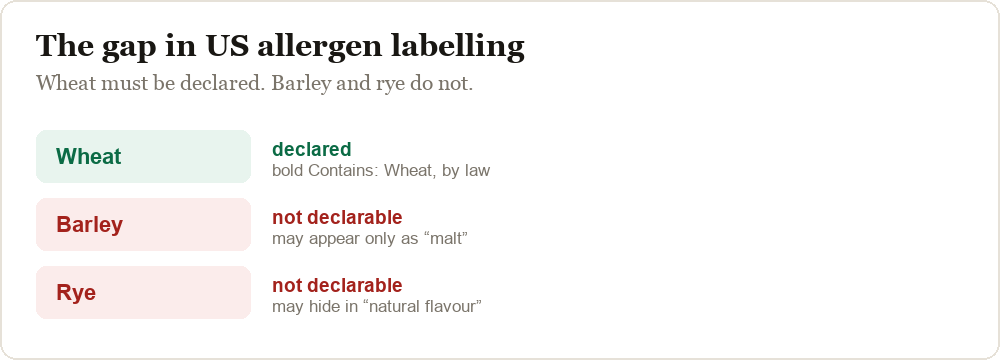
Gum is food, and food has to declare wheat. This is the crucial difference between Orbit and the medicines, supplements and cosmetics people group it with. Chewing gum is regulated as a food in the US, so FALCPA applies: any wheat-derived ingredient must be named on the label. A silent Orbit label is therefore genuinely informative in a way a silent Gas-X label is not. FALCPA covers wheat but not barley or rye, which is where Mars Wrigley's own policy picks up the slack.
The barley and rye half of the argument is a blog post. The labelling practice usually quoted for Mars Wrigley (that it bold-declares wheat, barley, rye and oats and adds a "may contain" line where gluten runs on the same line), is reported by gluten-free bloggers. It is not in any Mars document we could find, and this page previously presented it as "the company's stated labelling practice". It isn't. So the voluntary barley/rye declaration that would have covered FALCPA's blind spot is itself unverified, and barley malt inside a "natural flavour" would not have to appear on a US pack.
And one ingredient genuinely has no declared source. Orbit's typical formula is sorbitol, gum base, glycerol, natural and artificial flavours, then under 2%: hydrogenated starch hydrolysate, soy lecithin, aspartame, malic acid, xylitol, citric acid, acesulfame K, mannitol, fumaric acid, sucralose, colour and BHT. Hydrogenated starch hydrolysate is made from starch, the starch can be corn or wheat, and no Orbit label states which. That is a real unresolved fact about the recipe, not a hypothetical: this page previously reported "no gluten grain listed" from a screening database and skipped past the one ingredient whose source is undeclared. Two things soften it: hydrolysis strips the product past the intact-protein stage, and if wheat were the starting material FALCPA would force "wheat" onto a US label. Neither is a sourcing statement, and neither covers barley.
Wrigley is reported to have said so, but only at second hand. Celiac.com reports Wrigley's position that Orbit gum is naturally gluten-free and regarded as safe for people with celiac disease. An older, widely circulated Wrigley reply to a consumer listed Orbit alongside Spearmint, Doublemint, Extra, Eclipse and Juicy Fruit as free of any wheat, oat, rye or barley gluten, and added that the starches used on the individual stick wrappers are corn- or potato-derived, not grain. Both are secondhand relays of company correspondence, not published statements, and neither is a document we can point you at on a Wrigley domain. We count them as corroboration rather than proof: nothing here is a Mars document.
Why there's no "gluten-free" on the pack. Mars Wrigley does not label its products gluten-free as a matter of policy, and the stated reason is manufacturing: products are made in facilities that also handle gluten-containing products, so the company declines the claim rather than underwrite it. That is a conservative disclosure choice. It is not the same as a warning, and reading it as one is the most common mistake made about this brand.
Where it does go wrong. Consumers report getting inconsistent answers from Mars consumer relations on different occasions, and other Mars confectionery lines genuinely do contain wheat flour or barley malt. So "it's Mars, therefore fine" is not a rule.
How to resolve this yourself. The pack cannot answer it, so go to the manufacturer. Mars's consumer contact form is at mars.com/contact-us: choose your country, pick the Gum, Mints & Confections category and a product-satisfaction question, quote the barcode, and ask three things:
- What is the source starch for the hydrogenated starch hydrolysate in this product, corn, wheat or something else? This is the specific unresolved ingredient; asking about it by name is what separates a real answer from boilerplate.
- Does the product contain any barley- or rye-derived ingredient, including inside "natural and artificial flavours"? FALCPA does not require these to be declared, so the label cannot tell you.
- Has the finished gum been tested to below 20 ppm gluten, and does the line also run gluten-containing product?
Get it in writing, and note that Mars is on record giving inconsistent verbal answers, so a written reply, quoted back with the barcode, is the thing worth having. In the UK, search the pack's barcode in Coeliac UK's Food and Drink Information, a members' database of over 185,000 products built from manufacturer responses; if Orbit is not listed, no UK manufacturer answer exists either. If you get a sourcing statement or a ppm figure, send it to us and this page changes.
Where it varies
Formulation and labelling law both differ by market, but no market resolves the question. The verdict is unverified everywhere, for different reasons.
| Market | Position |
|---|---|
| US | FALCPA forces "wheat" onto the label, so wheat is genuinely excluded. Barley and rye need not be declared, and the starch hydrolysate source is not stated. Unverified |
| UK / EU | All 14 named allergens including "cereals containing gluten" must be declared, which is stricter, a barley-derived ingredient would be visible. Mars still publishes no gluten statement, and formulations differ from the US. Unverified, but the label carries more information |
| Elsewhere | Formulations and declaration rules both vary; nothing on this page carries across. Unverified |
How much risk is this?
Celiac disease: an open question rather than a known hazard. Nothing on the panel is a gluten grain, and the wheat route is closed by US law. What is not established is the starch source, the barley/rye position and the state of the line. If you are strict, chew a certified gum until Mars answers you.
Non-celiac gluten sensitivity: no issue.
Wheat allergy: the strongest position of the three. Wheat is a FALCPA allergen; if it were present in any form it would be on the label in plain English.
Sorbitol, not gluten, is the likely culprit. Worth saying because it comes up constantly: several pieces of sugar-free gum a day delivers enough sorbitol and mannitol to cause bloating, wind and loose stools in anyone, and it is routinely mistaken for a gluten reaction by people who have just gone gluten-free and started chewing more gum. If Orbit upsets you, try the same quantity of a xylitol-only gum before concluding you were glutened.
What to have instead
Orbit is unverified, so if you want an answered product rather than a reasoned inference, buy one of these instead:
- PUR gumStates its entire range is gluten-free, and is aspartame-free into the bargain. The most commonly recommended brand in celiac circles.
- TridentReported gluten-free across the flavour range, weaker evidence than PUR's own claim, but the easiest to buy in any petrol station.
- Ice BreakersHershey states all Ice Breakers products are gluten-free.
- XylichewStates gluten-free, non-GMO and aspartame-free; xylitol-only, so also the option with the best dental case.
- Glee Gum and Tree Hugger bubblegumBoth state gluten-free; Glee uses natural tree-sap gum base, Tree Hugger is gluten-free, non-GMO and vegan.
- Dubble BubbleStates peanut-free and gluten-free.
Not a swap: Extra, Eclipse, Juicy Fruit, Doublemint, Spearmint and Hubba Bubba are all Mars Wrigley and all sit in exactly the same position as Orbit, clean panel, no gluten statement, unverified. Switching between them changes nothing.
Related questions
Is Orbit White or Orbit Professional gluten-free? Unverified, same as the rest of the range. The published Orbit Professional Peppermint ingredient list contains no gluten grain, but it is the same formula family, the same unsourced starch hydrolysate and the same absent manufacturer statement.
Is chewing gum gluten-free in general? Almost always. The risk in gum isn't the gum base, the sweeteners or the flavours, it's rare wheat-derived dusting starch on the wrapper or, in older formulations, a barley-derived ingredient. Wrigley is reported to have told a consumer its wrapper starches are corn or potato, but that is relayed correspondence, not a published statement.
Is maltitol in gum a gluten risk? No. Maltitol is made by hydrogenating maltose, and the maltose often does come from barley or wheat starch. But it is a purified sugar alcohol, not a protein fraction, the gluten protein does not survive the process. Celiac organisations treat sugar alcohols as gluten-free.
Why won't Mars Wrigley just say "gluten-free"? Because their factories also run gluten-containing products, and a gluten-free claim in the US is legally enforceable at 20 ppm. Declining the claim costs them nothing and removes all liability. Silence here is a legal posture, not a disclosure of risk.
Does Orbit differ outside the US? Yes, formulations vary by market and so does labelling law. EU and UK packs must declare cereals containing gluten as one of the 14 named allergens, which is stricter than FALCPA and would expose a barley-derived ingredient. That makes a UK label more informative than a US one, but it still isn't a manufacturer gluten statement.
Can I trust "may contain wheat" to appear if it applies? We can't tell you that you can. It is voluntary labelling, and the claim that Mars applies it consistently is reported by third parties rather than published by Mars, the same secondhand sourcing problem that runs through this whole page. Treat the absence of a "may contain" line as no information either way.
How do I settle this for the pack I'm holding? Mars's form at mars.com/contact-us, category Gum, Mints & Confections, quoting the barcode. Ask what starch the hydrogenated starch hydrolysate is made from, whether any barley- or rye-derived ingredient sits inside the flavourings, and whether the finished gum is tested below 20 ppm. Ask for the reply in writing.
How we checked
| Source | Tier |
|---|---|
| Celiac.com, Is Orbit Gum Gluten-free?, full ingredient list, plus Wrigley's position that Orbit is naturally gluten-free. A commercial publisher and forum, not a celiac organisation | D |
| Beyond Celiac, Is Candy Gluten-Free?, category guidance, no Orbit-specific ruling | B |
| Orbit Professional Peppermint labelled ingredients, no gluten grain listed; a screening database, not the manufacturer | D |
| FALCPA, gum is food, so wheat must be declared on the label | C |
| The Helpful GF, the only source we found for "Mars Wrigley bold-declares wheat, barley, rye and oats"; a blog, not a Mars document | D |
| Mars Wrigley, no published gluten statement of any kind for Orbit, by company policy | n/a |
| Source starch for Orbit's hydrogenated starch hydrolysate, not declared on any label we found, and not published by Mars | n/a |
| Mars consumer contact form and Coeliac UK Food and Drink Information, routes to resolve this, not evidence about it | n/a |
Overall source tier: D, verdict unverified. Say plainly what this page does and does not have. No celiac organisation has ruled on Orbit, and no manufacturer document speaks to gluten in it. Beyond Celiac's candy guidance sits behind this page at category level only. Everything Orbit-specific (the ingredient list, Wrigley's reported position, the bold-declaration labelling policy), reaches us through secondary channels: a gluten-free news site and forum (celiac.com), a screening database (Spoonful) and a blog. However plausible their content, none of them is Mars. The one thing here that is not secondary is US food-allergen law, which forces "wheat" onto a gum label but says nothing about barley or rye, and the voluntary barley/rye declaration that would have covered that gap is exactly the claim sourced to a blog. Add an ingredient whose source starch is undeclared, and there is nothing left to convert into a "yes". Mars makes no gluten-free claim on any product by policy; that missing claim is a facilities decision and we are not treating it as evidence of gluten, but an absence is not confirmation either, and every Mars page on this site resolves the same way.
Last verified: 10 August 2026. Manufacturers reformulate without notice, and Mars runs limited-edition flavours. If a pack carries a "may contain wheat" line, that pack outranks this page.