Dairy · Kraft Heinz (US and Canada) / Mondelēz International (UK, Europe and most other markets)
Is Philly cream cheese gluten-free?
Kraft Heinz states plainly that PHILADELPHIA cream cheese is gluten-free, and the panels carry no gluten ingredient. No seal, though.
- Evidence
- BNational celiac organisation
- Last checked
- 2026-08-13
- Varies by country
- Yes
Source kraftheinz.com+7 more
Why
Cream cheese starts as cultured cream. The base product cannot contain gluten; everything worth checking sits in the additives, and Philadelphia's additives are gums, cultures and vitamins.
The panels are short and clean.
- Original brick: pasteurised milk and cream, salt, carob bean gum, cheese culture.
- Original spread (tub): pasteurised milk and cream, whey protein concentrate, whey, salt, carob bean gum, xanthan gum, guar gum, natamycin (a mould inhibitor), vitamin A palmitate, cheese culture.
Carob bean gum (locust bean gum) comes from carob seeds. Xanthan gum is produced by bacterial fermentation. Guar gum comes from guar beans. Natamycin is a mould inhibitor derived from a bacterium. None of them are grain proteins, and none of them are gluten.
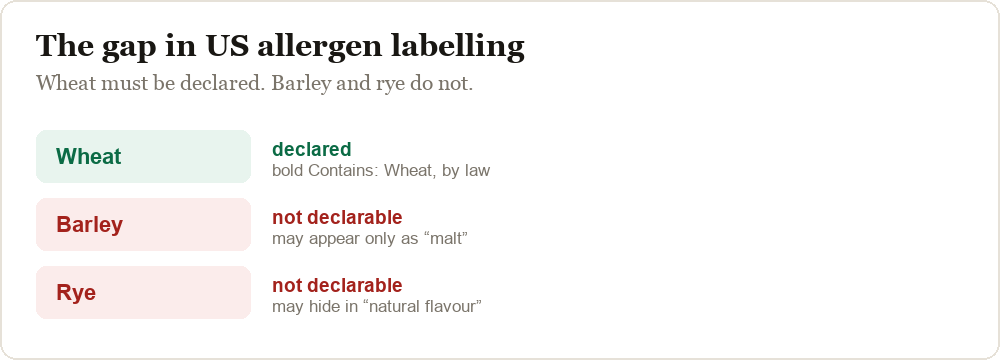
The one flagged ingredient is modified food starch, in the whipped and some flavoured tubs, and US law resolves it. Wheat is a major allergen under FALCPA, so any wheat-derived ingredient must declare wheat, either inline ("modified food starch (wheat)") or in a Contains: Wheat statement. Beyond Celiac puts it this way: "The vast majority of modified food starch in the US is gluten-free. Generally, modified food starch is made from corn, waxy maize and potatoes, meaning that those types are gluten-free." Note the hedges (typically, the vast majority, generally), and note that Beyond Celiac names three sources, not tapioca or rice. What closes the gap is the labelling rule it goes on to cite: if wheat is used, FALCPA requires it to be declared. This is the single point most competing pages get wrong. They list modified food starch as a "red flag" and leave the reader hanging, when the labelling rule already answers it.
Two honest limits on that rule. It is FDA jurisdiction, so USDA-regulated meat, poultry and egg products are not bound by FALCPA, cream cheese is FDA-regulated, so the rule applies here. And it covers ingredients, never cross-contact; shared-facility advisories are voluntary and a separate question. The one place FALCPA genuinely leaves a hole is barley and rye, which are not major allergens and so could sit undeclared inside "natural flavour", on somebody's label, somewhere. What closes that gap for this product is not an inference but Kraft Heinz answering the question itself.
The load-bearing evidence is Kraft Heinz's own answer. On its Philadelphia FAQ, under the question "Is Philly cream cheese gluten-free?", the company states: "Yes, PHILADELPHIA cream cheese is gluten-free." That is a manufacturer statement addressing gluten for this exact product, and it does the work that no ingredient argument can, because it covers the unsourced flavourings as well as the declared ingredients. Two limits on it: it is published on Kraft Heinz's US site for the brand it owns in the US and Canada, and it says nothing about cross-contact or testing thresholds.
An earlier version of this page leaned instead on a Kraft Heinz allergen FAQ that listed celery, mustard, lupin, molluscs, sunflower seeds, poppyseeds, cottonseed, "all sources of gluten" and sulfites over 10 ppm as things the company declares in the ingredient statement. That document lived on a domain that has been dead since early 2024 and we can no longer point at it, so this page no longer reconstructs it or rests on it.
Why there's no gluten-free seal, and why that isn't a warning. Kraft Heinz answers the gluten question in prose but puts no front-of-pack gluten-free claim or third-party seal on Philadelphia. A plain dairy product with no gluten route has never needed a certification to sell, and a seal is a tested-and-validated claim rather than a safety threshold. Read the absence as "not certified," not as "suspicious."
Where the Philadelphia name genuinely does mean gluten: the branded snack and dessert products, not the cream cheese. Cheesecake cups with a graham crust contain wheat flour. Dip packs sold with pretzel or bagel-chip dippers put wheat right in the box. Those are Philadelphia-branded assemblies, not cream cheese, and they are the realistic way somebody gets caught out here.
A note on conflicting claims. Secondary sites report that Gluten Free Watchdog testing has placed Philadelphia products well under 20 ppm. Those results sit behind a subscriber paywall and we have not viewed them, so we are not treating them as evidence. An older blog post claiming a phone call ruled the original unsuitable for celiacs is unsourced and contradicts the published panel; we give it no weight either.
Where it varies
The important thing to know is that Philadelphia is not one company's product. Kraft Heinz owns and makes it in the US and Canada. Everywhere else (the UK, Europe and most of the hundred-plus countries it sells in), the brand is Mondelēz International's. That is a split dating to the 2012 Kraft/Mondelēz demerger, and it matters here for one specific reason: the "PHILADELPHIA cream cheese is gluten-free" statement this page leans on is a Kraft Heinz statement, published on its US site. It does not govern a tub bought in London or Berlin.
| Market | Brand owner | What the verdict rests on |
|---|---|---|
| United States, Canada | Kraft Heinz | Plain dairy panel plus Kraft Heinz's own published answer: "Yes, PHILADELPHIA cream cheese is gluten-free" |
| United Kingdom, EU | Mondelēz International | Plain dairy panel plus UK/EU law, which names "cereals containing gluten" among the 14 allergens that must be emphasised in the ingredient list, so barley malt cannot hide in "flavouring" |
| Rest of world | Mondelēz International (most markets) | Local labelling law only. Read the pack |
The honest note. We have located no Mondelēz gluten statement for Philadelphia, nothing equivalent to the Kraft Heinz FAQ answer, and no Coeliac UK Crossed Grain licence on the retail tubs. The UK verdict is weaker than the US one, and it is differently supported: it rests on allergen law rather than on a manufacturer's answer, because UK and EU rules force gluten cereals to be declared whoever makes the tub. Two UK-specific things to check yourself: the flavoured and "light" tubs, whose recipes are not the US recipes, and Philadelphia Plant Based, which is built on oats, a cereal containing gluten under UK labelling unless the pack specifies gluten-free oats.
How much risk is this?
Celiac disease: the ingredient position is solid, a plain dairy panel plus the manufacturer's own "it is gluten-free" answer (in the US; see "Where it varies" for what carries the weight elsewhere). The remaining variable is cross-contact in a non-dedicated facility, which is unquantified. Philadelphia is one of the most widely used products in the gluten-free community and is not a common source of reported reactions. If you want a validated number rather than an ingredient argument, choose a certified brand.
Non-celiac gluten sensitivity: no issue.
Wheat allergy: no issue on the plain and standard flavoured tubs, wheat would be declared. Check the branded dessert cups and dip kits, which contain actual wheat components.
Lactose: Philadelphia contains some lactose, though less than fluid milk. Newly diagnosed celiacs often have temporary lactose intolerance while the gut heals, consider that before assuming gluten.
The real-world risk is the bagel, not the schmear. In a deli or a bagel shop, the tub sits next to wheat bagels and gets served with a knife that has been through a dozen of them. Ask for a fresh knife and a portion from an unopened container. This is where cream cheese actually causes problems.
What to have instead
Philadelphia is fine, so this is about what else in the category is safe, and what to reach for if you want a certification:
- Philadelphia Original brickThe shortest panel in the range. If you want one product to stop thinking about, it's this one.
- Philadelphia flavoured tubsChive and onion, garden vegetable, garlic and herb, strawberry, brown sugar and cinnamon, jalapeño, honey pecan. The strawberry panel runs milk and cream, sugar, strawberry purée, whey protein concentrate, dried strawberries, salt, modified food starch, vegetable juice for colour, carob bean and guar gums, natural flavour, natamycin, vitamin A palmitate and cheese culture, no wheat-derived ingredient declared.
- Organic Valley or store-brand plain cream cheeseUsually a milk, cream, salt and culture panel, as simple as it gets.
- Neufchâtel(the "⅓ less fat" style). Same category, same clean panel.
- Mascarpone or ricottaIf you want a plain cultured-dairy substitute for cooking and baking.
- A GFCO-certified cream cheeseIf you specifically need a seal rather than a manufacturer statement, worth seeking out if you are highly sensitive or buying for a child.
Genuinely avoid: Philadelphia cheesecake cups with graham crust, dip kits that ship with pretzel or bagel-chip dippers, and any cream cheese product with malt on the panel, malt means barley and it is the one word that flips this category to a hard no.
Related questions
Is cream cheese gluten-free in general? Yes. Plain cream cheese from any major brand is cultured cream plus salt and gums. Beyond Celiac classes plain dairy as gluten-free; the exceptions come from added flavourings, and in the US any wheat among them must be declared.
Is Philadelphia whipped cream cheese gluten-free? Yes. The whipped version adds modified food starch, which on a US label with no wheat declaration is not wheat, Beyond Celiac says US modified food starch is generally made from corn, waxy maize and potatoes, and FALCPA would force a wheat declaration if wheat were used.
Are Philadelphia flavoured tubs gluten-free? The standard flavours have no declared gluten ingredient. Philadelphia rotates limited-edition flavours, and ingredient panels can change without an obvious package redesign, so read the tub if it's a flavour you haven't bought before.
Is Philadelphia cream cheese certified gluten-free? No, and the distinction matters. Kraft Heinz states that PHILADELPHIA cream cheese is gluten-free in its FAQ, but there is no third-party certification and no front-of-pack gluten-free claim on the tub. A manufacturer statement is strong evidence; it is not a tested seal.
Is Philadelphia No-Bake Cheesecake Filling gluten-free? The filling itself lists no gluten ingredient, but sources disagree and the product is often sold alongside a graham crust that definitely contains wheat. Treat the filling and the crust as two separate products, and read the box.
Can I eat cream cheese at a bagel shop? The cream cheese, yes. The cross-contact, probably not, the tub and the knife live in a wheat environment all day. Ask for a fresh knife and an untouched container.
Is "natural flavour" a gluten risk on Kraft products? Barley isn't an FDA major allergen, so on some brands' labels it legally could be. For Philadelphia specifically the question is closed a different way: Kraft Heinz states outright that the cream cheese is gluten-free, which covers the flavourings as well as the declared ingredients. We do not extend that answer to the rest of the Kraft Heinz range. It was published for this brand.
Is UK Philadelphia the same as US Philadelphia? Same name, different company. Mondelēz International owns and makes Philadelphia in the UK, Europe and most of the world; Kraft Heinz holds it only in the US and Canada. The Kraft Heinz gluten-free statement quoted on this page is published on its US site and does not apply to a UK tub. What covers you there instead is UK and EU allergen law, which requires "cereals containing gluten" to be emphasised in the ingredient list, see "Where it varies".
How we checked
| Source | Tier |
|---|---|
| Kraft Heinz, Philadelphia FAQ: "Is Philly cream cheese gluten-free?", "Yes, PHILADELPHIA cream cheese is gluten-free." A live manufacturer statement addressing gluten for this product, on the US brand site | A |
Kraft Heinz allergen FAQ (the nine-item "all sources of gluten" disclosure policy), removed as a citation and no longer relied on. It lived on myfoodandfamily.com, a domain with no DNS record since early 2024, and no equivalent statement is published on a live Kraft Heinz page. The separate "gluten-free claim only on tested products" half was never on that page either, it came from Kraft consumer correspondence relayed by third parties, and this page no longer asserts it | n/a |
| Philadelphia Original, published ingredient and allergen panel | C |
| FDA/FALCPA rule: wheat-derived ingredients must declare wheat | C |
| Beyond Celiac, modified corn starch | B |
| Beyond Celiac, Is Milk Gluten-Free? | B |
| Mondelēz International, Philadelphia brand page, confirms Mondelēz operates the brand outside the US and Canada, "sold in more than a hundred countries" | C |
| Mondelēz, no gluten statement for Philadelphia located in any market; the UK/EU verdict rests on allergen law, not a company policy | n/a |
| Spoonful screening | D |
| Wheat by the Wayside and Gluten Free Palate, corroborating secondary coverage | D |
| Gluten Free Watchdog testing of Philadelphia products, referenced by secondary sites; results are subscriber-only and we have not viewed them | n/a |
Overall source tier: B. The US half of this page rests on a manufacturer statement: Kraft Heinz's live Philadelphia FAQ answers the gluten question about the product by name. That replaces the old, uncitable allergen FAQ this page used to reconstruct in nine items, that document lived on myfoodandfamily.com, dead since early 2024, and nothing here rests on it any more. But the manufacturer's answer is US-only. Kraft Heinz owns Philadelphia in the United States and Canada; Mondelēz owns it in the UK, Europe and much of the rest of the world, and Mondelēz publishes no gluten statement we could find. Outside North America the verdict rests on the published panel plus UK/EU allergen law, which is a label argument rather than a company answer. No celiac organisation has ruled on the brand. Underneath sit a clean published panel, the FALCPA declaration rule closing the modified-starch question, and Beyond Celiac's rulings on modified corn starch and plain dairy. That is a genuinely strong "yes", it just isn't a certification.
Last verified: 13 August 2026. Manufacturers reformulate without notice and Philadelphia rotates seasonal flavours. The tub in your hand outranks this page.