Soft drinks · Fevertree Drinks plc
Is Fever-Tree ginger beer gluten-free?
Fever-Tree publishes no gluten statement. The panel names no cereal, but barley malt runs in the same range, email Fever-Tree or choose Bundaberg.
- Evidence
- CPublished label or regulation
- Last checked
- 2026-08-13
- Varies by country
- No
Source fever-tree.com+4 more
Why
Ginger beer is one of the great naming traps of a gluten-free diet, and Fever-Tree is the bottle most people are holding when they ask.
Read the ingredient list and the question closes. Fever-Tree publishes it on its own site: Premium Ginger Beer is carbonated water, sugar, ginger root, natural ginger flavouring with other natural flavourings, tartaric acid and ascorbic acid. The Refreshingly Light version swaps sugar for fructose and is otherwise the same construction. UK retailer listings transcribe the label the same way, with cane sugar and carbonated spring water. There is nothing in either list that came from a grain.
"Brewed" here means steeped ginger, not fermented malt. Fever-Tree describes the drink as brewed from a blend of three gingers, from Nigeria, Cochin and the Ivory Coast. Beer's gluten comes from mashing malted barley to make fermentable sugar. No mash, no barley, no gluten. Secondary gluten-free reporting makes the same point, a true ginger beer is sugar, ginger and water, and most of the well-known brands are gluten-free, but not all, so the label still matters. That round-up is secondary reporting on the category, not a ruling on Fever-Tree by name; the ingredient list is doing the work here, not the write-up.
The argument this page used to make, and why we withdrew it. A previous version called the Madagascan Cola "the strongest evidence" on the page: that cola declares roasted barley malt extract, so Fever-Tree declares barley when it uses it, so silence on the ginger beer must mean there is none. Three things are wrong with that.
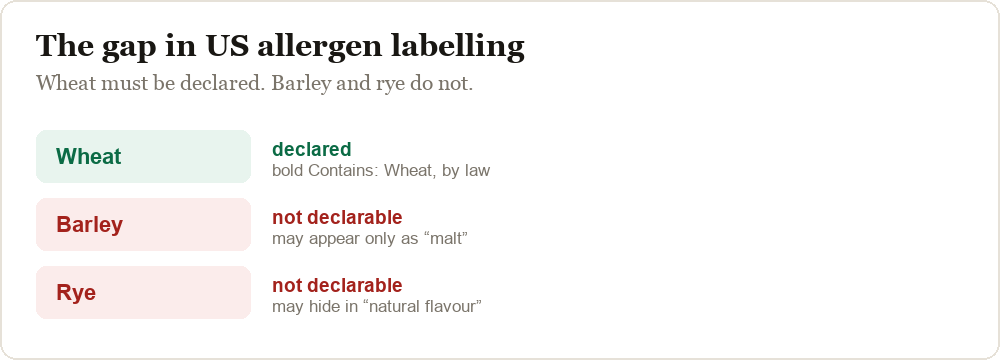
It mixed up two jurisdictions. The version of the argument we published quoted the US ingredient panel while relying on UK/EU declaration rules. Under EU 1169/2011 a cereal containing gluten must be emphasised in the ingredient list, so UK silence carries real information, that part is fine. But under US FALCPA only wheat is a major allergen. Barley and rye are not, and a US label can carry barley-derived material inside "natural flavorings" without declaring it. On the US bottle, "no allergen declaration" proves far less than the page implied. (We have now checked both pages: the US ginger beer page has no allergen statement at all, and the UK page's ingredient list emphasises nothing.)
It only ever covered ingredients. Even at its strongest, an allergen-declaration argument says nothing about what happened on the line. Declaration rules are about what was deliberately added, not about what was carried over.
And it pointed the wrong way. A barley-malt product in the same range is not reassurance. It is a documented gluten grain moving through the same company's supply chain, filling and bottling. It is a reason to want a cross-contact answer from Fever-Tree, not a substitute for one.
What we did not find, said plainly. Fever-Tree publishes no gluten-free claim on the US or UK page for this product, no allergen statement on the US page, and holds no gluten-free certification we can locate. Several retail listings describe the drink as gluten free and some secondary sites report the company calling its whole range gluten-free (we could not find that statement anywhere on a Fever-Tree page, so we are not going to repeat it). That combination, clean panel, no manufacturer claim, is why the verdict here is unverified, and it is a more useful thing to tell you than a confident guess.
The one flagged ingredient. US screening apps mark the product as uncertain because "natural flavourings" has no stated source. That is a generic ambiguity flag, not evidence of gluten. But it is also not nothing: it is precisely the line that FALCPA does not force open for barley, and precisely the line a manufacturer would have to answer.
How to resolve it yourself
- Email Fever-Tree's consumer team and ask two specific questions: is the ginger beer gluten-free, and is it produced on a line that also runs the Madagascan Cola or any barley-malt product? A general "is it gluten-free?" tends to get a general answer; naming the cola tends not to. They do reply to consumer queries, and one reply resolves this page.
- Buy the UK bottle if you have the choice. UK/EU labelling emphasises gluten-containing cereals inside the ingredient list, so the UK pack answers the ingredient half of the question on sight. It still says nothing about the line.
- Or sidestep it and pour a ginger beer whose maker has published a claim, see below.
How much risk is this?
Celiac disease: unresolved rather than dangerous. Nothing on the panel is a gluten grain, the drink is non-alcoholic, and on a UK pack barley would have to be emphasised if it were an ingredient. What is missing is the manufacturer's word, on the flavourings, and on the line. If you drink this regularly, spend five minutes emailing Fever-Tree; if you are newly diagnosed, highly sensitive, or buying for someone else, pour Bundaberg instead and don't spend the worry.
Non-celiac gluten sensitivity: the practical answer is that this is fine.
Wheat allergy: better placed than everyone else here. Wheat is a FALCPA major allergen, so a US label would have to declare it, and none of these panels do. The FALCPA gap is barley and rye, which is a celiac problem rather than a wheat-allergy one.
Cross-contact: unknown, and we are not going to call it minimal. Bottled soft drinks are a low-risk format in general, but Fever-Tree makes a barley-malt cola in the same range and publishes nothing about shared lines or cleaning between runs. That is an open question, not a closed one.
The real risk is the rest of the drink. A Moscow Mule or a Dark 'n Stormy is ginger beer plus a spirit, both fine, but the garnish, the bitters and the bar snacks are where a gluten-free night out usually goes wrong.
What to have instead
You don't need an alternative, but ginger beer is a category where brand choice matters more than most, so here is the safe shelf:
- Bundaberg Ginger BeerThe strongest documentation in the category: Bundaberg states on its own site that all its brewed drinks are gluten-free and contain no barley, malt extract, wheat products or hops. If you want a manufacturer's explicit claim rather than an inference, this is the bottle.
- Barritt's Ginger BeerLabelled gluten free, and named in secondary gluten-free round-ups of the category. The original and sugar-free versions both, check the bottle for the claim rather than relying on the round-up.
- Fever-Tree Ginger Ale, with the same caveat as aboveSame brand, gentler ginger, same clean ingredient list. It is not better-evidenced than the ginger beer: Fever-Tree makes no gluten claim for it either. Listed because it is a like-for-like swap in flavour, not because it resolves the question.
- Canada Dry or Schweppes ginger aleGluten-freeIf you just want ginger and bubbles, these are the most widely available. Note that no celiac organisation has ruled on either brand by name. The position is that mainstream soft drinks are generally made without gluten ingredients, which is a category statement, not a brand endorsement. See our ginger ale page for what is and isn't established.
- Fresh ginger, lime and soda waterGluten-freeZero ambiguity, and a better Moscow Mule than most.
Avoid without checking: alcoholic and "hard" ginger beers, which are the genuine risk in this category, some are fermented with or flavoured by malted barley. Also check any craft or small-batch ginger beer, and read any product whose label mentions malt.
Related questions
Does ginger beer contain alcohol? Fever-Tree's is a soft drink with no alcohol. Traditionally fermented ginger beers can carry trace alcohol, and "hard" ginger beers are properly alcoholic. Those are a different product and need their own label check.
Is Fever-Tree tonic water gluten-free? The tonic waters follow the same construction (carbonated water, sugar, quinine, flavourings and acids), with no cereal ingredient. Same evidence as the ginger beer: a published ingredient list rather than a certification.
Are all Fever-Tree mixers gluten-free? No, and this is the one to know. Fever-Tree's Madagascan Cola contains roasted barley malt extract, declared as an allergen on UK packs, and the US Distillers Cola lists it too. The cola is the exception in an otherwise grain-free range. Do not generalise from the ginger beer to every bottle.
Is ginger beer safe if I have celiac disease? Usually, but it is a check-the-brand category rather than a check-the-category one. Bundaberg and Barritt's carry explicit gluten-free positions; alcoholic ginger beers and small-batch brews are where malted barley actually appears.
Is the "Refreshingly Light" version different? Only in sweetener, fructose instead of sugar. The rest of the ingredient list is the same, with no gluten grain.
Is a Moscow Mule gluten-free? The ginger beer is, and vodka is gluten-free after distillation regardless of the starting grain. The drink is fine; check only the ginger beer brand and any pre-made mule mixer.
How we checked
| Source | Tier |
|---|---|
| Fever-Tree, Ginger Beer, "Carbonated Water, Sugar, Ginger Root, Natural Ginger Flavoring With Other Natural Flavorings, Tartaric Acid, Ascorbic Acid"; a published ingredient list, not a gluten statement | C |
| Fever-Tree, Madagascan Cola, UK ingredient listing: "Carbonated Spring Water, Fructose, Natural flavourings including Caffeine, Roasted BARLEY Malt Extract, Acid (Citric Acid)". Shows the company declares barley where it is used, but note this is a UK pack under UK/EU rules, not the US panel this page otherwise discusses | C |
| Tesco, Fever-Tree Light Ginger Beer, UK label transcription, no cereal allergen declared | C |
| Celiac.com, Is Ginger Beer Gluten-Free?, commercial publisher, secondary reporting: true ginger beer is sugar, ginger and water; most major brands gluten-free, but check | D |
| Spoonful screening, flags "natural flavorings" as unresolved | D |
| Fever-Tree, no gluten-free statement or certification located on the brand's own site | n/a |
Overall source tier: C, verdict unverified. Everything Fever-Tree publishes about this drink is a label, not a gluten statement. The company makes no gluten-free claim, holds no certification, and no national celiac organisation has ruled on it; the ginger-beer round-up consulted here, from Celiac.com, is secondary reporting about the category rather than a ruling on this drink.
An earlier version of this page argued the verdict was firm on the grounds that UK allergen law would force barley to be declared, as Fever-Tree does on its cola. That argument does not hold and has been withdrawn. It quoted the US ingredient panel while relying on UK/EU declaration rules; under US FALCPA only wheat is a declarable allergen, so silence about barley on a US pack proves very little. It also addressed ingredient gluten only and never cross-contact, and a barley-malt product in the same range is a shared-line question, not reassurance.
What is left is a published ingredient list with no cereal in it. That supports "no gluten ingredient is declared." It does not support "gluten-free," and this page will not write the second when it only has the first. If you want a mixer backed by an explicit manufacturer statement, Bundaberg has one.
Last verified: 10 August 2026. Formulations differ slightly between the US and UK ranges and manufacturers reformulate without notice. The label on the bottle in your hand outranks this page.