Alcohol · Category-wide: Sazerac, Brown-Forman, Beam Suntory
Is cinnamon whiskey gluten-free?
Whisky-based cinnamon whiskey is gluten-free. The malt-based lookalikes, including Fireball Cinnamon without the word Whisky, are brewed from barley.
- Evidence
- BNational celiac organisation
- Last checked
- 2026-08-23
- Varies by country
- No
Source coeliac.org.uk+3 more
Why
Cinnamon whiskey ought to be a simple category. It is whiskey with cinnamon in it, and both of those things are fine. What complicates it is that the biggest brand in the category sells three different alcoholic products under nearly the same name and label, and only one of them is whisky.
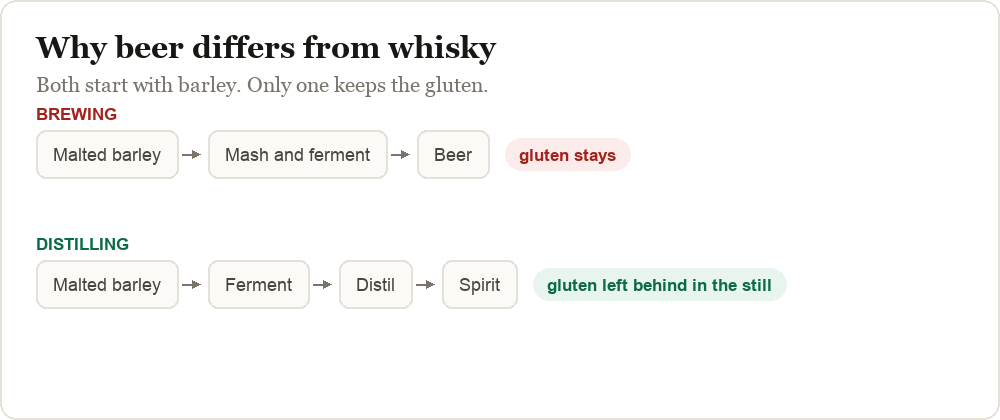
The distilled version is straightforwardly gluten-free. Coeliac UK's alcohol guidance: "All spirits are distilled during the manufacturing process and this process removes any trace of gluten. Therefore, all spirit drinks (including malt whisky which is made from barley) are safe for people with coeliac disease." Gluten proteins are too large to vaporise, so in a still they stay behind in the spent mash. A whiskey's grain bill is irrelevant to the finished spirit for that reason, and the cinnamon added afterwards is a spice.
The malt version is straightforwardly not. Sazerac's own FAQ separates the products: "Fireball Cinnamon products include malt-based and wine-based alcoholic beverages, whereas Fireball Whisky is whisky-based." The malt-based version is 33 proof, the wine-based version is 42 proof, and the whisky is 66 proof. Sazerac's stated reason is retail access: many US states allow only beer, malt and wine products to be sold outside liquor stores, so lower-proof malt and wine formulations get the brand into supermarkets and gas stations.
A malt beverage is brewed from malted barley and never goes through a still. Everything the malt contributed is still in the liquid. Coeliac UK is explicit about that half too: "Beer, lagers, stouts and ales contain varying amounts of gluten and are not suitable for a gluten free diet." The malt-based Fireball Cinnamon carries the label class "Malt Beverage with Natural Whisky and Other Flavors and Caramel Color", wording that became public in a 2023 class action alleging the two bottles were too easy to confuse. Whatever the merits of that suit, the labelling fact is the one that matters here: it says malt beverage, and that is what it is.
So the axis is the product class, and it is printed on the bottle.
| On the label | What it is | Verdict |
|---|---|---|
| Fireball Cinnamon Whisky, 66 proof (33% ABV) | Whisky base, cinnamon flavour, sugar | Gluten-free, it has been distilled |
| Fireball Cinnamon, 33 proof (16.5% ABV), "Malt Beverage with Natural Whisky and Other Flavors and Caramel Color" | Brewed from malted barley | Not gluten-free |
| Fireball Cinnamon, 42 proof (21% ABV), wine-based | Grape wine base with flavours | Gluten-free, wine involves no cereal |
| Any cinnamon whiskey sold in a liquor store (Jack Daniel's Tennessee Fire, Jim Beam Kentucky Fire, Evan Williams Fire, Sinfire) | Whiskey base, flavoured after distillation | Gluten-free on the distillation rule |
| Cinnamon-flavoured ready-to-drink cans, shots and "cinnamon fire" hard drinks in a supermarket | Frequently malt-based | Read the class line, malt means barley |
How to work out which one you are holding, in three seconds. Two things give it away. The word "Whisky": the spirit says Fireball Cinnamon Whisky, the malt version says only Fireball Cinnamon. The proof: 66 proof is the spirit, 33 proof is the malt one, 42 proof is the wine one. And a rule of thumb that covers most cases: if you bought it somewhere that cannot sell spirits, it is not a spirit.
What Sazerac does and does not say about gluten. Its FAQ never uses the word gluten. What it does publish is an allergen note: "While Fireball is not made with nuts or peanuts, note that it may be produced in a facility with milk, peanuts, tree nuts, and wheat." That is a shared-facility statement, not a gluten statement, and it is worth reading precisely. It tells you wheat is handled at the site, which is unremarkable for a company that also makes malt beverages. It does not say wheat is in the whisky, and it does not address gluten at all. On the cinnamon itself Sazerac says: "You're damn right! We use real, natural cinnamon to create our whisky."
No cinnamon whiskey producer publishes a gluten statement. Not Sazerac for Fireball, not Brown-Forman for Tennessee Fire, not Beam Suntory for Kentucky Fire. That silence is normal for spirits and is not evidence of gluten. Spirits carry no ingredient list, the gluten-free claim is voluntary, and since TTB Ruling 2020-2 of 13 October 2020 a US spirit distilled from gluten grains may carry it but almost none do.
Where a flavoured whiskey could genuinely go wrong. Flavouring happens after the still, and that is the one stage at which gluten can re-enter a spirit. The things to be alert to in this category are barley malt inside a caramel colour and cereal-derived carriers inside a proprietary flavour blend. Note that the malt-based Fireball Cinnamon declares caramel colour on its label and the whisky version does not. Under EU and UK allergen rules a gluten-containing ingredient added after distillation would have to be declared; US spirits labelling has no equivalent requirement, which is why this remains the open edge of the category rather than a settled one.
How much risk is this?
Celiac disease: buy the bottle that says Whisky and you are drinking a distilled spirit with spice in it. Buy the one that says Malt Beverage and you are drinking beer with cinnamon in it. The difference is total, and it is the single most important thing on this page. In practice the trap is the 99 cent mini bottle at a checkout, because that is the malt one, it is the one people buy without reading, and it looks the same.
Non-celiac gluten sensitivity: the same split applies, less sharply.
Wheat allergy: the whisky is distilled, but Sazerac's own allergen note says the product may be produced in a facility that also handles wheat. For an IgE wheat allergy that facility statement is a real consideration in a way it is not for celiac disease, and it is worth calling Sazerac rather than reasoning from this page.
Cross-contact at the bar: cinnamon whiskey is a shot drink, which means a shared shot glass, a shared pourer and often a chaser. The glassware is a bigger practical variable than the liquid.
What to have instead
If you want the drink without the label puzzle:
- Any straight whiskey with a cinnamon stickBourbon, rye or Scotch are all cleared by Coeliac UK by name, and a cinnamon stick in hot cider or a cinnamon syrup you can read the ingredients of gets you the same drink.
- Spiced rumDistilled from sugarcane, no cereal at any stage, and the spice profile overlaps heavily. This is the closest true swap.
- RumChataIf what you actually want is the cinnamon shot in a creamy form. Our RumChata page rules it gluten-free: rum base, dairy cream, no gluten grain.
- Mezcal or tequilaDistilled from agave, if you are just after a shot with character. Our mezcal page is a flat yes.
- Cointreau in mulled ciderThe one liqueur in reach with a published statement: "Cointreau liqueur is gluten free… Thus it does not contain any gluten."
Genuinely avoid: anything in this category whose label says "malt beverage", which includes the 33 proof Fireball Cinnamon, the mini bottles sold outside liquor stores, and most supermarket cinnamon-flavoured hard drinks. Our Smirnoff Ice page is the same trap wearing a vodka brand's name.
Related questions
Is Fireball gluten-free? The 66 proof Fireball Cinnamon Whisky is, on the distillation rule. The 33 proof Fireball Cinnamon is not: it is a malt beverage brewed from barley. Sazerac itself distinguishes them on its FAQ. The bottles look almost identical, so check the word Whisky and the proof.
What is Fireball actually made from? Sazerac describes it as whisky-based and says it uses "real, natural cinnamon", but the recipe is proprietary and the company does not publish an ingredient list. The base is widely reported to be Canadian whisky. Sazerac does not confirm the grain bill, and for the gluten question it would not change the answer if it did.
Is Jack Daniel's Tennessee Fire gluten-free? On the distillation rule, yes. It is Jack Daniel's whiskey blended with a cinnamon liqueur, so the flavouring is a post-distillation addition. Brown-Forman publishes a gluten answer for Jack Daniel's Black Label, not for Tennessee Fire specifically, so there is no brand-level confirmation of the flavoured expression.
Is Fireball whisky or is it schnapps? It is a flavoured whisky product in the liquor store, sweetened and reduced to 66 proof. People call it schnapps because of the sugar. Either way it is distilled, which is the only part that decides the gluten question.
Why is a malt version of a whisky brand even legal? Because many US states restrict which retailers may sell spirits, and a malt or wine base lets a brand into roughly 170,000 stores that could not otherwise stock it. Sazerac says as much on its FAQ. It is a distribution decision, and the side effect is that two almost identical bottles have opposite gluten answers.
Does Fireball contain wheat? Sazerac says it "may be produced in a facility with milk, peanuts, tree nuts, and wheat", which is a statement about the facility rather than the recipe. It never says the whisky contains wheat, and it never addresses gluten.
How we checked
| Source | Tier |
|---|---|
| Coeliac UK, Alcohol, "All spirits are distilled during the manufacturing process and this process removes any trace of gluten. Therefore, all spirit drinks (including malt whisky which is made from barley) are safe for people with coeliac disease"; "Beer, lagers, stouts and ales contain varying amounts of gluten and are not suitable for a gluten free diet" | B |
| Fireball FAQs, official, "Fireball Cinnamon products include malt-based and wine-based alcoholic beverages, whereas Fireball Whisky is whisky-based"; malt-based 33 proof, wine-based 42 proof, whisky 66 proof; "While Fireball is not made with nuts or peanuts, note that it may be produced in a facility with milk, peanuts, tree nuts, and wheat." Sazerac does not use the word gluten anywhere on the page | C |
| Fireball Cinnamon printed label class, "Malt Beverage with Natural Whisky and Other Flavors and Caramel Color" | C |
| VinePair, Fireball Cinnamon class action coverage, reports the label wording and the 16.5% ABV malt formulation, and the packaging similarity that prompted the suit | D |
| TTB Ruling 2020-2, 13 October 2020, permits "gluten-free" on spirits distilled from gluten grains, and states that the ruling "does not change TTB's policy with regard to malt beverages fermented from gluten-containing grains" | C |
| Sazerac, Brown-Forman and Beam Suntory, no published gluten statement located for any cinnamon whiskey | n/a |
Overall source tier: B. A category verdict. The gluten-free half rests on Coeliac UK's ruling on distilled spirits; the not-gluten-free half rests on the printed label class of the malt-based product and on Sazerac's own separation of its three product lines. No producer in the category has published a gluten statement, so nothing here is manufacturer-confirmed on the gluten question itself, and the shared-facility allergen note Sazerac does publish is not one.
Last verified: 23 August 2026. Producers reformulate without notice and this category in particular keeps launching new lower-proof formats. The class line on the bottle in your hand outranks this page.