Alcohol · CH Distillery (Carl Jeppson Company)
Is Malört gluten-free?
Unconfirmed. The distilled grain base carries no gluten, but CH Distillery publishes no gluten statement and the botanical blend is secret.
- Evidence
- CPublished label or regulation
- Last checked
- 2026-08-10
- Varies by country
- No
Source malort.com+4 more
Why
Malört is a bäsk liqueur: a Swedish-style bitter built on wormwood, sold in Chicago since the 1930s, and famous mostly for tasting like grapefruit rind and regret. The gluten question turns on two things: where the alcohol comes from, and what gets added after.
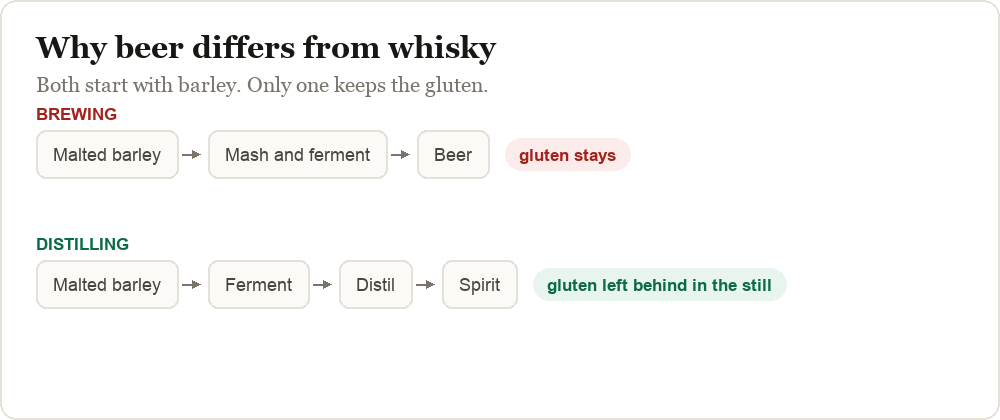
The base is a neutral grain spirit, and that part is fine. Distillation separates ethanol from everything heavy and non-volatile, gluten proteins included. This is the settled position of every major celiac organisation. Coeliac UK states that all spirits are distilled during manufacture, that this removes any trace of gluten, and that all spirit drinks, including barley-based malt whisky, are safe on a gluten-free diet. Beyond Celiac says pure distilled liqueur is considered gluten-free even when made with wheat, barley or rye. The grain in "neutral grain spirit" is not the problem people assume it is.
The additions after distillation are where the gap is. Beyond Celiac's actual warning about liqueurs is precise: flavourings and additives introduced after distillation are the route by which gluten re-enters a spirit. The National Celiac Association frames it the same way: flavoured spirits are gluten-free unless a gluten-containing ingredient has been added post-distillation. For Malört, the headline addition is wormwood (Artemisia absinthium), which is a plant and not a gluten source. But the rest of the recipe is a closely guarded proprietary blend, and the producer has never published it.
CH Distillery has published nothing. We checked the official Malört site directly. There is no FAQ entry on gluten, no allergen statement, and no ingredient list, only a description of the product as a wormwood-based digestif and the history of the Carl Jeppson Company, which CH Distillery acquired in 2018 when the brand's last employee retired. That is not evasiveness; small distillers rarely publish this. It does mean there is nothing first-party to cite.
No celiac organisation has ruled on Malört by name. The tier-B sources on this page cover the category, distilled liqueurs, not this product. That is usually enough. It is less than enough when the product's own recipe is secret.
The claims circulating online are all secondary. A retailer FAQ asserts Malört is gluten-free; an ingredient-screening database says it believes the product is gluten-free because no gluten ingredients are listed on the label. Distilled spirits are not required to declare ingredients at all, so "nothing gluten-containing is listed" tells you very little.
One more thing about the label, and it is commonly misreported. Until 2020, TTB rules did not permit a plain "gluten-free" claim on a spirit distilled from a gluten-containing grain, so the absence of that phrase on the bottle is regulatory and means nothing either way.
How to resolve it yourself
This takes one email, and the answer is durable:
- Contact CH Distillery in Chicago. Ask two specific questions: "Is any ingredient in the Jeppson's Malört botanical blend derived from wheat, barley or rye, and is anything grain-derived added after distillation?" Naming the step gets a real answer instead of a boilerplate disclaimer.
- Ask about shared equipment. CH Distillery produces a range of spirits. Whether any grain-based product shares infusion or bottling equipment is the second half of the question.
- Do not rely on bar staff. Malört is a novelty pour, usually served as a shot on a dare, and nobody behind the bar has the recipe.
If you get a written answer, it is worth more than this page, send it to us and we will upgrade the verdict.
How much risk is this?
Celiac disease: the realistic risk is low. The base is distilled, the signature botanical is a herb, and there is no known bäsk-liqueur tradition of adding grain after distillation. But "low and undocumented" is not the same as "confirmed", and this page is not going to blur the two. If you are strict, resolve it before you drink it.
Non-celiac gluten sensitivity: almost certainly a non-issue. Malört is also 35% ABV and is drunk in single shots, so exposure would be tiny even in the worst case.
Wheat allergy: the group with the most reason to ask first, since an allergic response does not scale down with dose the way celiac damage does, and the base grain is undisclosed.
Cross-contact: the bar risk exceeds the bottle risk. A Malört shot is typically poured fast into whatever glass is closest, in a room where beer is the main product.
What to have instead
If you want the same experience (a punishing, herbal, bitter shot), with a clearer gluten story:
- Fernet-BrancaThe other famous bartender's bitter. Herbal, aggressive, and the reference point most people reach for when describing Malört to someone who has not had it.
- UnderbergGerman herbal digestif in single-serve bottles, bitter and intense, and the one-shot format matches how Malört is actually drunk.
- AbsintheAlso wormwood-forward. This is the closest flavour match to Malört's core botanical, though anise and fennel round it out in a way Malört deliberately does not.
- Cynar or CampariMilder bitters, artichoke and citrus-forward respectively, if what you actually like is the bitterness rather than the punishment.
- Amaro Nonino, Averna, BraulioItalian amari with distilled or wine bases and botanical infusions, the same structural argument as Malört, but from producers who publish more.
All of these carry the same caveat as Malört: they are liqueurs with post-distillation botanicals, and few publish full ingredient lists. Ask the producer if you need certainty on any of them.
Related questions
What is Malört made from? A neutral grain spirit macerated with wormwood (malört is Swedish for wormwood, literally "moth herb"), alongside a proprietary blend of other botanicals. It is filtered and diluted to 35% ABV. Unlike absinthe, it contains no anise or fennel to soften the bitterness.
Does distillation really remove gluten? Yes. Gluten proteins are large and non-volatile; they stay in the still while the alcohol evaporates. Coeliac UK, Beyond Celiac, the Celiac Disease Foundation and the National Celiac Association all treat distilled spirits as gluten-free regardless of starting grain.
Why can't Malört be labelled gluten-free then? This is out of date in most write-ups. TTB Ruling 2020-2 (13 October 2020), which superseded Ruling 2014-2, now permits a "gluten-free" claim on a distilled spirit made from a gluten-containing grain. Producers may only use phrasing like "processed to remove gluten." The label's silence is a rule, not a signal.
Is absinthe gluten-free? Same structure, same reasoning: a distilled base infused with wormwood, anise and fennel. Considered gluten-free unless something grain-derived is added after distillation, and as with Malört, few producers publish ingredient lists.
Should I just avoid it? Only if you need documented certainty. The honest summary is that there is no identified gluten route into Malört and no confirmation that there isn't one. That is a genuinely different position from the ones on our tier-A and tier-B pages, and we would rather you knew which you were reading.
How we checked
| Source | Tier |
|---|---|
| Jeppson's Malört official site, no gluten statement, no allergen information, no ingredient list published | A (absence) |
| Beyond Celiac, Is Liqueur Gluten-Free?, category ruling, does not name Malört | B |
| National Celiac Association, alcohol, flavoured spirits gluten-free unless gluten added post-distillation | B |
| Coeliac UK, alcohol, all spirit drinks safe; distillation removes gluten | B |
| TTB Ruling 2020-2 (13 October 2020), which superseded Ruling 2014-2, permits "gluten-free" on grain-distilled spirits under good manufacturing practices; the 2014-2 prohibition is superseded | C |
| Spoonful screening, inference from a label with no ingredient panel | D |
| CH Distillery, no product-specific gluten statement located | n/a |
Overall source tier: C, verdict unverified. Every celiac-organisation source here rules on the category, not on this bottle, and the producer has published nothing. The distillation argument is strong and we think Malört is fine, but "we think" is not the register this site publishes verdicts in. A written answer from CH Distillery moves this page to tier A.
Last verified: 10 August 2026. Recipes and ownership both changed within the last decade; the brand moved to CH Distillery in 2018. If you obtain a gluten statement from the producer, it outranks this page.