Dairy · Category-wide: Palmetto Cheese, Price's, supermarket own-label and deli-counter
Is pimento cheese gluten-free?
Cheddar, mayonnaise and pimentos contain no gluten, and no pimento cheese we found declares one. The crackers are the hazard.
- Evidence
- BNational celiac organisation
- Last checked
- 2026-08-23
- Varies by country
- No
Source pawleysfoods.com+3 more
Why
This is a recipe question more than a brand question, and the recipe is short. Sharp cheddar, mayonnaise, diced pimentos, sometimes cream cheese, sometimes onion and cayenne. The Celiac Disease Foundation lists dairy among the naturally gluten-free food groups, and there is nothing in the standard build that changes that.
The tubs bear this out. Palmetto Cheese, the best-known national brand, lists "Gluten Free" among its product qualities on its maker's own site. Its panel is Wisconsin sharp cheddar, mayonnaise, cream cheese, pimentos, onion, maltodextrin, cultured dextrose, spices and preservatives, with egg and milk as the declared allergens. Nothing there is a gluten grain.
Where the answer gets more interesting is with the brands that will not say it. Price's, the pimiento cheese spread that has been in Southern supermarkets for decades, publishes its own panel and it contains no wheat, barley or rye. Its starch is named explicitly as modified corn starch. But the allergen line underneath reads: "Contains: Egg, Milk. Produced in a facility that also processes almonds and wheat." Price's makes no gluten-free claim anywhere on the product page and its FAQ does not address gluten at all.
That facility line is the honest complication on this page. It is a cross-contact advisory, not an ingredient, and advisory labelling is voluntary and unstandardised in the US. It does not mean the product contains gluten. It does mean Price's is telling you wheat is in the building, and has chosen not to claim otherwise. If you are strict, buy the tub that carries the claim rather than the one that carries the warning.
Two ingredients that get flagged and should not change your decision. Processed cheese products can contain wheat starch, which is why "check the label" is standard advice for cheese spreads generally. In this category the starches are named as corn on the panels we checked. And on an FDA-regulated US label, an unqualified "modified food starch" is not wheat: wheat is a FALCPA major allergen and must be declared. That holds for ingredients only, not for cross-contact, and only under FDA jurisdiction.
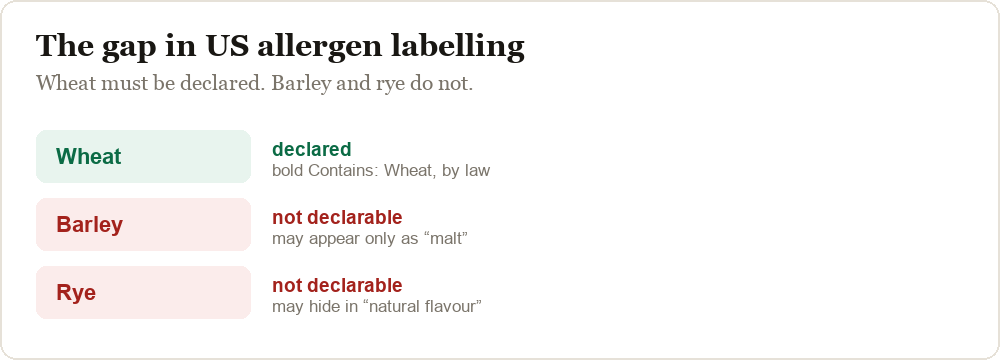
The real gap in FALCPA is barley, not wheat. Barley and rye are not covered, so a barley-derived flavouring could in principle sit inside "spices" or "natural flavor" undeclared. On a product that is 80% cheese and mayonnaise, that risk is theoretical rather than practical, but it is why an uncertified tub is a slightly weaker assurance than a certified one.
The deli counter is a different product
A tub with a printed panel and a scoop from a service case are not the same purchase, and this is where most gluten actually reaches pimento cheese.
- The shop may make its own. House-made pimento cheese at a deli, a butcher or a farm shop has no ingredient panel and no obligation to produce one. Some versions add beer, Worcestershire sauce, ranch seasoning or a splash of something from a bottle nobody can name.
- The equipment is shared. The same scoops, scales, gloves and counter surfaces handle breaded chicken, sandwich bread and floured items all day.
- The upsell is the problem. Deli counters sell pimento cheese with crackers, on a pretzel roll, in a sandwich or stuffed into something. Order the spread alone.
Ask two questions at the counter: is this made here or delivered sealed, and can you scoop it with clean equipment. If the answer to the first is "we make it," ask what goes in it.
How much risk is this?
Celiac disease: a sealed tub with a gluten-free claim is a safe food, and several exist. An uncertified tub with a clean panel is very likely fine and is not a tested product. Deli-counter and restaurant pimento cheese is the case to be careful with, and the thing it arrives with matters more than the spread itself.
Non-celiac gluten sensitivity: no issue with any packaged pimento cheese we looked at.
Wheat allergy: the panels are the right tool here, since wheat must be declared. Note the Price's advisory about a facility that also processes wheat, which is aimed at exactly your situation.
Restaurants: pimento cheese has migrated onto menus as a burger topping, a dip and a stuffed-in-something appetiser. Fried pimento cheese bites, pimento cheese on toast points, and anything described as "crispy" are breaded. The spread is not the risk; the vehicle is.
What to have instead
If the tub in front of you is uncertified, or if you are avoiding the deli case:
- Palmetto CheeseThe most widely stocked national brand carrying a gluten-free claim from its maker. Original, jalapeño and bacon versions all sit in the same range, so check the specific tub.
- Supermarket own-label pimento cheese, if the tub carries a gluten-free claimYesStore brands in this category often do print one, and a printed claim on an own-label tub is worth more than a national name that stays silent. Turn it over before you assume either way.
- Make it in five minutesGrate 8 oz of sharp cheddar, stir in about half a cup of mayonnaise, a 4 oz jar of drained diced pimentos, a spoon of cream cheese, a pinch of cayenne and black pepper. This is the whole recipe, it costs less than the tub, and it removes every open question at once.
- Cream cheese based spreadsGluten-freeIf you want something similar and documented. Kraft Heinz states plainly that Philadelphia cream cheese is gluten-free.
- The Laughing Cow wedgesFor a portable cheese spread with a manufacturer statement behind it.
Serve it with something safe: corn tortilla chips, celery, cucumber rounds, sliced apple or bell pepper strips, or crackers labelled gluten-free. Two things people reach for that are not automatic yeses: rice crackers, where the Japanese soy-glazed kind are brushed with wheat-brewed soy sauce, and restaurant tortilla chips, which often come out of a shared fryer. Avoid the default pairings entirely: wheat crackers, saltines, pretzel crisps and white sandwich bread.
Related questions
Is Palmetto Cheese gluten-free? Its maker, Pawleys Island Specialty Foods, lists "Gluten Free" among the product's qualities on its own site. That is a self-declared claim rather than a third-party certification, which still puts it ahead of every tub that says nothing.
Is Price's pimiento cheese spread gluten-free? Its published panel declares no gluten grain and names its starch as modified corn starch, but Price's makes no gluten-free claim and its own label says the product is made in a facility that also processes wheat. Clean ingredients, no claim, an advisory. Your call on how strict you are.
Is pimento cheese at a restaurant safe? Not by default. House-made versions have no panel, and the way it is served (fried, on toast, in a sandwich, with crackers) is usually the actual gluten source. Ask what is in it and what it comes with.
Does pimento cheese contain wheat starch? None of the panels we checked did. Processed cheese products in general sometimes do, which is why the category advice is to read the label, but the pimento cheese tubs in US supermarkets use corn-based starches where they use starch at all.
What can I eat pimento cheese with? Corn chips, rice crackers, celery, cucumber, apple slices and bell peppers all work, and gluten-free crackers work best if you want the classic version. Melted onto a burger is fine as long as the bun is.
Is pimento cheese the same as cheese spread? Not quite. Some products called "pimiento cheese spread" are built on a processed cheese base rather than grated natural cheddar, which is why the ingredient panels look longer than the recipe suggests. Neither version normally contains gluten, but the longer panel is the one worth reading.
How we checked
| Source | Tier |
|---|---|
| Palmetto Cheese, Pawleys Island Specialty Foods, "Gluten Free" listed under the product's qualities | A |
| Celiac Disease Foundation, Gluten-Free Foods, dairy listed among the naturally gluten-free food groups | B |
| Price's Original Pimiento Cheese Spread, manufacturer's own panel, modified corn starch, "Contains: Egg, Milk. Produced in a facility that also processes almonds and wheat" | C |
| Price's FAQs, no gluten or allergen question published | C |
| FALCPA, wheat is a declarable major allergen; barley and rye are not | C |
Overall source tier: B. No celiac organisation has ruled on pimento cheese specifically, and no single manufacturer's document can carry a category verdict, so this page rests on the Celiac Disease Foundation's position on dairy plus the published panels of the brands people actually buy. One brand claims gluten-free, one declines to and flags a shared facility, and none declare a gluten grain.
Last verified: 23 August 2026. Recipes and suppliers change without notice, and deli-counter pimento cheese is outside anyone's labelling. The tub in your hand, or the person behind the counter, outranks this page.